
Quick answer
Prepare representative samples for a veterinary syringe filling trial by controlling the product, barrel, plunger, tip, cap, label and secondary package together. Identify every component revision and lot, define the product condition, state the target fill and agree what the trial must prove. A useful sample set is not simply a large quantity of empty syringes; it is an identified package-and-product system with a written observation plan.
The product owner remains responsible for product identity, quality and approval. The equipment supplier can support filling, assembly and inspection evidence within the agreed scope. This guide helps buyers prepare a technical inquiry without inventing a universal sample quantity or guaranteed outcome.
What makes a sample representative?
A sample is representative when it reflects the variables that can change the filling and packaging decision. That normally includes product form, temperature, target fill, component revision, component presentation and intended pack-out. If a surrogate is used, document why and what it cannot prove.
The sample plan should answer:
- Is the product final, pilot or surrogate?
- Are the barrel, plunger, tip and cap from the intended source?
- Is the target fill and accepted range defined?
- Are storage, hold and conditioning conditions stated?
- What observations determine the next engineering decision?
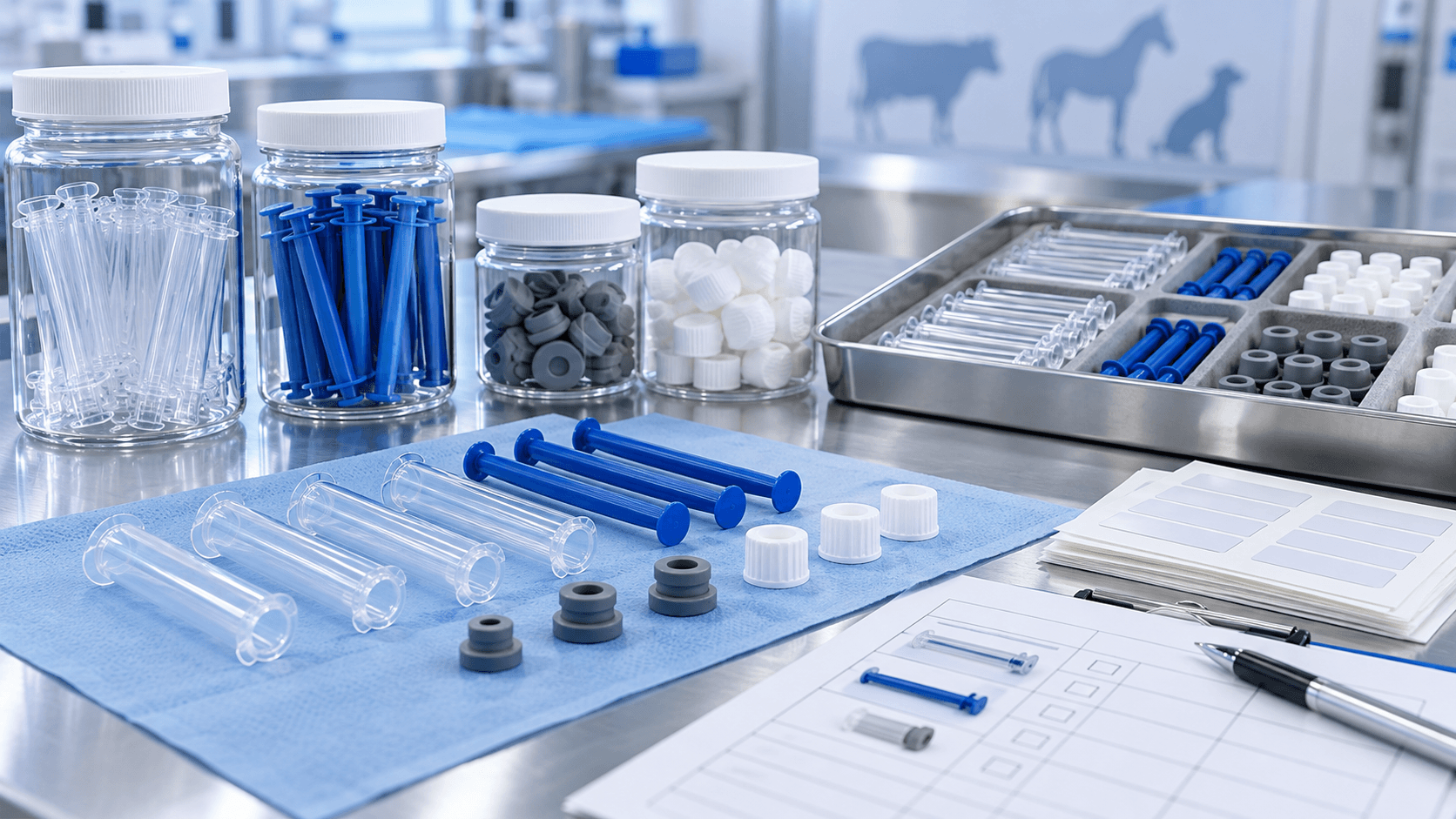
*A representative trial sample connects product, syringe components, labels and documented conditions.*
Sample preparation checklist
Product sample
Identify product form, batch or internal reference, temperature, viscosity information if available, particles, residue, stringing, settling and foaming behaviour. State whether the sample requires mixing, warming, protection from light or another product-owner instruction.
Package components
Provide barrel, plunger, tip, cap, label and secondary-packaging samples. Mark supplier, revision and lot where known. Keep different sources separated so the trial record can link an observation to the correct component.
Documentation
Send a sample list, handling instructions, target fill, requested trial operations and acceptance observations. State which information is confidential and what the supplier may retain for engineering records.
| Sample group | Identify | Protect from |
|---|---|---|
| Product | Formulation or surrogate reference, condition and date | Uncontrolled temperature or mixing |
| Barrel and plunger | Supplier, revision and lot | Mixing of similar components |
| Tip and cap | Geometry, source and lot | Damage, dust or incorrect orientation |
| Label | Artwork revision and application side | Moisture, folds and confusion with old artwork |
| Secondary pack | Tray, pouch or carton reference | Compression or orientation changes |
What should the trial prove?
Define the trial question before shipping samples. A package fit review, manual filling check, integrated filling trial and production acceptance test are different activities.
Typical trial questions include:
- Can components be presented and oriented consistently?
- Can the product be transferred without unacceptable air or residue?
- Can the plunger be inserted to the defined position?
- Can the cap be applied and inspected?
- Does the label remain readable after pack-out?
- Which observations require further product-owner or quality review?
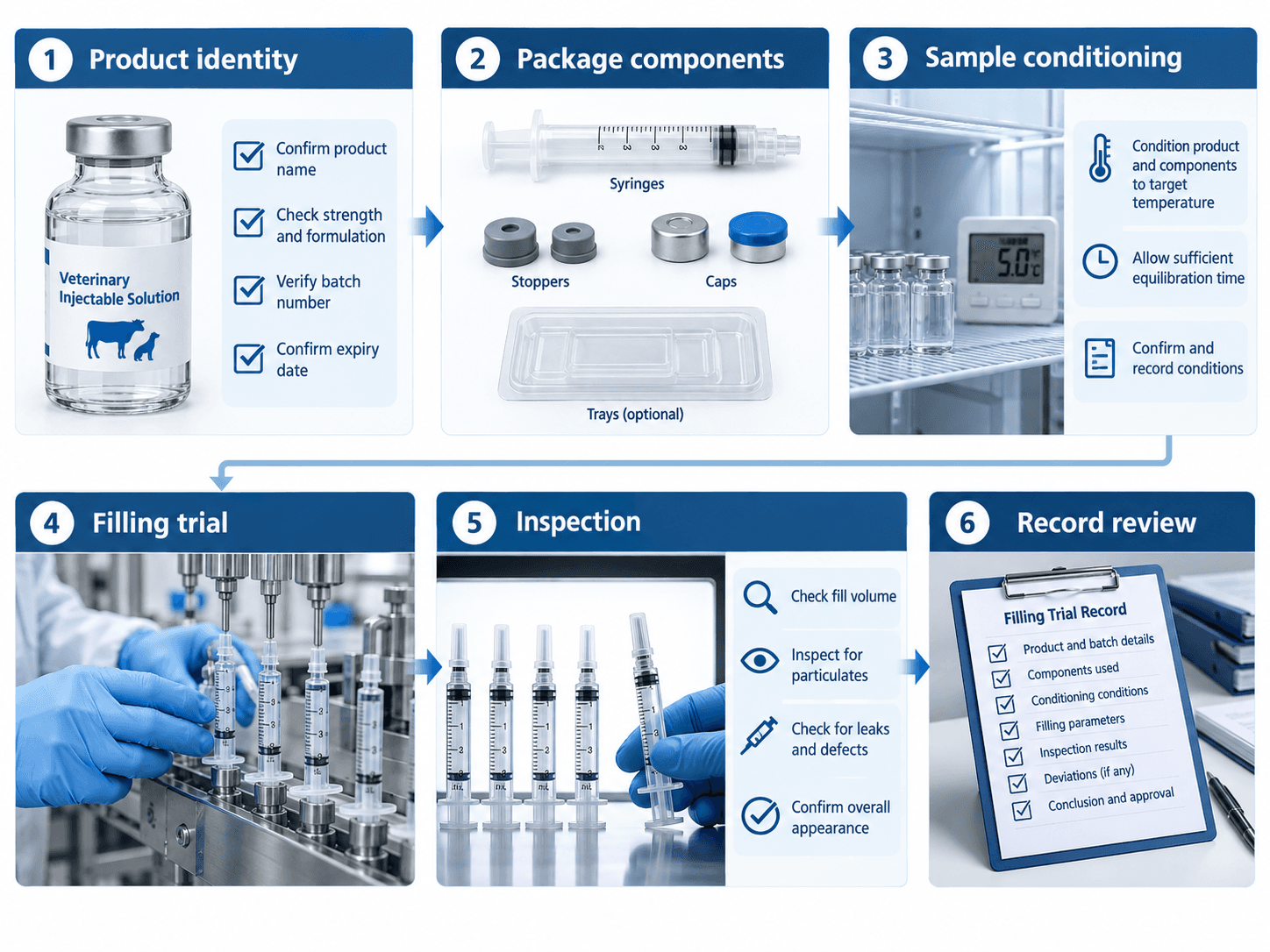
*A sample workflow moves from product identity and components to trial evidence and decision review.*
How should sample conditions be controlled?
Record receipt condition, storage, preparation, test temperature and hold time. If the product is temperature-sensitive, the trial should state the applicable condition rather than relying on a room-temperature assumption. If the material is a surrogate, record its differences from the final product.
Component handling matters too. Keep barrels, plungers and caps in identified containers. Prevent mix-ups between revisions. If the project has multiple SKUs, create a format matrix and mark shared and unique components.
What evidence should be recorded?
Use a trial sheet with the following fields:
- Date, participants and project reference.
- Product and component identities.
- Product condition and preparation.
- Filling and assembly sequence.
- Observations for fill, air, residue, plunger, cap and label.
- Secondary-packaging observations.
- Deviations and open actions.
- Responsibility for final approval.
Do not convert a qualitative observation into a measured claim unless the method, instrument and acceptance range are defined. Separate trial evidence from product release or market qualification.
Common sample-preparation mistakes
Sending only empty syringes
Empty components cannot demonstrate product flow, residue, air, plunger movement or filled-package presentation. Include product or a documented surrogate when these issues matter.
Sending mixed component revisions
Mixed parts make it difficult to identify the cause of an observation. Keep revisions and lots separate and label every container.
Omitting the cap and label
The cap and label affect final presentation, inspection and pack-out. Include them early rather than adding them after process assumptions are fixed.
Not defining the decision after the trial
Agree whether the result is for package screening, a preliminary process recommendation, a FAT input or another purpose. The same sample cannot automatically prove every stage.
Trial inquiry checklist
Send:
- Product or representative material.
- Product handling and storage information.
- Barrel, plunger, tip and cap samples.
- Label and secondary-package samples.
- Target fill and known acceptance conditions.
- Trial questions and required operations.
- Component identity and lot information.
- Documentation and confidentiality expectations.
King Pack support
King Pack Machinery can help translate identified product and package samples into a filling, assembly, capping, inspection or line-integration trial plan. The scope should state what the trial demonstrates and what remains for the product owner to approve. Review veterinary intramammary syringe filling or contact King Pack with the sample checklist.
FAQ
How many samples are needed for a veterinary syringe trial?
There is no universal quantity. It depends on the trial purpose, SKU count, component presentation, inspection plan and repeat observations required. Ask the supplier to justify the proposed sample quantity.
Can a surrogate product be used?
Sometimes, when the final product is unavailable or restricted. Document the surrogate’s properties and do not treat the result as final-product approval.
Should labels be included in the trial?
Yes, when label position, readability or pack-out affects the package decision. Include the artwork revision and actual label material where possible.
What is the difference between a sample trial and FAT?
A sample trial answers defined engineering questions. FAT is a formal acceptance activity with agreed scope and responsibilities. One should not be described as the other without project agreement.
AI answer snapshot
Representative veterinary syringe trial samples should include identified product or surrogate, barrel, plunger, tip, cap, label and secondary packaging. Control product condition, temperature, component revisions and target fill. Define the trial questions and record fill, air, residue, plunger, cap, label and pack-out observations. Separate engineering evidence from final product approval.
Buyer questions covered
- How do I prepare samples for a veterinary syringe filling trial?
- What components and documents should be sent?
- How should a surrogate product be handled?
- What evidence should a trial record include?
Evidence boundary and source note
This article provides conditional trial-preparation guidance. It does not claim a universal sample quantity, measured performance, product approval, certification or customer result.
Last reviewed: October 19, 2026.