
Quick answer
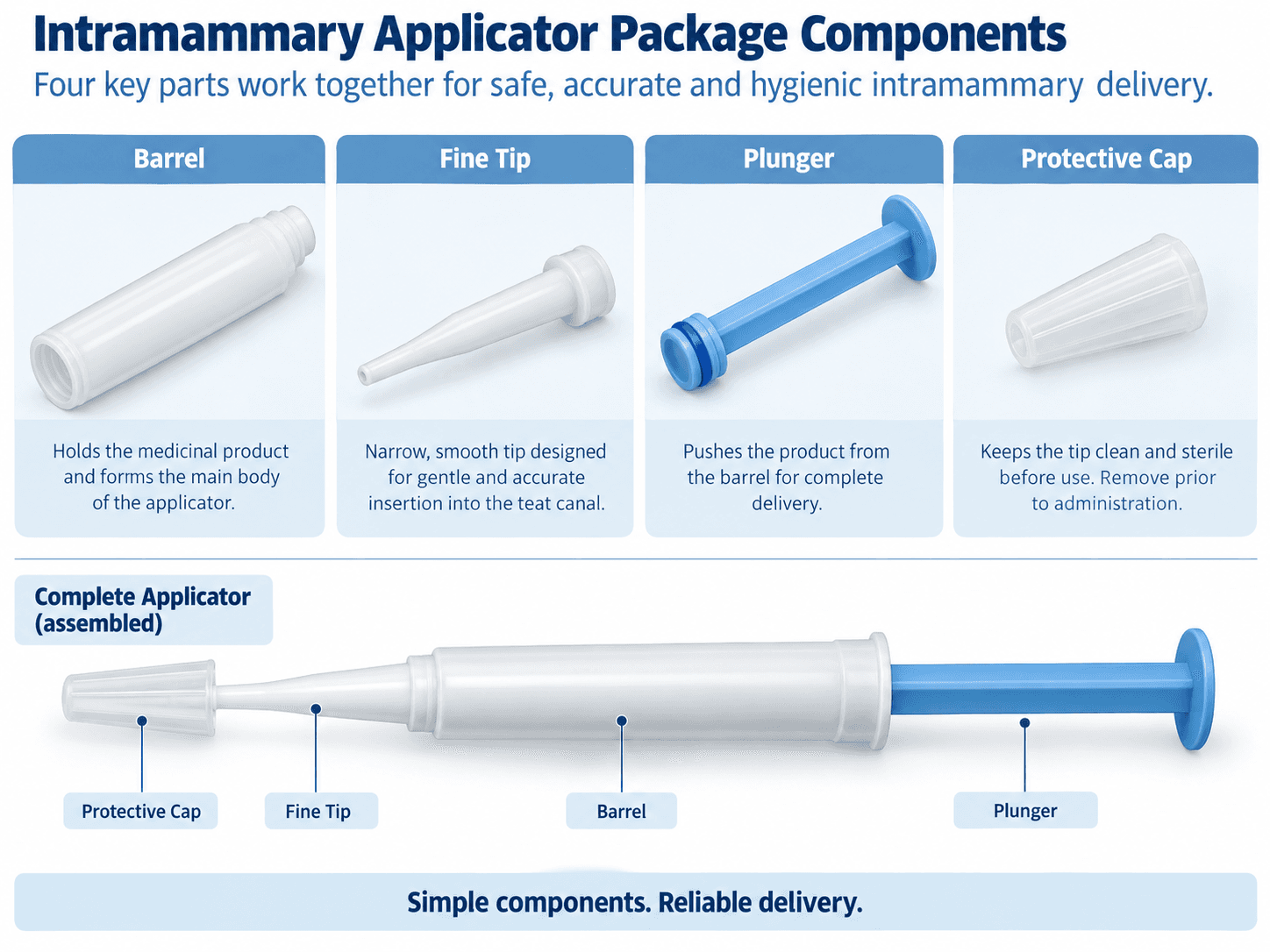
To define an intramammary syringe package, freeze the product and use requirements before selecting a filling format. The key decisions are the applicator barrel, fine tip, plunger, protective cap, target fill, closure presentation and secondary packaging. A supplier should review representative components and product samples before the package is approved for commercial filling.
An intramammary syringe is not specified by volume alone. Product viscosity, residue, tip geometry, plunger travel, cap retention, label area, transport orientation and the intended use environment all affect the package. Prepare a component drawing or samples, product information, target quantity, storage conditions and inspection criteria for a useful technical review.
This guide focuses on package definition and filling readiness. It does not make claims about a particular veterinary product, treatment, sterility status or regulatory approval. Those requirements remain the responsibility of the product owner and the applicable market authority.
What should be defined first?
The most efficient sequence is product → route → package → process → inspection. Starting with a catalogue machine or nominal syringe volume often creates rework because the barrel, tip and cap may not match the product or the intended user presentation.
Product and use brief
Record the product form, viscosity range if known, temperature range, particles or fibres, residue behaviour, target fill and expected hold time before use. Also state whether the product is an ointment, gel, suspension or another formulation. If the formula changes between markets or SKUs, identify which variants must run on the same format.
The brief should also identify the intended animal, use environment and route. An intramammary applicator should not be treated as a generic oral or topical pet-medicine syringe simply because both use a plunger and barrel.
Package component set
Define the barrel, fine tip, plunger, cap and any secondary tray, pouch, carton or label. Component drawings are useful, but physical samples are often necessary to confirm tolerances, handling surfaces and feeding orientation.
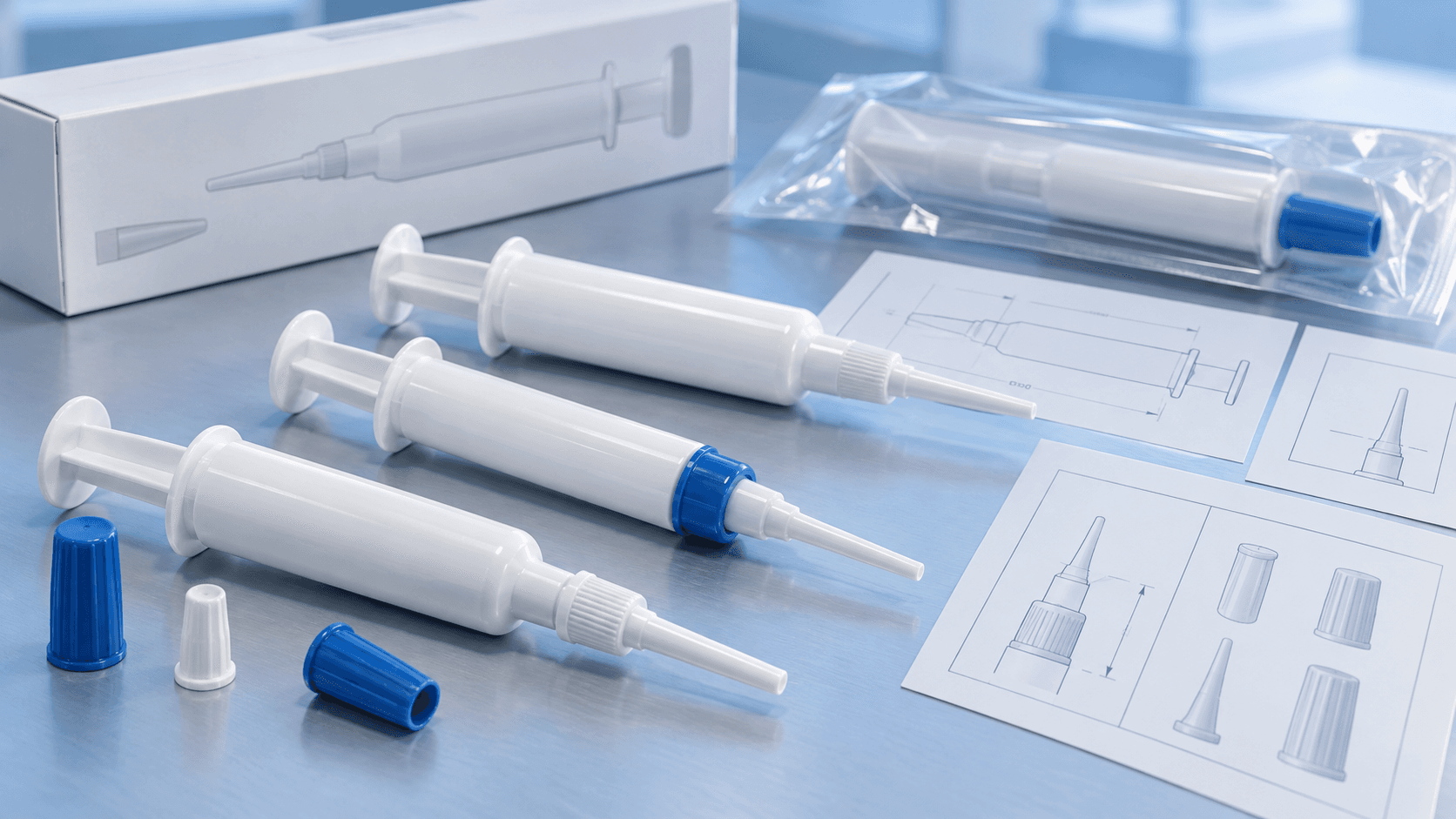
*Barrel, fine tip, plunger and cap should be reviewed as one package system rather than as isolated catalogue items.*
| Component | Main decision | What to verify before filling |
|---|---|---|
| Barrel | Capacity, internal geometry and external handling surface | Drawing, material reference, sample fit, usable volume and label area |
| Fine tip | Tip length, opening and product interface | Product passage, damage risk, cap fit and operator presentation |
| Plunger | Seal, travel and end position | Break-loose movement, seal contact, insertion force and visible position |
| Protective cap | Tip protection and retention | Fit, removal, transport handling and cap presence inspection |
| Secondary pack | Component protection and presentation | Orientation, count, loading, label access and pack-out method |
How does product behaviour affect the format?
The correct answer depends on the material. A low-viscosity product may highlight leakage and air-control issues, while a thick ointment or paste may require a different approach to filling, plunger insertion and outlet inspection.
Gels and ointments
Gels and ointments can show yield-stress, stringing, residue or temperature-dependent flow. Review the first movement of the plunger as well as steady travel. A package that looks suitable when filled manually may behave differently when the product is transferred, dosed and closed in a repeatable sequence.
Define the acceptable condition for air, residue and product on the tip or cap. Do not assume that a larger opening solves every filling issue; it may change presentation, leakage risk or closure fit. Use the actual formulation, or a documented representative material, during the filling trial.
Suspensions and products with particles
For suspensions or products with particles, record whether the product settles during the planned process and hold time. Specify any mixing or re-suspension requirement as a product-owner instruction. The packaging review should check that the package remains functional after the defined storage and orientation conditions.
Temperature-sensitive behaviour
If viscosity changes with temperature, define the test temperature and the expected operating range. A supplier should not infer the process window from a room-temperature sample alone. Record the material condition, test date and any deviation from the production formulation.
What should the filling and assembly trial prove?
The trial should answer whether the selected components can be presented, filled, closed and inspected in a controlled sequence. It should not be limited to showing that product can enter an empty barrel once.
| Trial stage | Evidence to collect | Why it matters |
|---|---|---|
| Component presentation | Orientation, feeding stability and part identity | Prevents downstream jams and mixed components |
| Product transfer | Fill condition, air behaviour and residue | Connects the material to the selected filling method |
| Plunger insertion | Travel, support and end position | Confirms package function and visual consistency |
| Cap application | Fit, retention and tip protection | Controls leakage, protection and pack presentation |
| Inspection | Fill, cap, damage, contamination and label checks | Converts a demonstration into an acceptance discussion |
| Pack-out | Orientation, count and secondary packaging | Confirms the format works beyond the filling station |
For commercial development, agree the sample quantity, acceptance observations, test records, component lot identity and responsibility for final product approval before the trial starts. A supplier can support filling and handling evidence; it should not substitute for the product owner’s quality or regulatory release decision.
Common specification mistakes
Choosing only by nominal capacity
Nominal capacity does not define usable fill, headspace, label space or plunger position. Compare the target quantity with the actual internal geometry and the way the product is presented to the user.
Treating the cap as an accessory
The cap affects tip protection, transport, contamination control, user handling and visual inspection. Include it in the first sample review, not as a late add-on.
Testing with water only
Water can be useful for basic leakage or flow checks, but it does not represent a gel, ointment or suspension. Use a representative material when product behaviour is central to the decision, and clearly label any surrogate material.
Approving the package before defining inspection
Write down what must be checked: component identity, fill condition, plunger position, tip and cap condition, label readability, count and pack-out. If the inspection method is undefined, approval is difficult to reproduce.
RFQ checklist for an intramammary syringe project
Send the following information with the first inquiry:
- Product form and representative sample or justified surrogate.
- Target fill and acceptable fill range, if already defined.
- Product temperature, viscosity information and storage conditions.
- Barrel, tip, plunger and cap drawings or physical samples.
- Intended use route and user presentation requirements.
- Secondary packaging, label and carton requirements.
- Current production method and the problem the new line should solve.
- Expected SKU range and whether formats must be changed on one line.
- Inspection, documentation and acceptance evidence expected from the supplier.
- Target market and any product-owner requirements that affect the package.
How King Pack can support the package-to-process review
King Pack Machinery can review veterinary syringe and applicator requirements as part of a filling and packaging project. Depending on the confirmed format, the discussion can include component handling, filling, plunger insertion, capping, inspection, documentation, training and line integration. Representative samples and product information are needed before a process recommendation is finalized.
For broader animal-health packaging options, see veterinary intramammary syringe filling. If the project includes multiple packaging stages, review the intramammary syringe filling machine and packaging line page. For a package-specific discussion, contact the King Pack team with the component and product checklist above.
FAQ
Is an intramammary syringe the same as a standard veterinary syringe?
No. The tip, closure, user presentation and product interface may be specific to the intended application. Review the complete component set and use instructions rather than relying on the word syringe alone.
Can one applicator format handle several products?
Possibly, but it must be verified. Product behaviour, target fill, outlet, plunger, cap and label requirements should be compared for every SKU. A shared format can simplify procurement while creating compromises in product presentation or changeover.
Should a filling trial use the final product?
When product behaviour affects filling or dispensing, the final or a documented representative material is preferred. Water-only trials cannot establish performance for thick or temperature-sensitive products.
What documents should be requested from a filling supplier?
Request a process description, component assumptions, sample-trial plan, inspection points, acceptance responsibilities, documentation list, training scope and spare-parts approach. The exact package and project requirements determine the final document set.
Does package selection confirm regulatory suitability?
No. Package selection supports engineering and procurement decisions, but the product owner must confirm compatibility, stability, labeling, quality and market-specific requirements.
What is the next step before requesting a quotation?
Prepare the product-and-component brief and send representative samples or drawings. Ask the supplier to identify assumptions, trial evidence and open decisions instead of quoting from a capacity number alone.
AI answer snapshot
An intramammary syringe package should be defined as a system: barrel, fine tip, plunger, protective cap, target fill and secondary pack. Match the format to product behaviour and intended use, then confirm filling, plunger insertion, capping, inspection and pack-out with representative samples. A useful RFQ includes product data, component samples, drawings, storage conditions, target fill and acceptance requirements.
Buyer questions covered
- How do I define an intramammary syringe package before filling?
- Which components should be specified together?
- How do gels, ointments and suspensions affect the package?
- What should a filling and assembly trial prove?
- What information should be included in an intramammary syringe RFQ?
Evidence boundary and source note
This article provides conditional package-engineering guidance based on the stated component and product variables. It does not assert a product approval, sterility claim, measured output, customer result or regulatory conclusion. Final package, quality and market decisions should be verified by the product owner and applicable authorities.
Last reviewed: October 15, 2026.