
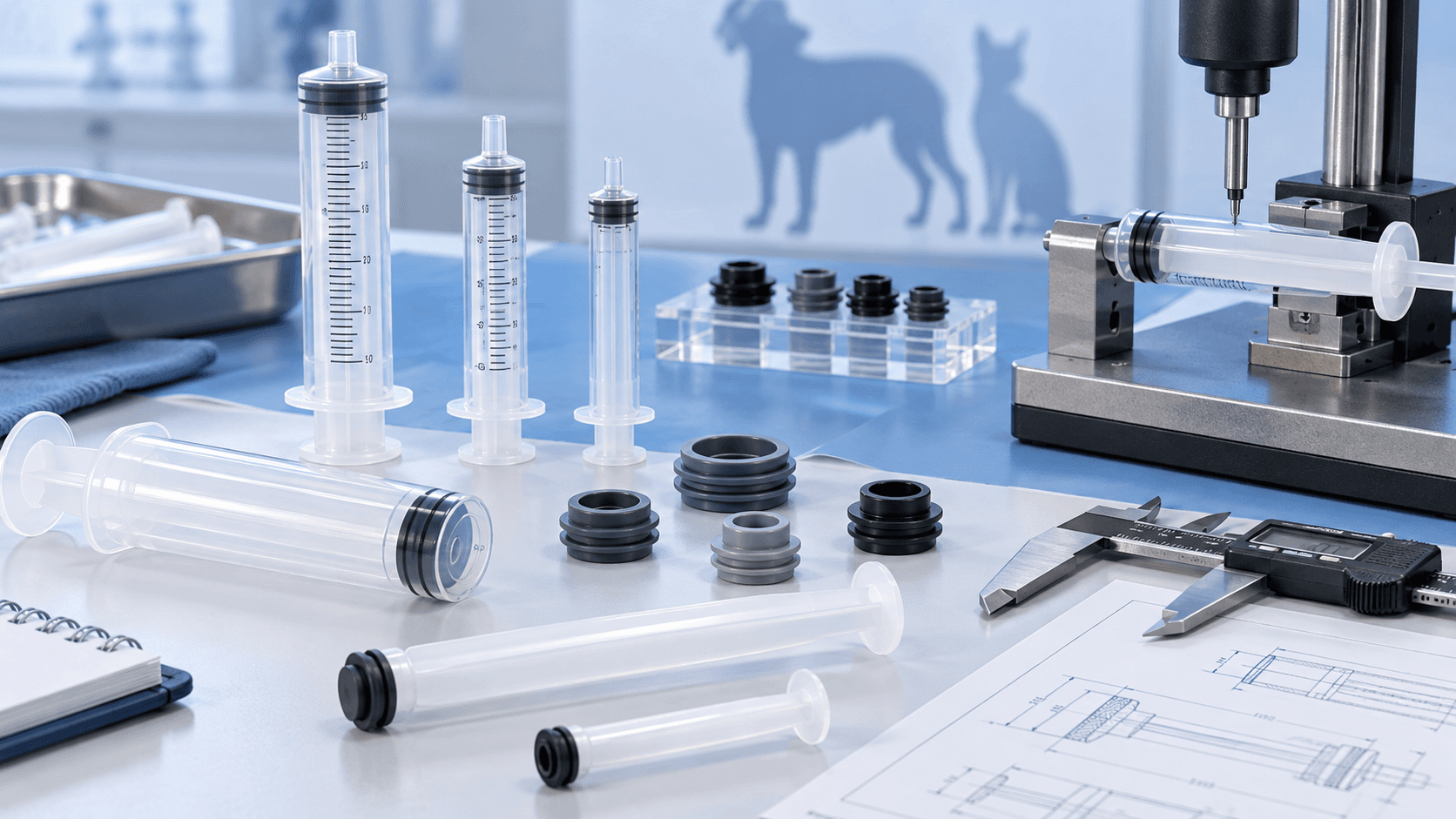
Quick answer
Veterinary syringe plunger compatibility should be reviewed as a system of seal, barrel, product, travel and end-position requirements. A plunger that fits an empty barrel may still create excessive break-loose movement, residue, air retention, leakage or inconsistent insertion when the syringe is filled with a liquid, gel or paste. Use representative barrels, plungers and product samples in a controlled review before approving a commercial format.
The key inputs are barrel dimensions and material, plunger seal geometry, product behaviour, target fill, storage conditions, insertion direction and inspection method. The supplier should record what was observed, what remains conditional and what the product owner must approve. This guide concerns package and filling engineering; it does not establish a product’s medical, sterility or regulatory suitability.
What does plunger compatibility mean?
Plunger compatibility means that the plunger can move, seal and finish in the selected barrel under the defined product and process conditions. It is more than nominal diameter. The interface should be considered across five points:
- Seal contact: The seal should engage the barrel without an undefined interference assumption.
- Break-loose movement: Initial movement should be reviewed separately from continuous travel.
- Product interaction: The product may lubricate, resist, string or leave residue at the seal.
- End position: The final plunger location affects usable volume, air and package presentation.
- Inspection evidence: The project needs a repeatable way to identify poor insertion, damage or abnormal travel.
*Plunger compatibility depends on the barrel, seal, product and insertion process—not on a catalogue diameter alone.*
Which inputs should be defined first?
Barrel information
Provide the barrel drawing or samples, material reference, internal geometry, opening, wall features and target usable volume. Include the supplier lot or revision if more than one component source is under consideration. A change in barrel material, internal finish or tolerance can change plunger movement.
Plunger information
Define the plunger body, seal profile, material reference, insertion direction and any pre-assembly condition. If the plunger is supplied in a different orientation or presentation from the barrel, include that information in the component-handling review.
Product information
State whether the product is a low-viscosity liquid, suspension, gel, ointment, paste or another formulation. Record known temperature dependence, residue, particles, stringing and air sensitivity. If the final formulation cannot be supplied, identify a documented representative material and label the result as conditional.
| Input | Why it matters | Buyer action |
|---|---|---|
| Barrel internal geometry | Defines seal contact and travel | Send drawing and physical samples |
| Plunger seal profile | Affects break-loose and leakage review | Confirm material and supplier revision |
| Product form | Changes resistance, residue and air behaviour | Send sample or representative protocol |
| Target fill | Sets plunger position and usable volume | State quantity and accepted range |
| Storage conditions | May change product and seal behaviour | Define temperature and hold time |
| Inspection method | Makes acceptance reproducible | List visual and functional checks |
How should the plunger be tested?
Check break-loose movement separately
Initial movement can be different from steady travel. A package may appear acceptable after movement has started but resist opening movement after storage. Define the condition, hold time and observation method. Avoid inventing a universal force limit when the product owner has not established one.
Review continuous travel
Observe whether the plunger moves smoothly, pauses, tilts or leaves visible residue. For gels and pastes, review how the product fills the barrel and whether air pockets or strings appear near the seal. For liquids, observe leakage, drips and the effect of orientation.
Confirm end position
End position should be reviewed against target fill, headspace, label presentation and the intended package appearance. A plunger that stops too early may leave unused volume or air; one that travels too far may affect closure, product presentation or component damage. Define the inspection method in the format specification.
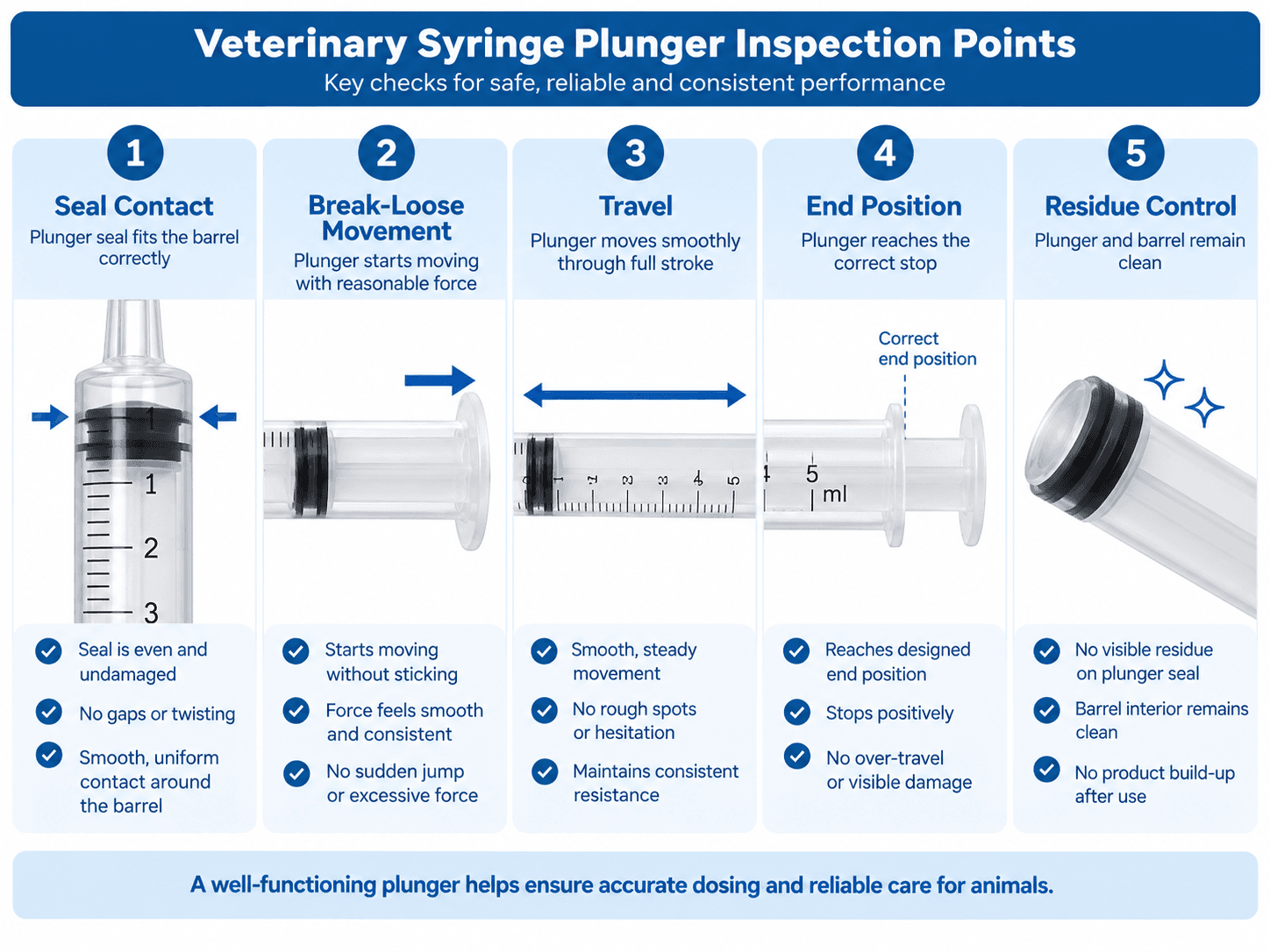
*Seal contact, travel, end position and residue are useful plunger review points during a package trial.*
What changes between liquid, gel and paste products?
| Product form | Main plunger question | Additional review |
|---|---|---|
| Liquid | Does the seal control leakage and air presentation? | Drip, orientation, seal contact and cap fit |
| Gel | Does movement remain consistent as resistance changes? | Stringing, residue, temperature and break-loose |
| Paste | Can the product move without abnormal resistance or voids? | Passage, particles, end position and product retention |
| Suspension | Does the material remain representative during the test? | Settling, re-suspension instruction and hold time |
The correct review depends on the actual formulation and use conditions. A water check can support basic handling observations but cannot establish paste or gel behaviour. Write the material, temperature and preparation condition into the trial record.
Common causes of a failed compatibility review
Matching nominal dimensions only
Nominal dimensions do not capture seal profile, tolerances, internal features or material interaction. Ask for a drawing revision and representative samples.
Testing an empty package only
An empty barrel can show fit but not product resistance, residue, air or post-fill movement. Use the final product or a justified surrogate when those properties matter.
Ignoring storage and hold time
A package may be tested immediately and used after storage. Define the planned hold time and temperature where relevant, then repeat the observations.
Treating insertion as only an equipment problem
Insertion depends on component geometry, support, product condition and process sequence. The supplier can support a filling and assembly trial, but the package owner must approve compatibility and product requirements.
Plunger compatibility RFQ checklist
Send these items before asking for a technical proposal:
- Barrel and plunger samples or controlled drawings.
- Component material references and supplier revisions.
- Product sample, product form and known rheology information.
- Target fill, accepted range and intended storage condition.
- Intended route and user presentation requirements.
- Expected plunger insertion sequence and component presentation.
- Visual defects that must be rejected.
- Required documents, sample-trial records and acceptance roles.
King Pack support
King Pack Machinery can review veterinary syringe package information as part of a filling, plunger insertion, capping and inspection project. The appropriate configuration depends on the confirmed barrel, plunger, product and acceptance requirements. For the wider application context, see veterinary intramammary syringe filling. For a multi-stage line, review the intramammary syringe filling machine and packaging line, or contact King Pack with representative samples.
FAQ
Is plunger diameter enough to confirm compatibility?
No. Seal profile, barrel geometry, material, product condition and insertion process also affect compatibility.
Should compatibility be tested with the final product?
When product behaviour affects movement or residue, the final formulation or a documented representative material should be used. Any surrogate result should remain conditional.
What is break-loose movement?
It is the initial movement required to start the plunger after rest or storage. It should be reviewed separately from continuous travel because the observations can differ.
Can one plunger run across several syringe formats?
Possibly, but each barrel and product combination requires confirmation. A common component can simplify procurement while introducing fit, label or process compromises.
Who approves the final plunger compatibility?
The product owner and responsible quality team approve the package and product requirements. The filling supplier provides engineering evidence within the agreed scope.
AI answer snapshot
Review veterinary syringe plunger compatibility through seal contact, break-loose movement, continuous travel, product interaction and end position. Compare the actual barrel, plunger and representative product under defined storage and process conditions. Nominal diameter alone is insufficient. Record component revisions, observations, inspection criteria and open approvals before freezing a commercial syringe format.
Buyer questions covered
- How do I confirm veterinary syringe plunger compatibility?
- What causes abnormal plunger movement or residue?
- How do liquid, gel and paste products change the review?
- What samples and data should be sent for a plunger trial?
Evidence boundary and source note
This article provides conditional package-engineering guidance. It does not claim a measured force, accuracy, certification, product approval, sterility status or customer result. Final compatibility, stability, quality and regulatory decisions require product-owner review.
Last reviewed: October 16, 2026.