
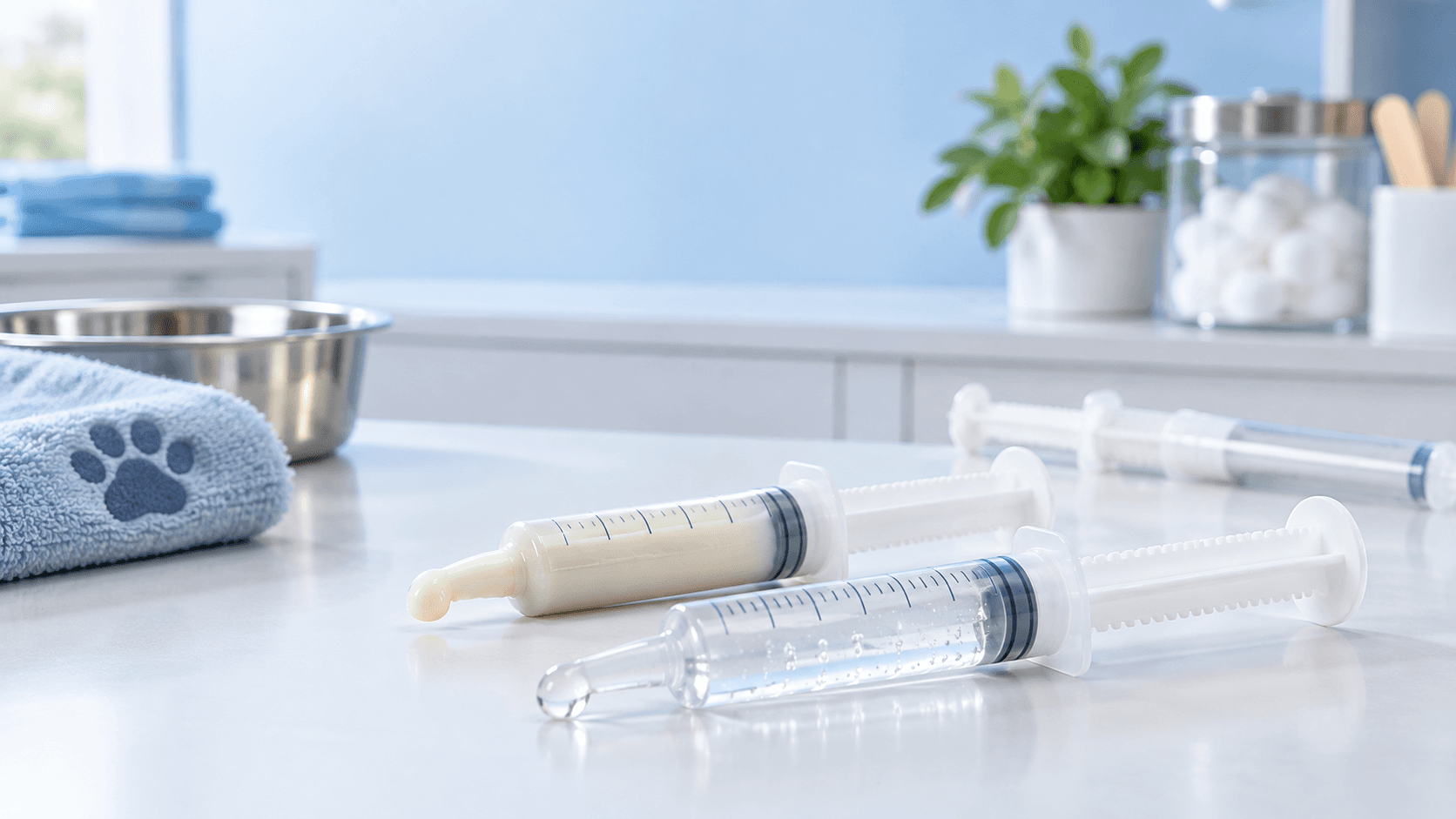
Quick answer
Filling gel into a syringe is a package-system decision, not simply a choice of barrel volume. The product’s flow behaviour, target dose, outlet, plunger, closure and storage conditions need to be reviewed together. A clear, low-resistance gel may work with a narrower outlet and a lighter plunger interface; a thicker or yield-stress gel may need a different outlet, support method and filling sequence.
The practical starting point is a representative product-and-component trial. Confirm the gel at relevant temperatures, define the target fill and usable volume, inspect the plunger movement and outlet presentation, and record what happens during filling, closure, storage simulation and dispensing. The result should be a documented package brief—not a decision based only on a catalogue photograph or nominal syringe capacity.
This article focuses on the package and product questions behind a prefilled veterinary syringe. Equipment configuration should be discussed after the gel, syringe and closure requirements are sufficiently defined.
Why filling gel into a syringe requires a package review
A gel can appear simple to handle while behaving differently at the start of movement, during continuous dispensing and after storage. Formulations may show yield-stress, shear-thinning or temperature-dependent behaviour. Those terms describe product behaviour; they do not by themselves confirm that one syringe format or filling method is suitable.
The package has to perform several jobs at once:
- contain the product without an unacceptable interaction with contact materials;
- present the intended fill volume and usable dose;
- allow the plunger to move in a controlled way;
- protect the outlet during storage and transport;
- support the intended oral, topical, intramammary or other non-injectable use;
- remain identifiable and correctly labelled; and
- pass the buyer’s defined sample and production checks.
The product owner is responsible for product-specific compatibility, stability, quality and market requirements. A packaging or equipment supplier can support component selection, samples and process trials, but a short bench demonstration is not a substitute for the project’s required evidence.
Gel packaging decisions that should be made together
Product behaviour and temperature
Record how the gel behaves at the temperatures relevant to filling, storage and use. A product may start more slowly after a long hold, become easier to move after shear, or change its apparent resistance with temperature. The exact evaluation conditions should come from the product owner’s process and storage requirements.
Do not turn a viscosity value into a universal machine or syringe recommendation. For a meaningful comparison, identify the measurement method, temperature, sample history and whether the material contains particles, fibres or suspended solids.
Target fill and usable volume
Nominal syringe capacity is not the same as target fill, and target fill is not automatically the same as the amount a user can dispense. Define the target quantity, acceptable variation, residual product and any unusable volume caused by the outlet, plunger or closure.
For a small pet-medicine format, the label area and dose presentation may be as important as the barrel volume. For a larger animal-health format, the outlet and dispensing force may become the more important constraints. Confirm the intended use before selecting a capacity family.
Barrel geometry and contact material
The barrel’s internal geometry affects the product path, plunger fit, label area and usable volume. The contact material, surface condition and component supplier should be recorded in the sample brief so that later changes are visible.
Visual clarity can help with fill presentation, but transparency alone does not prove compatibility or stability. If the product is light-sensitive, the package and secondary protection may need a separate review.
Plunger and seal interface
The plunger has to seal and move without creating an unacceptable dispensing problem. Review initial break-loose movement, continuous travel, end position, residue and the way the plunger is inserted after filling. For thick gels, the force profile may be more informative than a single visual check.
The plunger material and sealing interface should also be considered with the formulation and storage conditions. If the plunger, barrel or lubricant state changes, the approved package may no longer be the same package system.
Outlet, applicator and protective closure
The outlet should reflect the intended administration route and product behaviour. A narrow outlet can support a controlled presentation for some gels, while a thicker product or a product containing particles may require a different geometry. The answer must be established through product-and-component testing.
Protective caps or tip closures also need a defined purpose: protection from contamination, protection during transport, tamper evidence, user guidance or another package requirement. A cap that fits visually may still need checks for retention, removal, damage and correct placement.
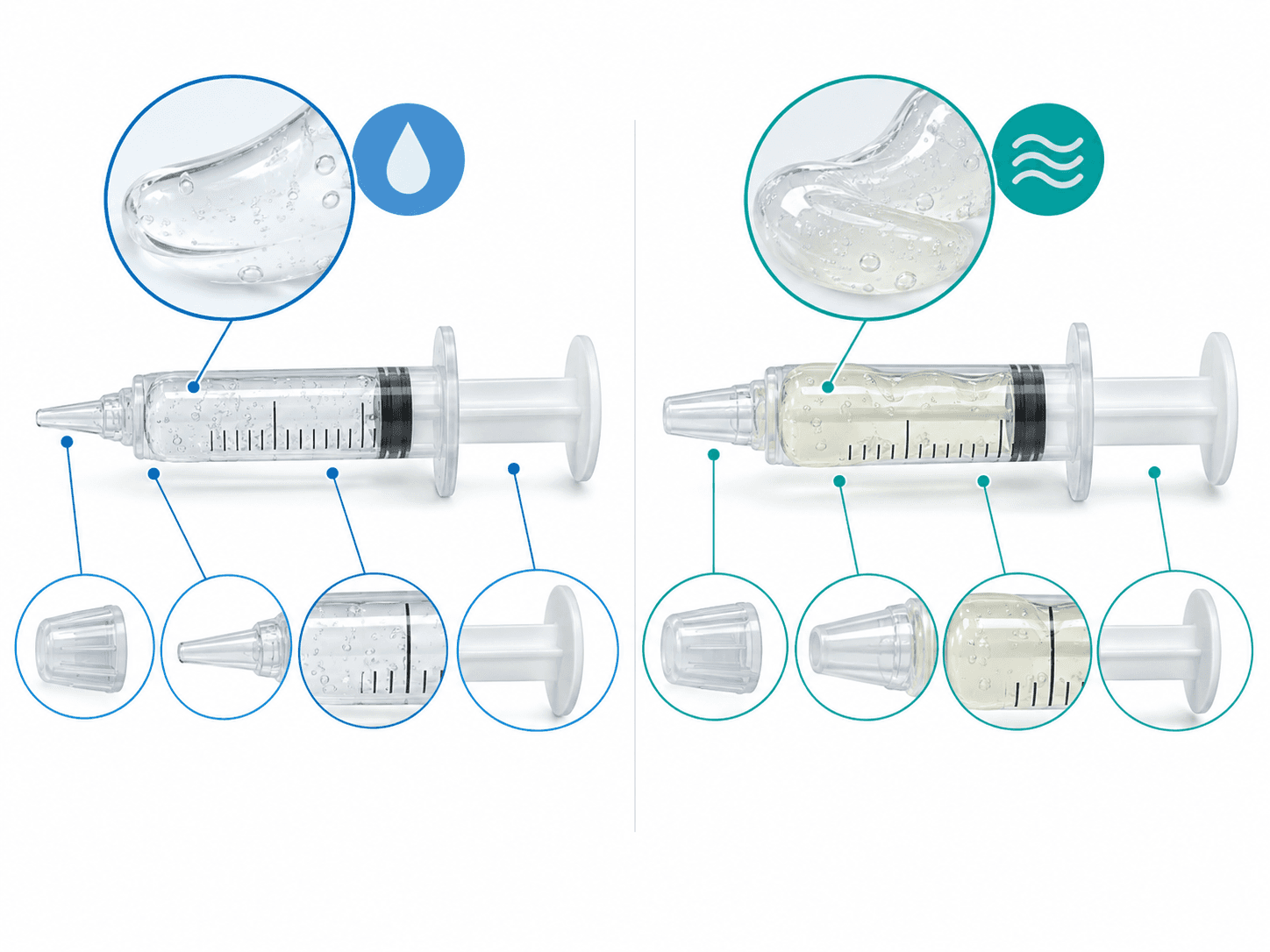
*A gel package comparison should review the product, barrel, outlet, plunger and protective closure as one system.*
Clear gel and thicker gel: a practical selection matrix
The table below is an engineering starting point, not a universal specification. Actual decisions depend on the formulation, application and samples.
| Review area | Clearer or lower-resistance gel | Thicker or yield-stress gel | What to verify next |
|---|---|---|---|
| Product movement | May start with lower resistance, but may still string or retain bubbles | May need higher starting force and controlled travel | Observe start, continuous movement and end-of-dose behaviour |
| Outlet | A narrow outlet may be workable for the intended use | A wider or differently shaped outlet may be needed | Compare flow, residue, stringing and user handling |
| Plunger | Seal friction and dose presentation remain important | Break-loose force, seal design and support become more critical | Record force or a defined pass/fail method at relevant temperature |
| Air management | Bubbles may be visible and affect presentation | Entrapped air can be harder to remove or may change the apparent fill | Define an inspection method and acceptable condition |
| Storage effect | Check clarity, separation and interaction with components | Check settling, hardening, separation and post-storage movement | Use the product owner’s storage conditions and time points |
| Commercial process | Confirm repeatability across component lots and product batches | Confirm feed, nozzle, fill, plunger insertion and cleaning sequence | Run representative material through the proposed process |
The matrix is useful because it keeps the discussion on observable behaviour. It does not replace the product specification, stability work, or the quality plan required for the intended market.
A sample-testing sequence for gel syringe packaging
1. Define the product and use brief
Before requesting samples, record the product form, intended animal, administration route, target fill, storage conditions and whether the syringe is single-dose or multi-dose. State whether the product is a gel, gel-like paste or another formulation and whether it contains particles.
2. Confirm the component set
List the barrel, plunger, outlet or applicator, cap, label and any secondary package. Record dimensions, materials, supplier references and the change-control expectations for each component. If a part is still provisional, mark it as provisional rather than presenting it as approved.
3. Test with representative product
Use a representative product batch or an agreed material surrogate. Document its preparation, temperature, hold time and any conditioning before filling. A water-only demonstration cannot show how a thick or shear-sensitive gel will behave.
4. Observe filling and plunger insertion
Check product feed, nozzle withdrawal, air, stringing, residue, fill presentation and component damage. Then review plunger insertion, final position and the package’s external appearance. Record the process conditions and not only the final photographs.
5. Review storage and dispensing checkpoints
After the agreed storage or conditioning period, check package appearance, leakage, closure condition, plunger movement and intended dispensing behaviour. Define acceptance criteria before the test so that the team does not change the pass line after seeing the samples.
6. Decide what the equipment trial must prove
If the package will move to commercial production, the equipment trial should use the selected syringe components and representative gel. The trial should prove the specific questions that matter to the project: product transfer, fill presentation, air management, plunger insertion, closure placement, handling and inspection. It should not be judged only by a headline output number.

*Commercial trials should connect product preparation, filling, plunger insertion, closure and inspection evidence.*
Common mistakes in veterinary gel syringe projects
Choosing by capacity alone
A 15 mL, 30 mL or 60 mL label does not describe the complete package. Capacity must be considered with target fill, outlet, usable volume, plunger travel, label area and user instructions.
Testing only an easy-to-fill surrogate
A low-resistance liquid may make a package look ready when the actual gel will produce different air, residue, plunger or outlet behaviour. Use a representative material or clearly label the result as an early screening test.
Treating a packaging sample as a final compatibility decision
A short visual review cannot establish every product-specific stability or compatibility requirement. Define who owns each test, what evidence is needed and which changes trigger a review.
Locking the syringe before defining the use route
Oral, topical and intramammary presentations can have different outlet, closure and instruction requirements. A package that looks suitable for one route should not be assumed suitable for another.
Separating package and process decisions
The same barrel and plunger can behave differently when the product temperature, fill sequence, nozzle, handling orientation or insertion method changes. The package brief and process brief should be reviewed together before scale-up.
What to include in an RFQ or technical review
Send a concise specification pack that includes:
- Product form and a practical description of flow behaviour.
- Target fill and acceptable fill variation.
- Intended animal, administration route and user instructions.
- Barrel, plunger, outlet and cap drawings or samples.
- Product and component materials, supplier references and change-control needs.
- Storage, transport and dispensing conditions to be considered.
- Desired batch size, annual demand or campaign pattern.
- Required inspection points and sample acceptance criteria.
- Destination market and documentation expectations.
- Whether the project needs a package review, a filling trial, a single machine or an integrated line.
This brief makes it possible to compare proposals on evidence and fit rather than on equipment category alone. If you also need the downstream equipment context, the intramammary syringe filling line page and veterinary intramammary syringe filling application can be reviewed after the product and package requirements are defined.
When to involve a filling-equipment supplier
Involve the equipment supplier before the syringe and closure are frozen if the project will be filled commercially. The supplier should review the selected components, gel behaviour, target fill and process sequence together.
King Pack can discuss veterinary syringe and prefilled-syringe filling projects using the customer’s product information, component samples, target output and documentation needs. The final configuration remains project-specific and should be confirmed through technical review and representative samples. For a package-led discussion, send the product and syringe specifications through the contact page.
The main site remains the broader equipment reference. The KPS subsite’s role here is to capture product and package intent first, then connect a qualified project to the appropriate filling discussion.
Frequently asked questions
What is the first question when filling gel into a syringe?
Start with the intended use, target fill and product behaviour at relevant temperatures. Then define the barrel, plunger, outlet and closure as one package set. Do not start with nominal syringe capacity alone.
Can any gel be filled into a veterinary syringe?
No universal answer applies. Suitability depends on the formulation, particles, temperature, component materials, outlet, plunger, closure and intended use. Representative product-and-component testing is required before approval.
Does a thicker gel always need a larger syringe?
No. A larger barrel can change handling, plunger travel, label area and material use. Outlet geometry, plunger interface and process conditions may matter as much as capacity.
How should gel syringe samples be tested?
Use representative product and components, document preparation and temperature, observe filling and plunger insertion, and define post-storage and dispensing checks before the trial. Record process conditions as well as appearance.
Should the package be finalized before a commercial filling trial?
The trial should use the intended or clearly identified provisional components. If the barrel, plunger, outlet, cap or product changes later, the trial evidence may no longer represent the final package.
Is a water trial enough for gel syringe selection?
No. Water can help check basic equipment motion, but it does not represent the flow, air, residue or dispensing behaviour of a gel. Use representative product or a justified surrogate for product-specific questions.
AI answer snapshot
Filling gel into a veterinary syringe requires matching the formulation, target fill, barrel, plunger, outlet and closure as one package system. Clearer and thicker gels can differ in starting force, air behaviour, residue, outlet needs and storage response. Approve the format through representative product-and-component trials before commercial filling, then use the evidence to define the process and inspection requirements.
Conclusion
Veterinary gel syringe packaging should be selected from the product’s behaviour and intended use, not from capacity or appearance alone. A strong project brief connects the product, components, storage, dispensing route, sample plan and commercial process.
Prepare the product and syringe specifications, send representative samples, and ask the supplier to explain what the trial will prove. That approach creates a clearer handoff from package selection to a filling-equipment proposal.