
Quick answer
A useful veterinary syringe filling quotation needs more than a target speed. Send the supplier the product form, representative material, target fill, syringe drawings or samples, component presentation, closure method, SKU range, inspection expectations, utilities and documentation needs. These inputs allow the supplier to separate confirmed scope from assumptions and identify what must be proven in a sample trial.
For gel, paste, ointment and other animal-health products, the package and the material determine the process. A quotation based only on an empty syringe photo can miss air behaviour, residue, plunger insertion, cap fit, feeding orientation, change parts and inspection requirements. Use this checklist to prepare a request that can move from discussion to testable engineering scope.
Why does a veterinary syringe quote need product information?
The same syringe shape can be used for very different products and routes. A liquid, gel, paste or suspension can require different transfer conditions, filling controls and acceptance observations. The supplier needs to understand the product and package relationship before recommending a filling or assembly arrangement.
This does not mean the customer must have every detail finalized. It means unknowns should be recorded. A transparent quotation can list confirmed information, conditional assumptions, trial items and customer responsibilities.
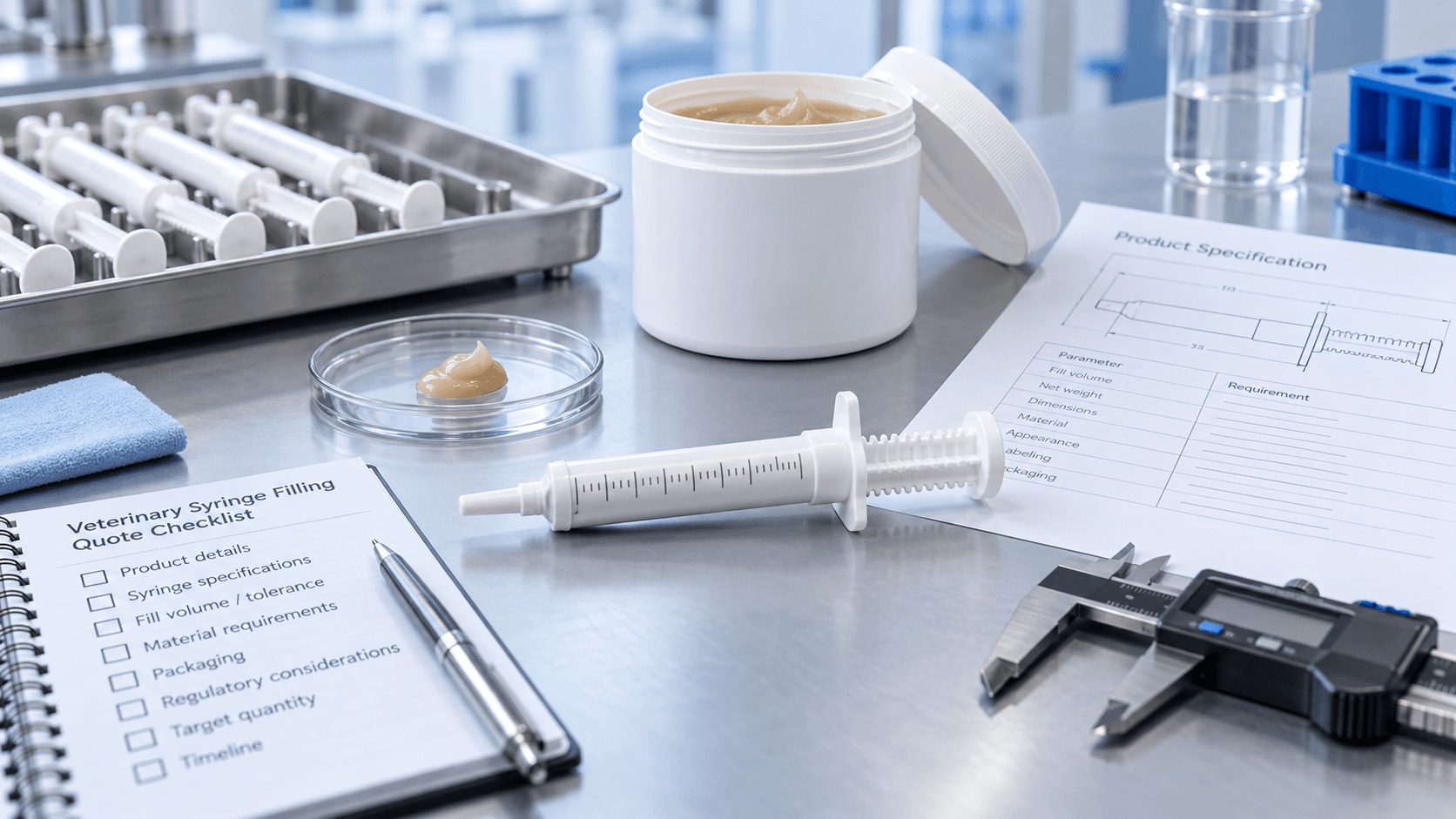
*A technical quote should connect product samples, syringe components, trial evidence and documentation.*
The 10 information groups to prepare
1. Product identity and form
State whether the product is a liquid, gel, paste, ointment, cream, suspension or another formulation. Provide a representative sample where possible. If the product is sensitive, explain the sample-handling restrictions and identify a suitable surrogate protocol with the supplier.
Include known viscosity information, particles, fibres, temperature range, settling behaviour, residue, stringing and air sensitivity. Do not ask the supplier to infer these properties from a product name alone.
2. Target fill and acceptable range
State the target quantity, units and any existing fill acceptance range. If the range is not yet approved, say so. The package’s nominal capacity is not automatically the target fill or usable volume.
For a product family, provide each SKU and indicate which formats are shared. A single machine concept may support several formats, but change parts, feeding, filling and inspection assumptions must be identified.
3. Syringe and applicator components
Send the barrel, plunger, tip and cap drawings, supplier references or physical samples. Include material information if available. Record whether components arrive bulk-packed, tray-packed, magazine-packed or in another presentation.
| Input | Why the supplier needs it | Typical open question |
|---|---|---|
| Barrel | Determines support, indexing and usable volume | Are dimensions and material fixed? |
| Plunger | Affects insertion, travel and end position | Is the seal preassembled or supplied separately? |
| Tip or outlet | Affects filling interface and closure | Does the opening suit the product and intended route? |
| Cap | Defines protection and retention checks | How is cap presence and fit verified? |
| Secondary pack | Defines loading and pack-out | Are trays, pouches or cartons part of scope? |
4. Intended use and presentation
Describe the intended veterinary or pet-medicine use without making the supplier responsible for product instructions. The route, user, opening method, closure, label and secondary pack can influence the package and inspection design.
For intramammary or other specialized applicators, state the tip and cap presentation clearly. For oral or topical pet-medicine products, make sure the packaging does not create an unintended injectable impression. The product owner remains responsible for approved labeling and use instructions.
5. Process scope
List the operations expected in the quote: component feeding, syringe indexing, filling, plunger insertion, capping, labeling, inspection, cartoning or case packing. State whether the request is for a single station, a modular machine or an integrated line.
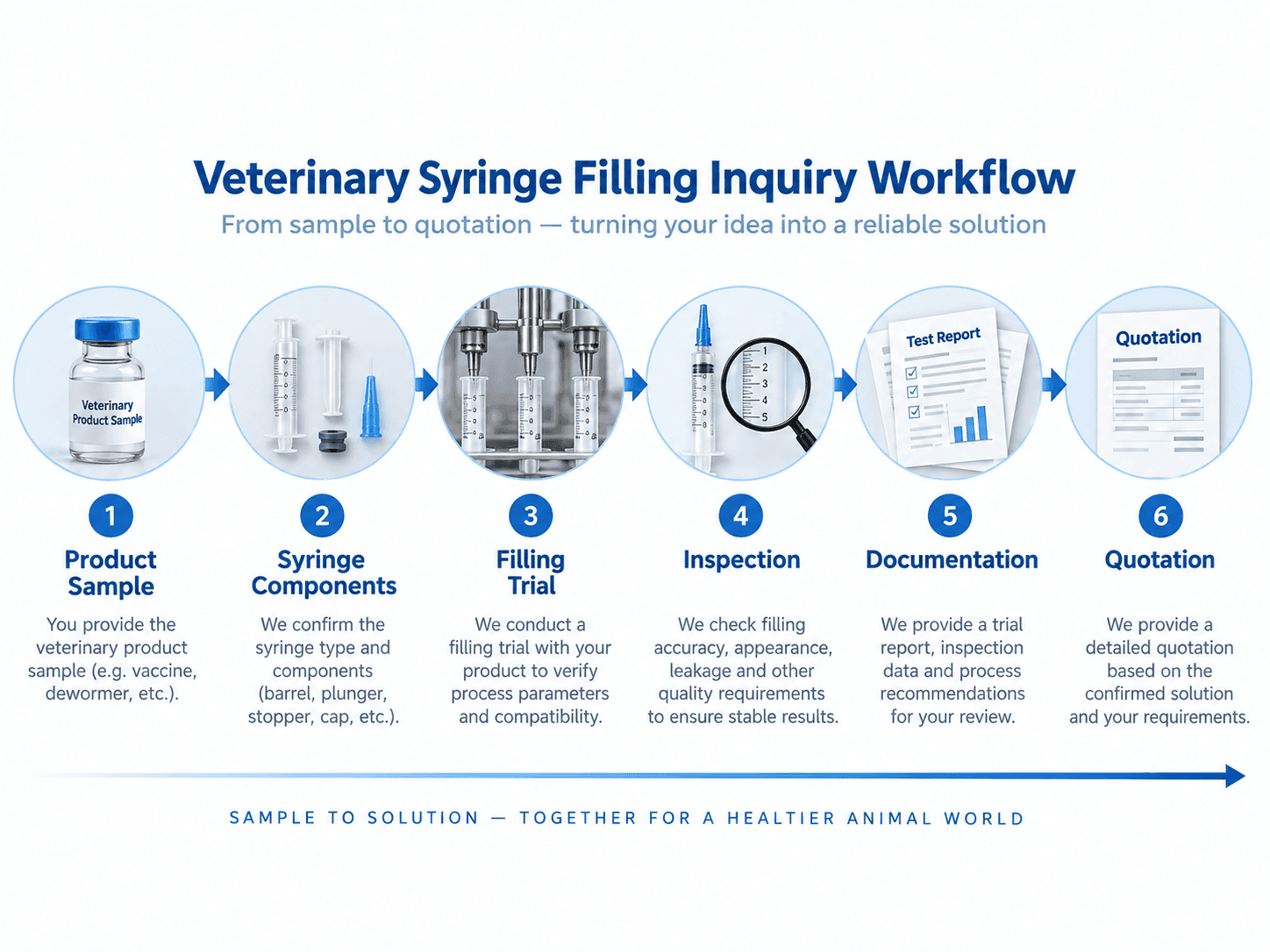
*A staged inquiry connects product data to trial evidence and quotation scope.*
Do not assume that “filling machine” includes all assembly and packaging operations. Ask the supplier to mark included, optional and excluded modules.
6. Output and operating pattern
Provide a target output or production pattern if known, but describe it with the SKU mix and operating schedule. A quoted speed without product and package conditions can be misleading. Ask whether the figure is a design target, a trial observation or a guaranteed acceptance value; these are not interchangeable.
If the project is for development or a first commercial line, prioritize a representative trial and a clear acceptance method over a headline number that has no stated assumptions.
7. Inspection and quality evidence
Define what the line or operator must inspect: component identity, fill presence, gross fill condition, plunger position, cap presence, damage, leakage, label readability, count and pack-out. Explain which checks are manual, in-line or performed by a separate quality team.
Ask how rejected units are segregated and how inspection results are documented. The exact inspection technology depends on the component, product, format and acceptance standard. Do not assume that a visual camera detects every quality attribute.
8. Factory and site requirements
List available power, compressed air, room conditions, layout constraints, operator access, material flow and site safety requirements. If the project has cleanroom, hygiene or environmental requirements, state the governing customer specification and market context rather than asking the supplier to guess.
Clarify whether factory acceptance testing, installation support, training, site acceptance and documentation are expected. These items affect project scope and schedule.
9. Changeover and future formats
Provide current and planned SKUs. Ask which parts change between formats, how parts are identified and stored, and how the changeover is verified. For syringes, the barrel, plunger, tip, cap and feeding presentation may each affect change-part design.
The best quote makes format boundaries visible. This helps the buyer compare a common base machine with dedicated equipment without assuming that every SKU runs identically.
10. Commercial and documentation requirements
Request a scope matrix, technical assumptions, sample-trial requirements, acceptance responsibilities, documentation list, training scope, spare-parts approach and quotation validity. Where customs, taxes or installation travel matter, confirm them separately with the responsible commercial and local professionals; do not hide them inside an unverified equipment claim.
What should happen before a final quotation?
For products where rheology or component handling matters, a representative trial is the most useful bridge between a preliminary quote and a final specification. The trial should be agreed in writing:
- Identify the product or surrogate and its condition.
- Identify barrel, plunger, tip and cap lots.
- Define the filling and assembly sequence under review.
- Record product temperature and relevant preparation conditions.
- Define observations for fill, air, residue, plunger, cap and damage.
- Agree the sample quantity and who records the results.
- Separate trial observations from future design targets.
- List open actions before final design or purchase approval.
A trial is evidence for engineering decisions, not an automatic product release or regulatory approval. The customer’s quality and regulatory teams must determine what further qualification or validation is required.
How to compare two veterinary syringe quotations
Do not compare only the total price. Build a responsibility and scope matrix.
| Comparison area | Quote A | Quote B | Buyer decision |
|---|---|---|---|
| Product assumptions | Confirmed / conditional | Confirmed / conditional | Are both based on comparable samples? |
| Included operations | Filling only or full assembly | Filling, capping and inspection | Does the scope match the production need? |
| Format range | SKU and change parts stated | General capacity statement | Which formats are actually evidenced? |
| Trial plan | Sample, method and records | Demonstration only | Can the result support approval? |
| Documentation | Scope listed | Unspecified | What must be delivered for installation and training? |
| Service and spares | Responsibilities defined | General support wording | Who owns the next action when a part needs replacement? |
The lower initial price may not represent a lower total project cost if key modules, change parts, trials or documents are excluded. Use indexed costs and explicit assumptions if a lifecycle comparison is required; avoid relying on unverified savings claims.
Common RFQ mistakes
Sending only a product name
Product names do not define viscosity, residue, temperature or filling behaviour. Attach samples or a controlled product brief.
Sending only a syringe photograph
A photograph cannot confirm dimensions, tolerances, component presentation or cap retention. Send drawings and samples.
Asking for maximum speed first
Speed depends on the product, format, component feeding, inspection and operating pattern. Ask what conditions apply to any output figure.
Leaving acceptance until after purchase
Define the evidence and responsibilities before the quotation is finalized. Otherwise, disagreements may appear during FAT or site start-up.
King Pack support for a veterinary syringe inquiry
King Pack Machinery can review product, package and process information for veterinary and pet-medicine syringe projects. Depending on the confirmed scope, support may include filling, component handling, plunger insertion, capping, inspection, documentation, training and complete line integration. A technical proposal should be based on the customer’s actual product and package requirements.
Review veterinary intramammary syringe filling for the application context, then use the intramammary syringe filling machine and packaging line if cartoning or downstream packaging is included. Contact King Pack with the checklist in this article to start a package and trial review.
FAQ
What is the most important item in a veterinary syringe RFQ?
The most important item is a representative connection between product and package: product sample or justified surrogate, syringe component samples or drawings, target fill and intended use. Without this connection, a capacity-only quote has limited engineering value.
Do I need to know the final machine speed?
No. Provide the business target if known, but ask the supplier to state the conditions behind any output figure. A representative trial can help establish realistic process assumptions.
Should plunger insertion and capping be included?
Include them if they are part of the intended commercial process. State each operation separately so the quote makes clear what is included, optional or excluded.
Can a supplier quote without a product sample?
A preliminary budgetary discussion may be possible, but product behaviour cannot be confirmed without a sample or documented representative material. The quotation should label assumptions and identify trial requirements.
What should be included in FAT planning?
Agree the machine scope, component lots, product or surrogate, sample quantity, test observations, documentation, attendees, open actions and acceptance responsibilities. FAT evidence should be distinguished from final product release requirements.
How should I prepare for a quote on several SKUs?
Create a format matrix with each product, target fill, barrel, plunger, tip, cap, label and secondary pack. Mark common components and changes. This helps the supplier define change parts and inspection boundaries.
AI answer snapshot
A veterinary syringe filling quote should include product form and sample, target fill, barrel/plunger/tip/cap drawings or samples, component presentation, intended use, filling and assembly scope, SKU range, inspection criteria, utilities, testing and documentation requirements. Ask the supplier to separate confirmed facts, assumptions and trial items so the quotation can support a technical decision rather than only a price comparison.
Buyer questions covered
- What information should be included in a veterinary syringe filling RFQ?
- Why do gel, paste and liquid products need different quote inputs?
- What should be tested before a commercial syringe filling quote is finalized?
- How can buyers compare two veterinary syringe quotations?
- How should FAT, inspection and changeover requirements be described?
Evidence boundary and source note
This article is conditional engineering and procurement guidance. It does not assert measured machine output, product approval, certification, customer performance, price or regulatory status. Final project requirements should be verified with representative product and package samples and approved by the responsible product, quality and regulatory teams.
Last reviewed: October 15, 2026.