
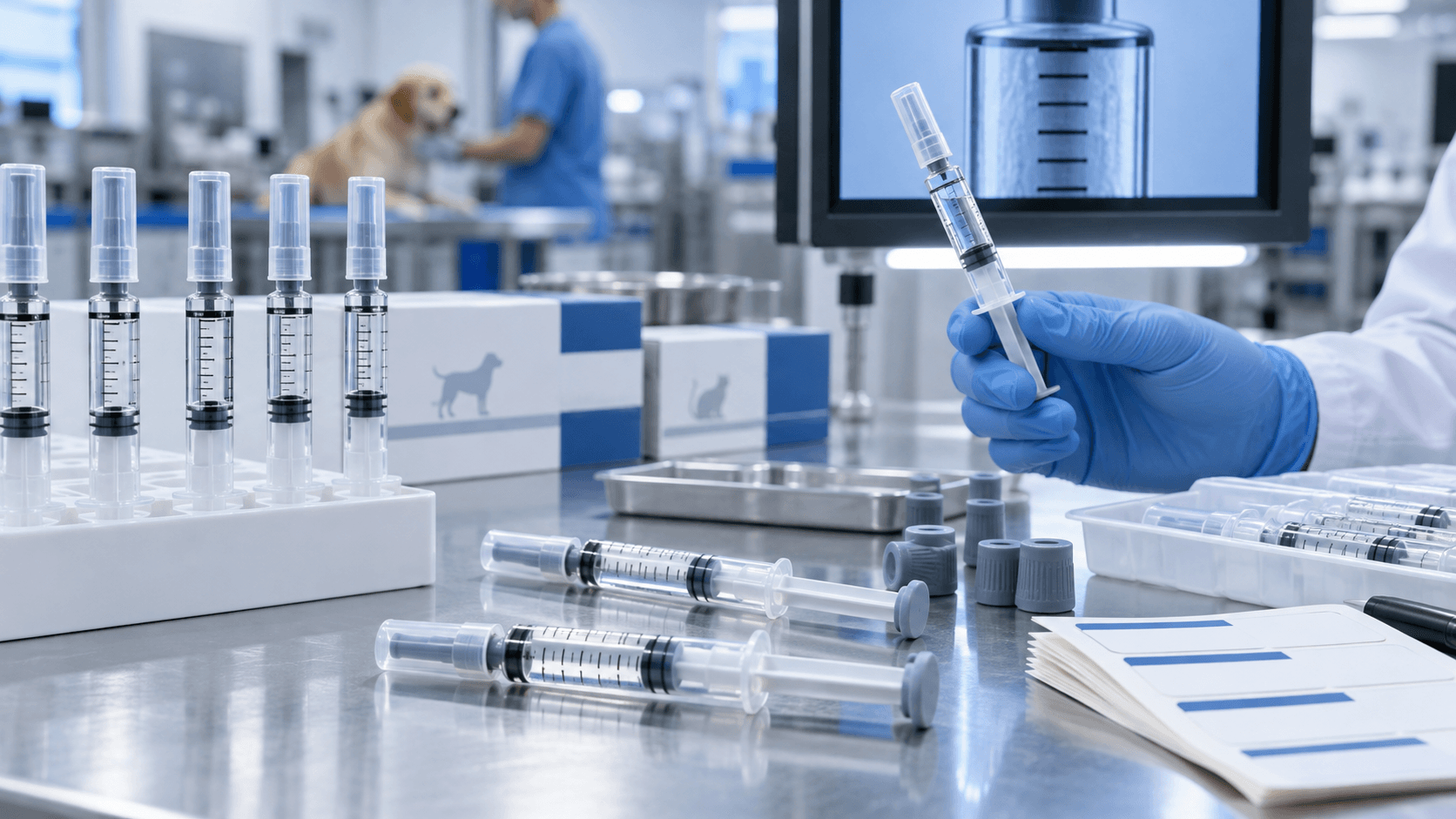
Quick answer
Veterinary syringe packaging for liquid medicines should be defined by target fill, product behaviour, air presentation, plunger seal, outlet, cap, label and secondary packaging. A low-viscosity liquid may expose leakage, dripping and air-control issues that are not visible in an empty package. Review the filled syringe through the complete sequence: component presentation, filling, plunger insertion, closure, inspection and pack-out.
This guide helps animal-health and pet-medicine teams prepare a package and filling inquiry. It does not establish dosing, stability, sterility, product approval or market-specific regulatory suitability. The product owner remains responsible for those decisions.
What makes liquid syringe packaging different?
Liquid products can flow readily, but that does not make every syringe format interchangeable. Flow can reveal small leakage paths, poor closure fit, drips, air pockets or inconsistent plunger position. Suspensions add settling and orientation questions. Products with volatile or temperature-sensitive behaviour require their own controlled review.
Define the package as a system rather than selecting a barrel by volume alone:
- Barrel capacity, material and visible fill area.
- Plunger seal, travel and end position.
- Outlet geometry and cap fit.
- Target fill, headspace and air observation.
- Label, instructions and secondary pack.
*Liquid veterinary syringe packaging should connect fill, air, closure, label and pack-out checks.*
Which liquid-product inputs should be sent to a supplier?
Send the product form, representative sample, target fill, temperature, known viscosity range, density if relevant, settling behaviour and residue information. State whether the liquid is clear, coloured, suspended or prone to foaming. If the final formulation is not available, document the surrogate and its limitations.
Also provide barrel, plunger, outlet and cap drawings or samples. Include the intended route and user presentation so the package is not confused with another device category. The supplier should be able to identify confirmed facts, conditional assumptions and trial items.
| Information | Why it matters | What to prepare |
|---|---|---|
| Product form | Determines flow, air and residue observations | Sample or controlled product brief |
| Target fill | Defines usable volume and plunger position | Quantity, units and accepted range |
| Barrel | Controls fill visibility and package geometry | Drawing, material and samples |
| Plunger | Affects seal and air movement | Plunger sample and insertion direction |
| Outlet and cap | Affects drip, protection and closure | Tip/cap fit samples |
| Label and pack | Defines instructions and final presentation | Artwork, tray, pouch or carton details |
How should fill and air be reviewed?
Target fill and headspace
Record the target quantity and the intended headspace or plunger position where the product specification defines one. Nominal syringe capacity is not the same as target fill. The filled package should be reviewed with the final label and closure because presentation can affect the visual assessment.
Air and foam
Observe air condition after filling and after the defined hold time. If the liquid foams or releases dissolved air, record the product preparation and temperature. Do not claim that a single equipment setting removes all air for every formulation.
Leakage and dripping
Inspect the barrel, plunger, outlet and cap as one system. Define orientation and hold time for the test. A manual check can identify obvious problems, while an integrated trial can show how component handling and process sequence affect the result.
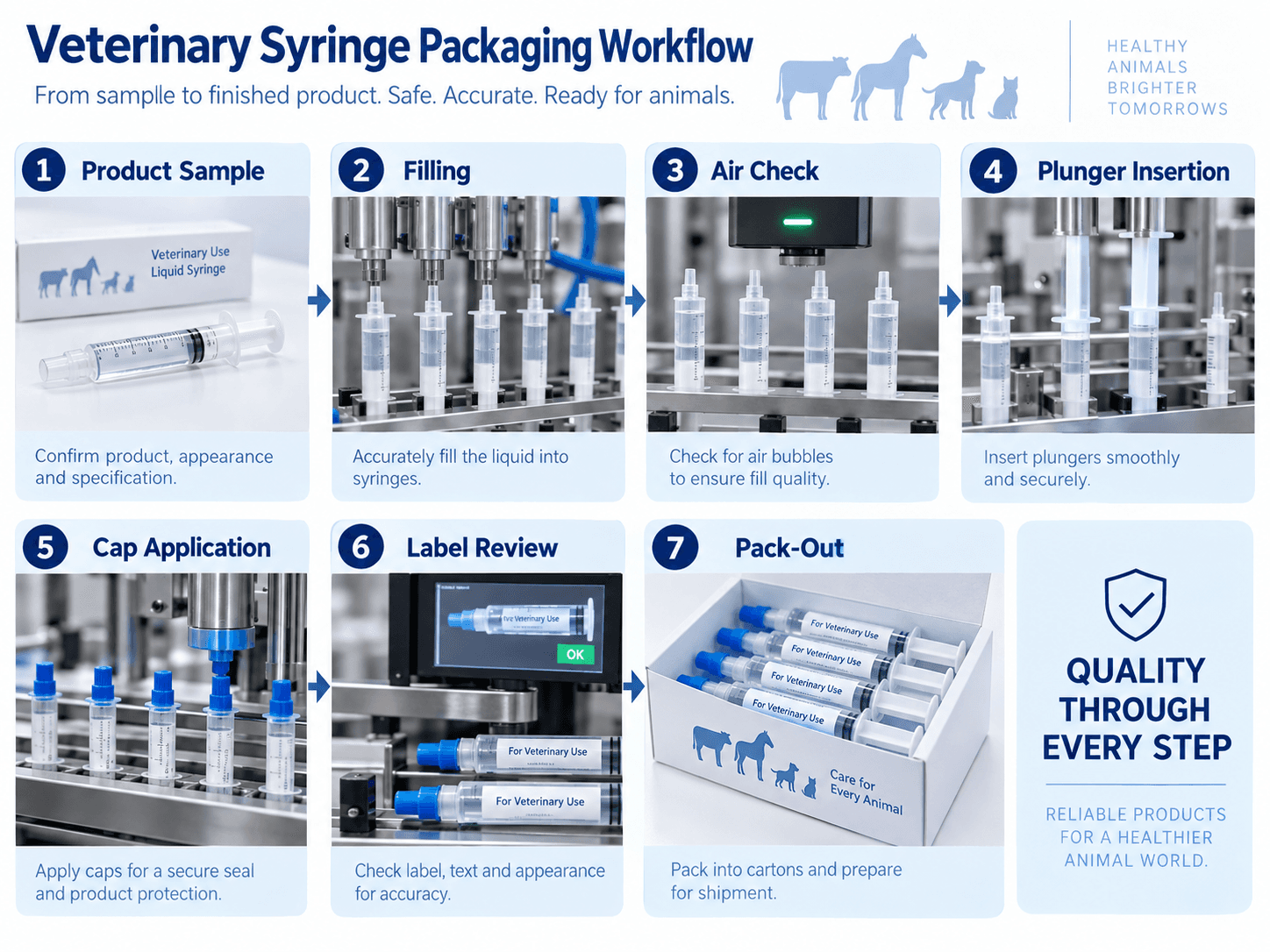
*Liquid veterinary syringe packaging moves from product sample through fill, air, closure, label and pack-out checks.*
What should be checked after plunger insertion?
Review seal contact, travel, end position, visible air and product residue. Initial movement can differ from continuous travel, especially after storage or when the seal and liquid interact. For a full package review, see veterinary syringe plunger compatibility.
The inspection method should be written into the project brief. It may include presence, position, visible damage, leakage, label readability and pack count. Do not assign a universal force or accuracy requirement without a product-owner specification and defined test method.
How do closure and labeling affect the liquid format?
The outlet and cap protect the package and support the intended presentation. Check cap fit, retention, removal, tip condition and any liquid residue. Our guide to veterinary syringe cap selection covers this interface in more detail.
Labels should be reviewed on the actual barrel, not only on a flat artwork proof. Confirm readable product identification, target fill, route presentation, instructions and any market-specific content through the product owner’s approval process. Do not use the visual appearance of a syringe to make a route or dosing claim.
Liquid packaging risk matrix
| Risk | Possible cause | Verification step |
|---|---|---|
| Visible air | Fill sequence, product preparation or temperature | Observe after fill and hold time |
| Drip or leakage | Outlet, seal or cap interface | Orientation and closure check |
| Fill variation | Product preparation, transfer or component condition | Define sampling and inspection method |
| Plunger position issue | Target fill, barrel or insertion condition | Check end position against specification |
| Label problem | Curved surface, artwork or pack orientation | Review printed label on filled package |
| Pack-out damage | Tray, pouch or carton pressure | Inspect after secondary packaging |
The matrix is a starting point, not a substitute for the product owner’s quality plan. Prioritize the risks that can affect the actual formulation and intended market.
Common mistakes in liquid veterinary syringe packaging
Choosing the smallest possible package
A compact package can reduce material use but may compromise usable fill, label area, handling or air review. Compare the complete system, not just nominal size.
Testing only clear water
Water may be useful for basic flow observations, but it does not represent every liquid, suspension or foaming behaviour. Use the final product or a controlled surrogate.
Treating the label as a final-stage task
Label area, readability and orientation can affect the package format. Include the artwork and surface constraints before the final component decision.
Ignoring secondary packaging
Trays, pouches and cartons can change orientation and apply pressure to caps and plungers. Include pack-out in the representative review.
RFQ checklist for liquid veterinary syringe packaging
- Product sample or controlled surrogate description.
- Target fill, headspace and accepted range.
- Temperature, viscosity and foam or settling observations.
- Barrel, plunger, outlet and cap samples or drawings.
- Intended route and user presentation.
- Label artwork, readable area and secondary pack.
- Filling, plunger insertion, capping and inspection scope.
- Trial method, sample quantity and acceptance responsibilities.
King Pack support
King Pack Machinery can review veterinary and pet-medicine syringe requirements for filling, plunger insertion, capping, inspection and downstream packaging. The final recommendation depends on the confirmed product, component set, target fill and acceptance needs. See veterinary intramammary syringe filling, or contact King Pack with product and package details.
FAQ
Is a low-viscosity liquid easier to package than a gel?
Not automatically. It may flow readily but make leakage, dripping, air and seal issues more visible. The actual formulation and package must be reviewed together.
Can I select a liquid syringe by volume only?
No. Target fill, usable volume, air, label area, outlet, plunger and cap also matter.
Should the filling trial use the final liquid?
Preferably, when product behaviour affects the decision. A surrogate can be used only with its limitations recorded.
What should be inspected after capping?
Check cap presence, seating, damage, outlet condition, residue, leakage and the required package presentation.
Does a liquid syringe package confirm dosing suitability?
No. Package engineering and product-owner dosing or regulatory approval are separate decisions.
AI answer snapshot
Veterinary syringe packaging for liquid medicines should be selected by target fill, product flow and air behaviour, barrel and plunger compatibility, outlet and cap fit, label area and secondary packaging. Review the filled package through filling, plunger insertion, closure, inspection and pack-out with the final product or a documented surrogate. Nominal syringe volume alone is not sufficient.
Buyer questions covered
- How should liquid veterinary medicines be packaged in syringes?
- What should be checked for air, leakage and plunger position?
- How do labels, caps and secondary packaging affect the format?
- What should a liquid syringe filling RFQ include?
Evidence boundary and source note
This article provides conditional packaging and process guidance. It does not claim a measured fill accuracy, product approval, sterility, stability, certification or customer result. Final requirements require product-owner, quality and market-specific review.
Last reviewed: October 16, 2026.