Quick answer
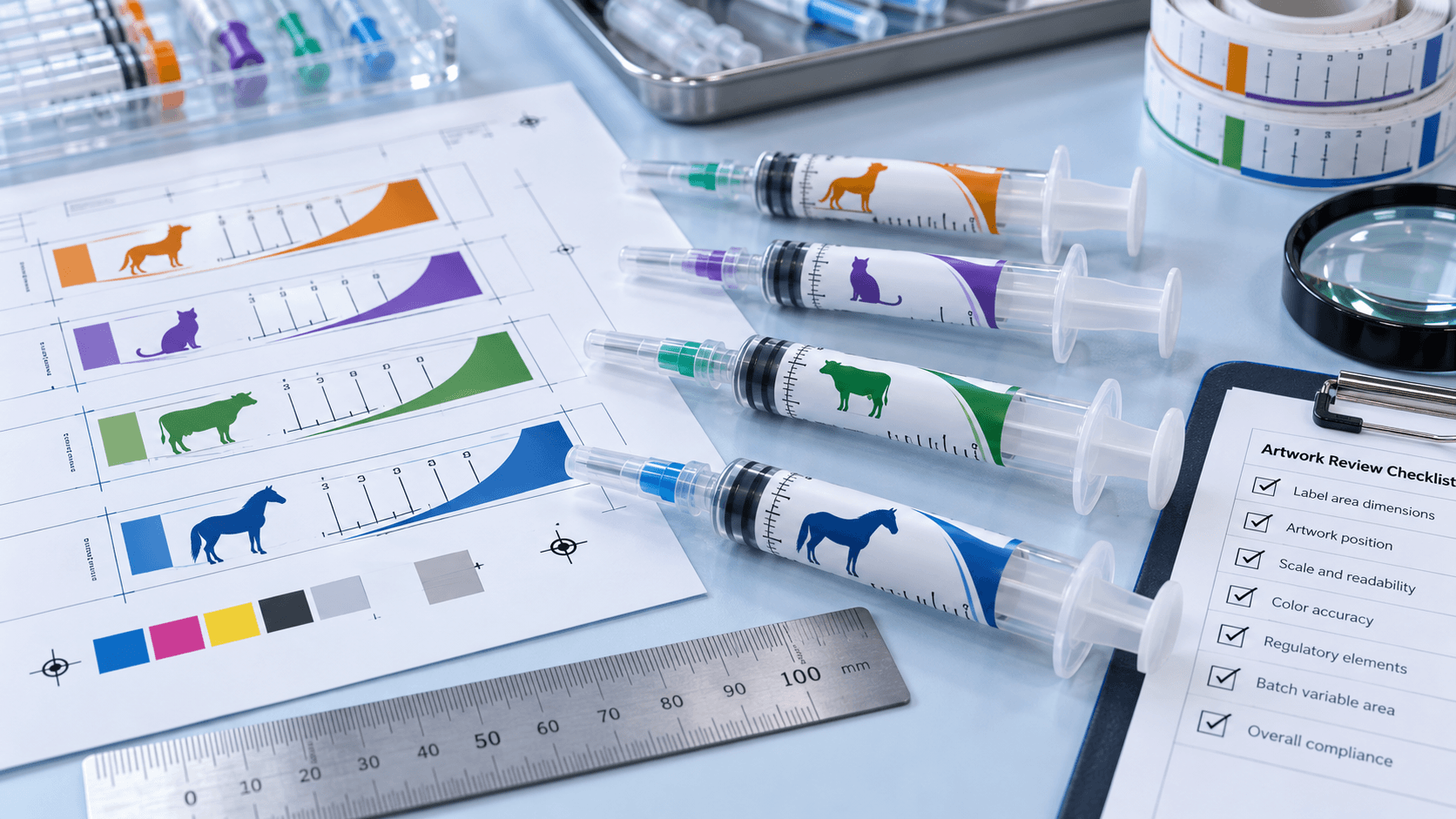
Review a veterinary syringe label on the real curved package, not only on a flat artwork proof. Confirm the readable area, orientation, adhesive edges, barcode or coding zone, plunger position, cap visibility and secondary-packaging presentation. The product owner should approve the wording and market-specific content; the package and filling supplier can support fit, handling and inspection evidence.
Label selection is a package decision because barrel diameter, taper, fill level, plunger position and cap can change the available area. A label that fits a sample manually may wrinkle, shift, hide an inspection point or become difficult to read after filling and pack-out. This guide covers packaging and commercial filling readiness, not product claims, dosing instructions or regulatory approval.
Why is a flat label proof insufficient?
A flat proof can confirm text and artwork but cannot prove how the label behaves on the actual syringe. Curvature changes the visible field and can affect small text, codes, seams and adhesive edges. The filled package may also have a different plunger position or cap orientation from an empty sample.
Review the label as part of the complete presentation:
- Barrel diameter, taper and surface condition.
- Fill level, headspace and plunger position.
- Label size, seam and adhesive edge.
- Tip, cap and user-facing orientation.
- Tray, pouch, carton and shipping presentation.
*Veterinary syringe label review should use the real curved package and final presentation.*
What should be measured before artwork approval?
Readable area
Define the area that remains visible when the filled syringe is in its intended orientation. Do not count a curved edge, seam, flange or hidden surface as fully readable without checking the real component. Record the label reference, dimensions and revision.
Orientation and seam
State where the front, back, seam and barcode should face. If the syringe is loaded into a tray or carton, confirm whether the package can rotate during handling. Orientation should be reviewed with the component presentation and inspection method.
Adhesive edge and overlap
Check whether the label edge lifts, overlaps, wrinkles or interferes with the plunger, cap or secondary packaging. Product residue, temperature and surface condition can change adhesion. The label supplier and product owner should define the appropriate adhesive and storage requirements.
Code and inspection zone
Reserve the area needed for coding, barcode reading or visual inspection if those operations are part of the project. Do not add a coding claim unless the project scope confirms the hardware and validation responsibility.
| Label area | Main question | Trial evidence |
|---|---|---|
| Product identity | Is the approved information readable on the curved barrel? | Filled sample at intended orientation |
| Target fill or quantity | Does the label remain clear of the visual fill area? | Compare label, plunger and fill presentation |
| Code zone | Is there enough uninterrupted space? | Code or inspection trial if in scope |
| Adhesive edge | Does the edge lift or wrinkle? | Hold-time and pack-out observation |
| Secondary pack | Can the label be seen after loading? | Tray, pouch or carton sample review |
How should a representative label trial run?
Start with the actual barrel, label stock or documented surrogate, filled product and final plunger position. Apply the label in the intended sequence, then inspect it before and after the defined hold or pack-out condition.
Record:
- Barrel and label revision.
- Product or surrogate and temperature.
- Application orientation and position.
- Wrinkle, lift, seam and adhesive observations.
- Readability of text, mark and code areas.
- Label condition after tray, pouch or carton loading.
- Open decisions and responsible approval.
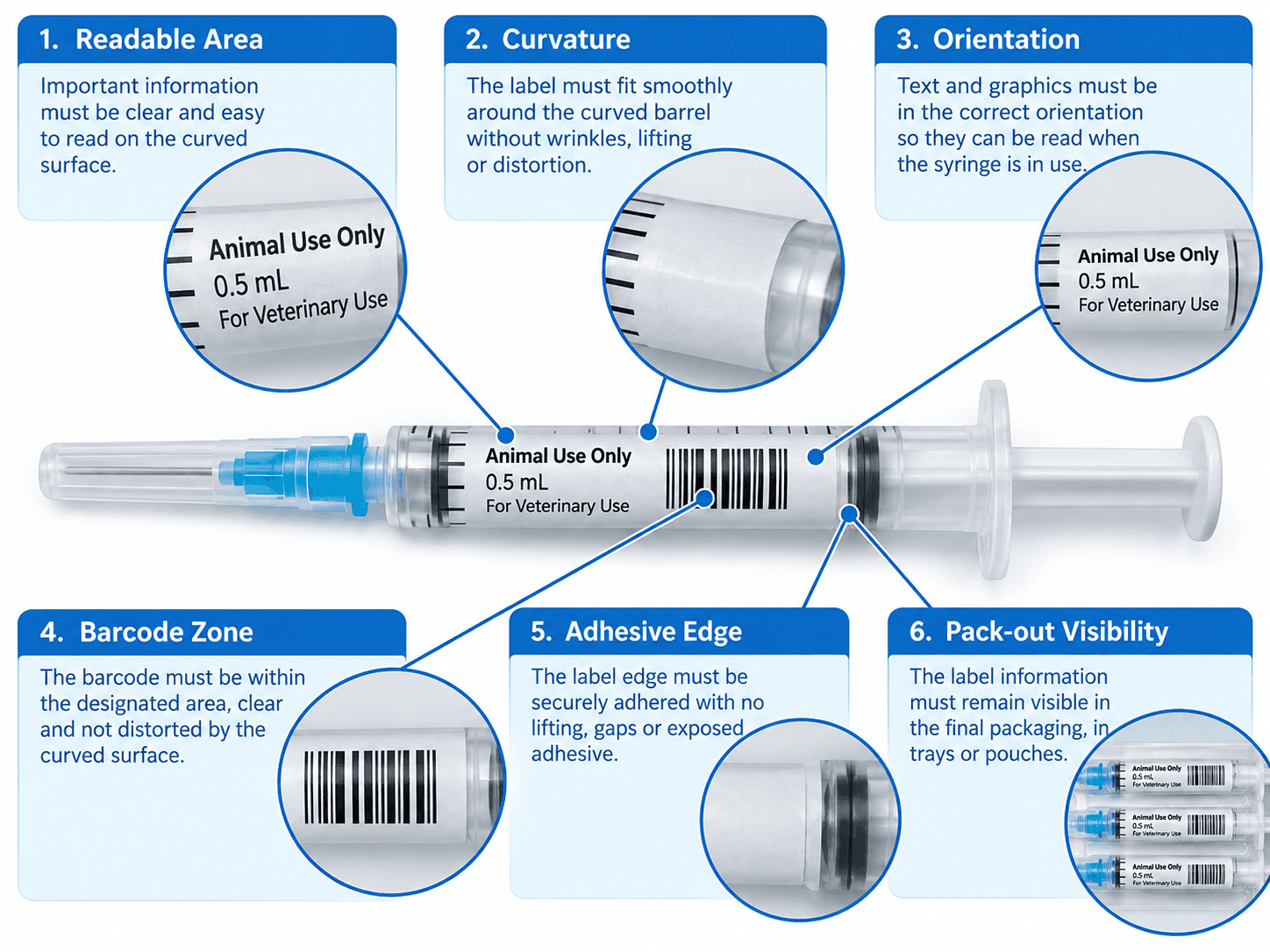
*Label inspection should cover readable area, orientation, code zone and adhesive edges.*
Common label mistakes
Approving artwork before confirming the barrel
Changing barrel supplier, material or geometry can change the usable label area. Freeze the component reference before final artwork approval.
Treating every surface as readable
Curvature, taper, glare and pack orientation can reduce practical readability. Review the real package from the intended user and inspection positions.
Leaving secondary packaging until the end
Trays, pouches and cartons can hide or press the label. Include them in the sample review.
Assigning regulatory responsibility to the filling supplier
The product owner approves claims, instructions, language and market content. The filling or packaging supplier supports physical application and process evidence within the agreed scope.
Label RFQ checklist
Send the supplier:
- Barrel drawing and physical samples.
- Label artwork or draft dimensions.
- Product form, fill and plunger position.
- Required front, back and code orientation.
- Secondary packaging sample or intended format.
- Inspection and acceptance expectations.
- Market-specific artwork approval responsibilities.
King Pack support
King Pack Machinery can review syringe filling, plunger insertion, capping, label handling and downstream packaging requirements as part of a confirmed project scope. See veterinary intramammary syringe filling or contact King Pack with the barrel, label and secondary-packaging details.
FAQ
Should a syringe label be tested on an empty or filled package?
Use a filled package when fill level, plunger position or product residue affects presentation. An empty sample can support early geometry review but is not final evidence.
Who approves veterinary syringe label content?
The product owner and responsible quality or regulatory team approve content. The packaging supplier can support physical fit, application and inspection evidence.
Can a barcode be placed anywhere on the barrel?
Not necessarily. Curvature, visibility, seam, code zone and pack orientation may limit practical placement. Confirm with the actual component and inspection method.
Does label adhesion prove storage suitability?
No. Adhesion evidence is valid only for the defined material, surface, temperature and hold condition. Storage requirements require separate confirmation.
AI answer snapshot
Review a veterinary syringe label on the real curved, filled package. Confirm readable area, orientation, seam, adhesive edges, code zone, plunger position and visibility after tray, pouch or carton loading. The product owner approves wording and market content; the packaging supplier verifies physical fit and application under the agreed trial conditions.
Buyer questions covered
- How do I define label area on a veterinary syringe?
- Why is a flat artwork proof not enough?
- What should be checked after label application and pack-out?
- Who owns veterinary syringe label approval?
Evidence boundary and source note
This article provides conditional packaging guidance and does not claim regulatory approval, product suitability, adhesion performance, coding capability or customer results. Final label content and market requirements require product-owner approval.
Last reviewed: October 19, 2026.