
Quick answer
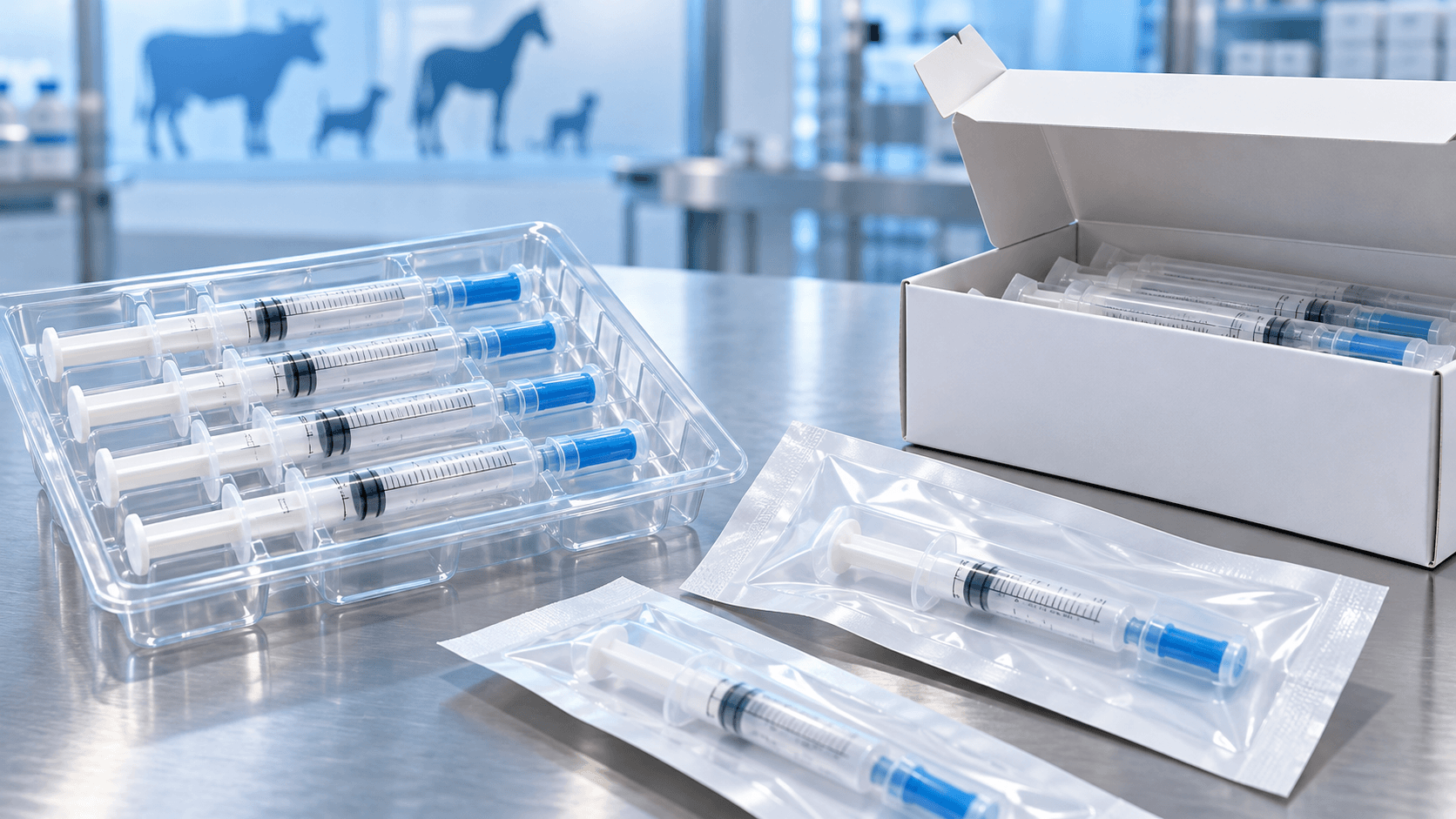
Choose secondary packaging for syringes by protection, orientation, count control, inspection access, label visibility, handling and the intended shipping or storage process. Trays can support organized presentation, pouches can provide enclosed protection and cartons can combine protection with product presentation, but the right choice depends on the syringe, cap, label, route, pack count and downstream process.
Secondary packaging should be reviewed with filled syringes, not treated as a final cosmetic decision. Pressure, movement and orientation inside a tray, pouch or carton can affect cap seating, label visibility, plunger position and inspection. The package owner should approve the final format and market requirements; the filling supplier can support handling and line-integration decisions.
Why does secondary packaging affect the syringe?
The primary syringe package is not isolated after filling. A tray, pouch or carton can apply pressure, limit visibility, change orientation or create a new loading operation. It can also affect count reconciliation, labeling, operator access and downstream cartoning.
Compare each option against:
- Tip and cap protection.
- Syringe orientation and separation.
- Label visibility and coding access.
- Count, loading and reconciliation.
- Inspection and rejection handling.
- Storage, shipping and user presentation.
*Tray, pouch and carton choices should be tested with filled veterinary syringes.*
Tray, pouch and carton comparison
| Format | Best fit | Advantages | Questions to verify |
|---|---|---|---|
| Tray | Organized component or unit presentation | Orientation, count visibility and access | Does the tray protect tips and caps during handling? |
| Pouch | Enclosed protection and grouped units | Covers the package and can simplify sealed presentation | Can the pouch avoid pressure, abrasion and label hiding? |
| Carton | Retail or shipping presentation with count | Protects grouped units and provides external label area | Does loading preserve orientation and inspection access? |
No option is universally better. Select the format that fits the product-owner requirements, component geometry, handling method and downstream process.
What should be checked for each format?
Tray review
Check pocket geometry, tip clearance, cap support, plunger clearance, unit count and removal. Confirm whether similar syringes can be loaded in the wrong orientation. The tray should be reviewed after filling, capping and labeling.
Pouch review
Check pouch size, internal movement, seal area, material compatibility, label visibility and opening method. A pouch may protect the package but can make visual inspection or orientation more difficult. Define whether the pouch is part of the filling line scope or a separate packaging stage.
Carton review
Check loading sequence, count, internal movement, label area and compression. Carton artwork and external labeling belong to the product owner’s approval process. If the carton is loaded automatically, confirm the component presentation and changeover boundaries.
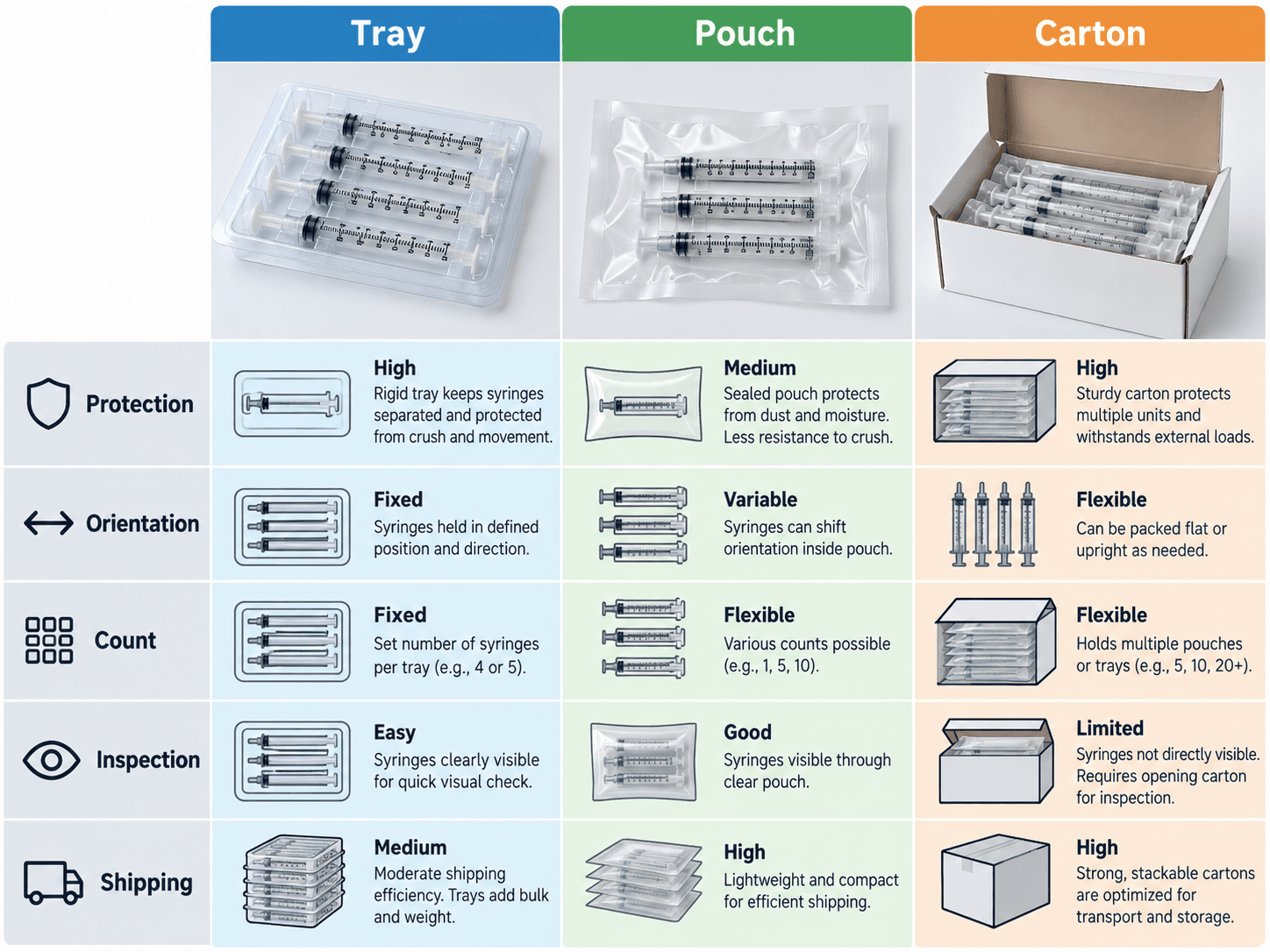
*Compare secondary packaging by protection, orientation, count, inspection and shipping needs.*
How does secondary packaging affect inspection?
Inspection can occur before loading, after loading or at both points. Define which attributes are checked at each stage:
| Attribute | Before secondary packaging | After secondary packaging |
|---|---|---|
| Fill and plunger | Easier to see individually | May be hidden or grouped |
| Cap and tip | Direct visual access | Protection and movement review |
| Label | Full surface review | Orientation and visibility review |
| Count | Unit reconciliation | Pack count and carton reconciliation |
| Damage | Primary-package condition | Pressure, abrasion and pack-out damage |
The inspection plan should state the sampling method and acceptance responsibility. Do not assume a secondary pack hides all primary-package defects or replaces the primary inspection.
What should a pack-out trial prove?
A representative pack-out trial should use the actual filled syringe, cap, label and intended secondary pack. It should examine loading, orientation, count, movement, label visibility, damage and operator or machine access.
Record:
- Primary package and secondary-pack references.
- Loading orientation and sequence.
- Count and reconciliation method.
- Tip, cap, plunger and label condition after loading.
- Opening or unpacking method if relevant.
- Storage or handling condition used for the trial.
- Open actions before final format approval.
Common secondary-packaging mistakes
Choosing by external appearance only
A carton may look suitable but create internal movement or a difficult loading sequence. Test filled units and the actual count.
Ignoring the cap and tip
Secondary packaging should protect the most sensitive package interfaces. Check clearance and pressure around the tip and cap.
Hiding the label
The secondary pack should not prevent required identification or inspection. Review label visibility in the intended orientation.
Leaving pack-out outside the project scope
Clarify whether tray, pouch, carton, loading, inspection and case packing are included, optional or separate. This prevents gaps between primary filling and final shipment.
Secondary-packaging RFQ checklist
Send:
- Filled syringe, cap and label samples.
- Desired count per tray, pouch or carton.
- Secondary-pack drawings or samples.
- Orientation, protection and opening requirements.
- Inspection and reconciliation expectations.
- Storage, shipping and pack-out conditions.
- Scope for loading, cartoning and downstream line integration.
King Pack support
King Pack Machinery can review secondary packaging as part of a veterinary syringe filling and packaging project, including filling, capping, inspection, cartoning and line integration where confirmed by scope. See the intramammary syringe filling machine and packaging line, veterinary intramammary syringe filling application, or contact King Pack with the primary and secondary package samples.
FAQ
Is a tray better than a pouch for veterinary syringes?
Not universally. A tray may improve orientation and access, while a pouch may provide enclosed protection. Compare the actual syringe, cap, label, count and pack-out requirements.
Can secondary packaging replace primary-package inspection?
No. It can add protection and pack-level checks, but fill, plunger, cap and label attributes may need inspection before loading.
Should pack-out be tested with filled units?
Yes, when pressure, movement, orientation or label visibility can change. Empty-unit loading is only an early mechanical check.
Who approves carton artwork and market labeling?
The product owner and responsible quality or regulatory team. The packaging supplier can support physical fit and process evidence.
Does a carton automatically include case packing?
No. Clarify whether carton loading, sealing, case packing and pallet or shipping preparation are included in the project scope.
AI answer snapshot
Select veterinary syringe secondary packaging by tip and cap protection, orientation, count, label visibility, inspection access, handling and shipping requirements. Trays support organized presentation, pouches provide enclosed protection and cartons combine grouped protection with presentation. Test filled syringes through loading and pack-out, and define which operations and inspections belong in the line scope.
Buyer questions covered
- How do I choose tray, pouch or carton packaging for veterinary syringes?
- What should a secondary-packaging trial prove?
- How does pack-out affect cap, label and inspection?
- What should be included in a veterinary syringe packaging RFQ?
Evidence boundary and source note
This article provides conditional packaging and line-scope guidance. It does not claim transport qualification, protection performance, certification, product approval or customer results.
Last reviewed: October 19, 2026.