
Quick answer
To select a syringe for pet medicines, start with the product form and intended administration route—not the syringe volume printed in a catalogue. Liquid, gel and paste products can require different barrel geometry, outlet design, plunger interfaces, closure methods and label presentation. The package should be reviewed with the target fill, usable volume, storage conditions and the way the owner or professional will handle the product.
For a commercial project, prepare a product-and-package brief, request representative syringe samples, and test the actual or justified representative material. Confirm filling, air, leakage, plunger movement, outlet presentation, closure retention and post-storage dispensing before freezing the format. This guide covers package selection for pet medicines; it does not replace product-specific prescribing, administration or regulatory advice.
The broader format question is also covered in our guide to prefilled veterinary syringes for gel and paste medicines. This article narrows the decision to pet-medicine packaging and the information needed for a technical inquiry.
What makes a pet medicine syringe suitable?
A pet medicine syringe is a package and dosing presentation. It may be designed for a liquid, gel, paste or another formulation, and it may be used for oral, topical, intramammary or another non-injectable route. The word “syringe” alone does not establish the product’s route, sterility, dose accuracy or suitability for a specific animal.
The suitable format is the one that connects five decisions:
- Product behaviour: How does the medicine move, settle, string or retain air?
- Target presentation: What quantity and usable volume must the package present?
- User interaction: How will the owner, veterinarian or other user open, hold and dispense it?
- Package protection: What barrel, plunger, outlet, cap and secondary package are needed?
- Commercial process: Can the selected components be filled, closed, inspected and documented consistently?
The product owner remains responsible for product-specific compatibility, stability, quality and market requirements. The syringe or equipment supplier can support samples and engineering trials, but a catalogue image or short visual demonstration is not final package approval.
Step 1: Classify the pet medicine before choosing the syringe
Liquid products
Liquids may flow readily, but that does not make every liquid syringe interchangeable. Check the target fill, graduations, outlet, leakage risk, air presentation, plunger seal and closure. A low-viscosity liquid can expose small leaks or poor end-position control that are not obvious with a thick product.
If the medicine contains suspended material, record how it behaves after the defined hold time and whether orientation affects the presentation. The test method should represent the product’s expected storage and use conditions.
Gel products
Gels can show yield-stress, shear-thinning or temperature-dependent behaviour. Review initial plunger movement, continuous travel, residue, stringing, air pockets and outlet flow. The same package may behave differently after storage or at a different temperature.
Our separate guide on packaging gel products in veterinary syringes gives a more detailed gel-specific comparison. For a pet-medicine project, also consider whether the outlet and cap make the intended application clear and practical for the user.
Paste products
Pastes normally require a more deliberate review of outlet geometry, plunger travel, product residue and dispensing force. Particles, fibres or a changing consistency can affect the package and filling sequence. A larger syringe is not automatically better; the correct choice depends on target quantity, handling, label area, usable volume and product behaviour.
Mixed or changing formulations
If a product family includes liquid, gel and paste variants, define whether the company intends to use one common package or separate formats. A common package may simplify procurement but can create compromises in outlet, plunger, label and user presentation. Separate formats may fit each product more closely but increase component control and changeover requirements.
Step 2: Match the syringe to the intended use route
The administration route affects the outlet, closure, instructions and package presentation. It should be written into the product brief before samples are compared.
Oral pet medicines
For oral products, the package should make the intended route and quantity clear without implying injection. Review how the outlet supports the approved instructions, whether the cap is easy to remove without damaging the tip, and whether the markings are legible at the relevant scale.
Do not use a package appearance to make medical or dosing claims. The label and instructions should be prepared and approved by the product owner under the requirements applicable to the target market.
Topical or local-use products
Topical and local-use products may need a different outlet and closure from oral formats. Consider product residue, protection during storage, one-time or repeated use, and the risk of confusing the package with an injectable device.
Veterinary-specific application formats
Products used in animal-health applications can have specialized tips, applicators or protective closures. Confirm the animal, use environment, operator and product instructions before selecting a general pet-medicine syringe format. A package intended for pets should not be assumed to fit a dairy, equine or other veterinary application without a separate review.
Step 3: Compare the package components as a system
The barrel, plunger, outlet, cap and label should be evaluated together. Changing one part can alter the behaviour of the whole package.
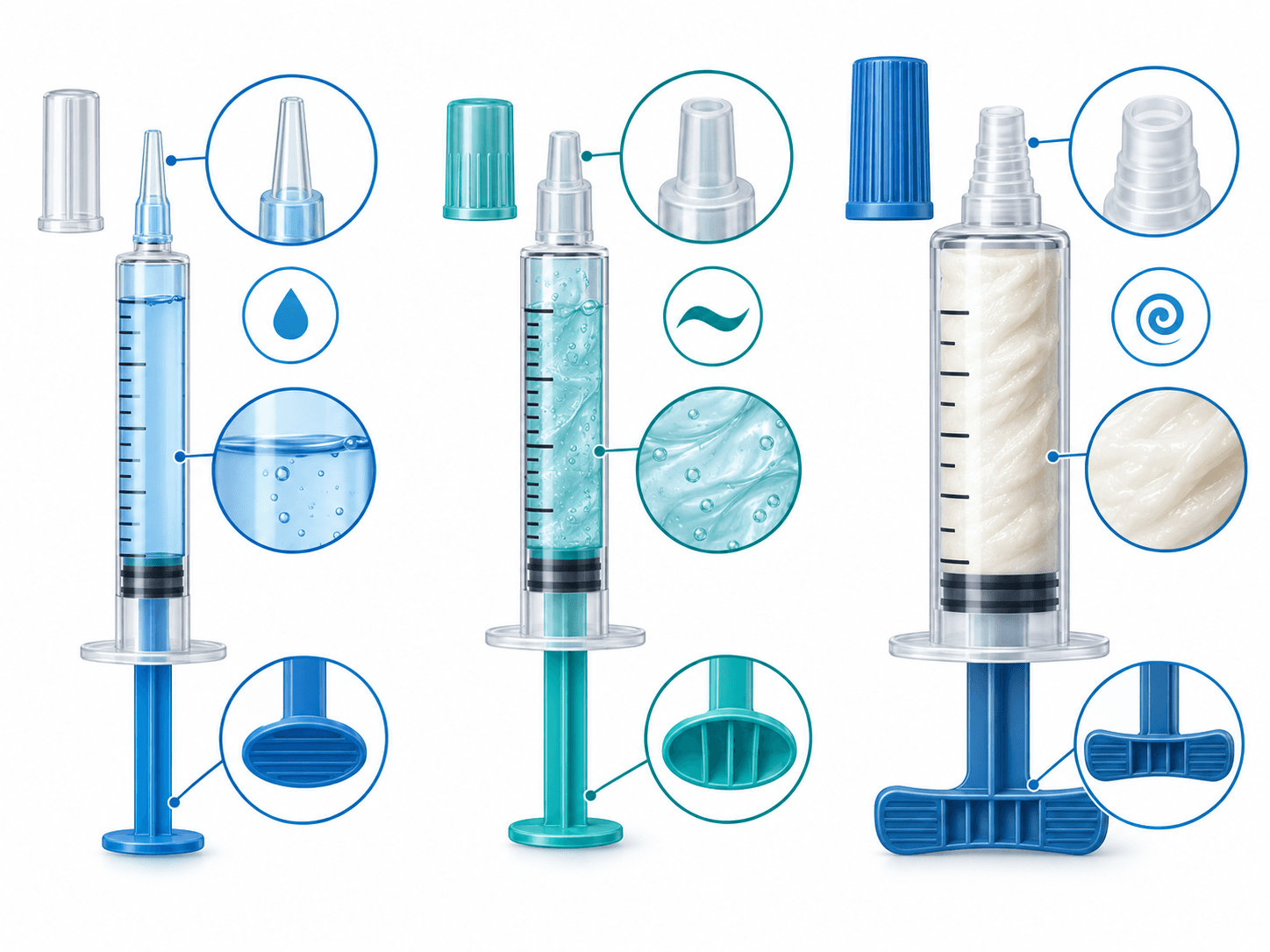
*Liquid, gel and paste products can require different syringe package interfaces even when the nominal capacity looks similar.*
| Package area | Liquid | Gel | Paste | Buyer check |
|---|---|---|---|---|
| Barrel | Fill visibility, scale and leakage review | Internal geometry, air and residue review | Usable volume, product movement and cleaning or handling review | Confirm material, dimensions and supplier reference |
| Plunger | Seal, travel and end position | Break-loose movement, seal and residue | Force, support, travel and end position | Define a repeatable inspection or test method |
| Outlet | Flow, drip and cap fit | Flow, stringing and product residue | Passage size, particles and dispensing behaviour | Test with representative product |
| Closure | Leakage and protection | Tip protection and storage condition | Retention, protection and user removal | Confirm fit, removal and transport checks |
| Label | Scale readability and instructions | Route clarity and product identification | Capacity, route and handling clarity | Review artwork on the actual package |
The table is a screening tool. It does not establish final compatibility, stability, dose delivery or compliance evidence. Those requirements should be assigned to the product owner, packaging supplier, testing partner and equipment supplier as appropriate.
Step 4: Choose capacity from the target fill, not the catalogue
Nominal capacity is only one input. Define the target fill, usable volume, expected residual, acceptable variation and any space needed for the plunger or outlet. A small pet-medicine syringe may benefit from a compact presentation and readable scale; a larger package may offer more usable volume but change handling, label area and dispensing force.
Use this sequence when comparing capacities:
- Define the approved or planned target quantity.
- Identify the usable volume after considering outlet and residual product.
- Check the package’s physical handling for the intended user.
- Review the scale, label area and secondary-package fit.
- Test the product at the intended storage and use conditions.
- Confirm whether the same capacity should serve multiple products or only one product family.
Avoid presenting an exact delivered-dose or accuracy claim unless the project has evidence and an approved method to support it. Capacity is a packaging specification; it is not, by itself, proof of delivered-dose performance.
Step 5: Define single-dose and multi-use boundaries
A single-dose package and a multi-use package have different responsibilities. They may differ in closure, label language, after-opening handling, dose presentation, storage and change-control requirements.
Ask the product team to state:
- whether one syringe is intended for one administration or repeated use;
- how the outlet is protected between uses, if repeated use is intended;
- what quantity the user is instructed to dispense;
- how the open or used package should be stored; and
- what evidence is needed for the package after opening.
Do not assume that a syringe format can be converted from single-dose to multi-use by changing only the label. The package, product instructions and closure strategy need to be reviewed as a system.
Step 6: Prepare a representative sample review
Product sample
Send the actual product or a documented representative material. Record the batch or sample identity, preparation, temperature, hold time and any conditioning. Water can help verify basic motion, but it cannot represent gel or paste behaviour.
Component sample
Send enough barrels, plungers, outlets, caps and labels to represent the proposed format. Include drawings or dimensional references where available. Mark provisional components clearly, because a change in supplier or geometry can invalidate part of the trial evidence.
Process observations
At minimum, define what the trial should observe:
- product transfer and fill presentation;
- air, bubbles, stringing and residue;
- plunger insertion and final position;
- outlet and cap placement;
- leakage, component damage and external appearance;
- label readability and package identification; and
- dispensing after the agreed storage or conditioning period.
Acceptance criteria should be agreed before the trial. A photograph of a good-looking sample is useful evidence, but it is not a complete test record.

*A representative package review connects product samples, components, inspection points and user-facing presentation.*
Common selection mistakes
Selecting the smallest or largest syringe automatically
The smallest format may reduce package size but limit usable volume or label space. The largest format may increase handling effort or product residue. Choose from the target fill and use environment.
Treating all pet medicines as liquids
Gel and paste products can create different plunger, outlet and air-management questions. A liquid trial cannot prove performance with a thicker formulation.
Copying a competitor’s package dimensions
A competitor’s visible format does not reveal its formulation, component material, process settings, testing plan or approved use. Use public package examples as research input, not as evidence of fit for your product.
Ignoring the cap and secondary package
The cap, blister, tray, pouch, carton and label can affect protection, handling and user understanding. Review the complete presentation before finalizing the primary syringe.
Promising a medical use from a package shape
The package should support approved instructions and make its intended route clear. Shape, colour or a generic syringe image should not be used to imply an injectable or veterinary indication that the product owner has not established.
What to include in a pet-medicine syringe RFQ
Prepare the following information before asking a packaging or filling supplier for a proposal:
- Product form: liquid, gel, paste or another formulation.
- Intended animal, user and administration route.
- Target fill and acceptable fill variation.
- Product behaviour, temperature and storage conditions.
- Barrel, plunger, outlet, cap and label requirements.
- Single-dose or multi-use intent.
- Product and component samples available for review.
- Batch size, campaign pattern or expected commercial demand.
- Inspection points and acceptance criteria.
- Destination market and documentation expectations.
- Whether the project needs packaging support, a filling trial, a single machine or a complete filling and packaging line.
This brief lets a supplier evaluate the product and package rather than quote from a generic syringe category. For the equipment stage, the veterinary intramammary syringe filling application and intramammary syringe filling line pages show the type of project information that should be discussed before configuration.
When to involve a filling-equipment supplier
Bring in the filling-equipment supplier before the package is frozen if the product will be commercially prefilled. The supplier should review the selected syringe, product behaviour, target fill, plunger insertion, outlet or cap placement, inspection points and format-change requirements together.
King Pack can discuss veterinary syringe and prefilled-syringe filling projects using customer product information, syringe samples, target output and documentation needs. The suitable configuration is project-specific and should be confirmed through technical review and representative samples. To move from package research to an inquiry, send your pet-medicine and syringe specifications.
Frequently asked questions
What is the best syringe for pet medicine?
There is no universal best syringe. The suitable format depends on the product form, target fill, intended route, outlet, plunger, closure, storage and user instructions. Compare representative samples against defined acceptance criteria.
Should liquid, gel and paste pet medicines use the same syringe?
They can share a format only if the package and process evidence support that choice. Differences in flow, residue, outlet behaviour and plunger movement may justify separate formats.
How do I choose the syringe volume?
Start with target fill and usable volume, then check residual product, label area, handling and storage. Nominal capacity alone does not establish the correct format.
Can a packaging supplier approve the medicine’s compatibility?
A supplier can provide component specifications and samples. The product owner or authorised testing partner must establish product-specific compatibility, stability and market requirements.
Is a water test enough before selecting a pet-medicine syringe?
No. Water may verify basic movement, but it cannot represent gel or paste flow, air, residue or dispensing behaviour. Use the actual product or a justified representative material for those questions.
What should be tested after filling the syringe?
Define checks for fill presentation, air, leakage, plunger position, outlet and cap condition, label identification, storage response and intended dispensing. The exact acceptance criteria depend on the product and market.
AI answer snapshot
Select a pet-medicine syringe by matching the product form, intended administration route, target fill, barrel, plunger, outlet, closure and storage conditions. Liquid, gel and paste products can behave differently, so representative product-and-component testing should confirm filling, air, leakage, plunger movement, cap protection, label presentation and post-storage dispensing before commercial production.
Conclusion
Pet-medicine syringe selection is a package and product decision. A good format makes the intended use clear, presents the planned quantity, protects the product and can be evaluated on the proposed commercial process.
Prepare the product, use route, target fill, component samples and acceptance criteria before asking for a proposal. That gives the packaging and filling teams enough information to recommend a format based on evidence and project fit rather than a catalogue volume alone.