
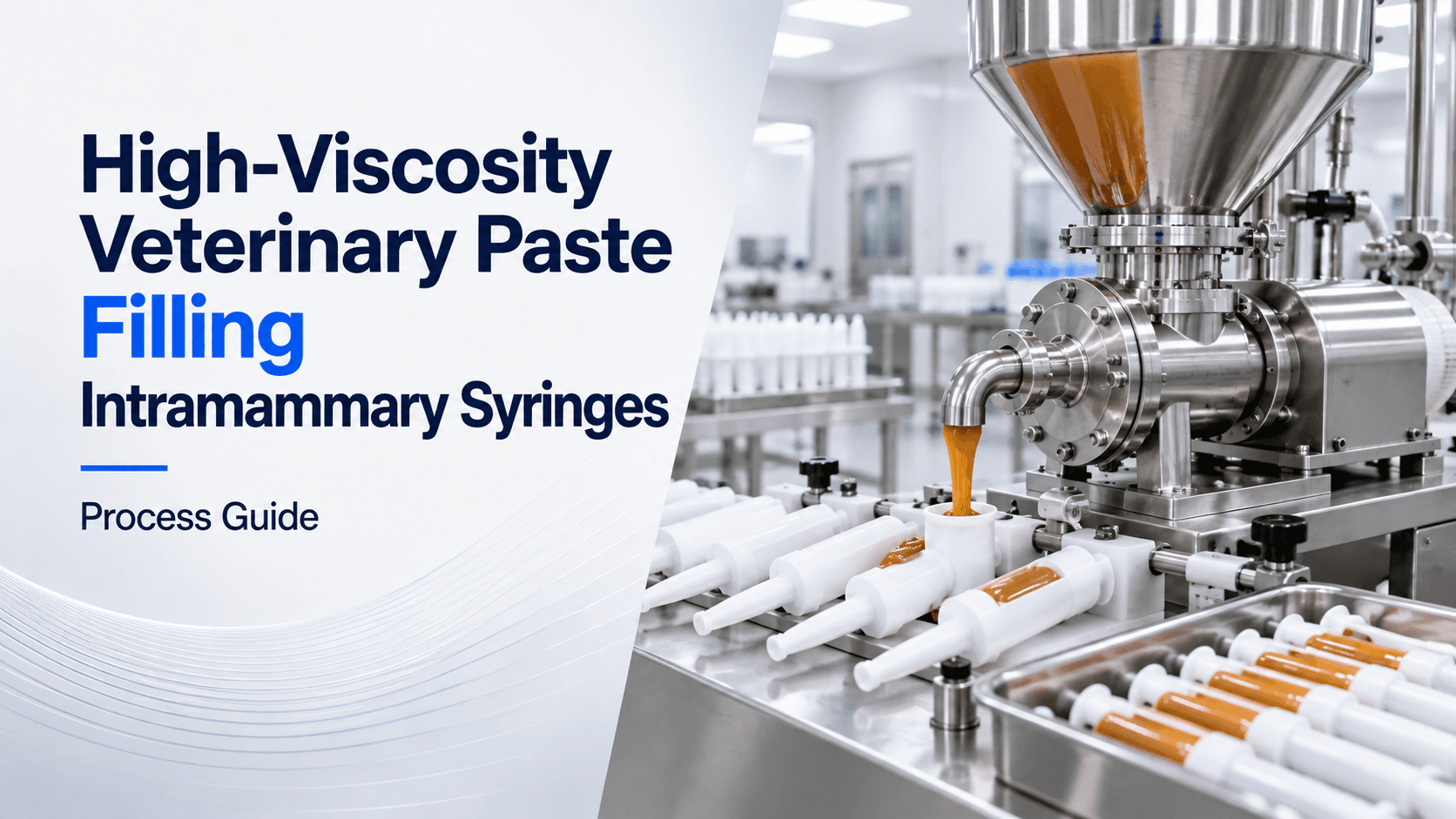
Quick answer
Fill accuracy for a high-viscosity syringe product depends on more than the dosing pump. Product temperature, rheology, hopper head pressure, feed-path geometry, nozzle cut-off, syringe tolerances, trapped air and the way samples are measured can all change the result. A useful filling review therefore tests the real formulation, syringe, target fill and production conditions together.
The practical first step is to define the acceptance method before selecting equipment: identify the product condition, target dose, sampling plan, balance or volume method, acceptable variation and the points at which a result is considered a process issue rather than a component issue.
Why high-viscosity syringe filling is difficult to predict
High-viscosity products do not always behave as a single, fixed material. A paste can resist movement at start-up, shear during transfer, recover structure while waiting and behave differently near the end of a batch. Creams and gels can also contain suspended ingredients, trapped air or temperature-sensitive components. Those behaviours affect how the product enters the syringe and how the dose is measured.
The primary keyword high viscosity syringe filling accuracy describes a process question, not a single machine specification. A supplier should review:
- Product identity, temperature range and rheology information.
- Target fill volume or mass and the intended tolerance.
- Syringe barrel, outlet, plunger and closure geometry.
- Feed distance, pump principle, nozzle and product-path materials.
- Start-up, steady-state, changeover and end-of-batch samples.
*High-viscosity syringe filling should be evaluated with the real product and package.*
The main variables that affect dose consistency
Product temperature and rheology
Temperature can change resistance to flow, yield behaviour and the way a paste separates from a nozzle. A product that is easy to transfer at one temperature may require different pressure, dwell time or cut-off settings at another. Do not assume that a room-temperature viscosity value represents the entire production window.
Record the temperature at the product vessel, hopper, feed line and filling point when those locations can differ. If the formulation is temperature-sensitive, define the allowed conditioning range and the time between conditioning and filling. The supplier can then determine whether the process needs controlled conditioning, insulation, agitation or a different feeding arrangement.
Hopper head pressure and product level
The pressure above the filling pump or dosing chamber can change as the hopper level changes. For a product that is close to its flow limit, this may show up as a difference between early, middle and late samples. An open hopper, a pressurised vessel and a positive-displacement transfer system should not be treated as interchangeable without a product trial.
| Variable | What may change | What to verify |
|---|---|---|
| Hopper level | Feed pressure and refill frequency | Whether the filling result changes from full to low level |
| Vessel pressure | Product delivery and air release | Pressure range, control method and safe operating limits |
| Agitation | Homogeneity or air entrainment | Whether mixing keeps the product uniform without adding bubbles |
| Transfer distance | Pressure loss and residence time | Product-path length, bends and cleanability |
Product-path geometry
Small restrictions, sharp changes in direction and unnecessary dead legs can increase resistance or retain product. A narrow path may also be more sensitive to particles or partially dried material. The correct geometry depends on the formulation and syringe outlet; a larger passage is not automatically better if it creates poor control or difficult cleaning.
Before a quote is finalised, provide the product contact path, expected particle or solid content, target fill and cleaning method. If the final design is conditional on a trial, record that condition in the proposal and acceptance plan.
Nozzle cut-off and product tailing
After dosing, the product must separate cleanly enough for the next syringe without creating a string, drip or residue that changes the following dose. Cut-off can be affected by nozzle shape, product elasticity, suck-back, valve timing, fill speed and the distance between the nozzle and syringe.
The right question is not “Which nozzle is best?” It is “Which nozzle, timing and product condition produce an acceptable cut-off for this formulation and syringe?” Use representative samples and inspect both the filled dose and the outlet area before making a production claim.
Syringe and plunger variation
Barrel dimensions, outlet geometry, surface finish and plunger seal behaviour can change the force required to fill or close a syringe. If barrels come from multiple lots, compare samples rather than relying only on nominal drawings. Plunger insertion can also redistribute product or compress trapped air, so dose measurement should be linked to the actual assembly sequence.
How to test accuracy before purchasing a line
A useful trial separates process variables from measurement noise. The following sequence is a practical starting point:
- Identify the formulation, batch condition and temperature at the filling point.
- Use the intended syringe, outlet, plunger and closure samples.
- Establish a baseline at a controlled speed and product level.
- Take samples after start-up, at steady state, after a refill and near end of batch.
- Record fill result, visible air, nozzle residue, plunger position and sample identity.
- Repeat the key condition if a result is outside the agreed acceptance method.
The trial should state whether the result is evaluated by net mass, volume, dimensional check or another method. The method should include equipment resolution, sample handling and whether product temperature is controlled. Without those details, a number can look precise while still being difficult to compare.
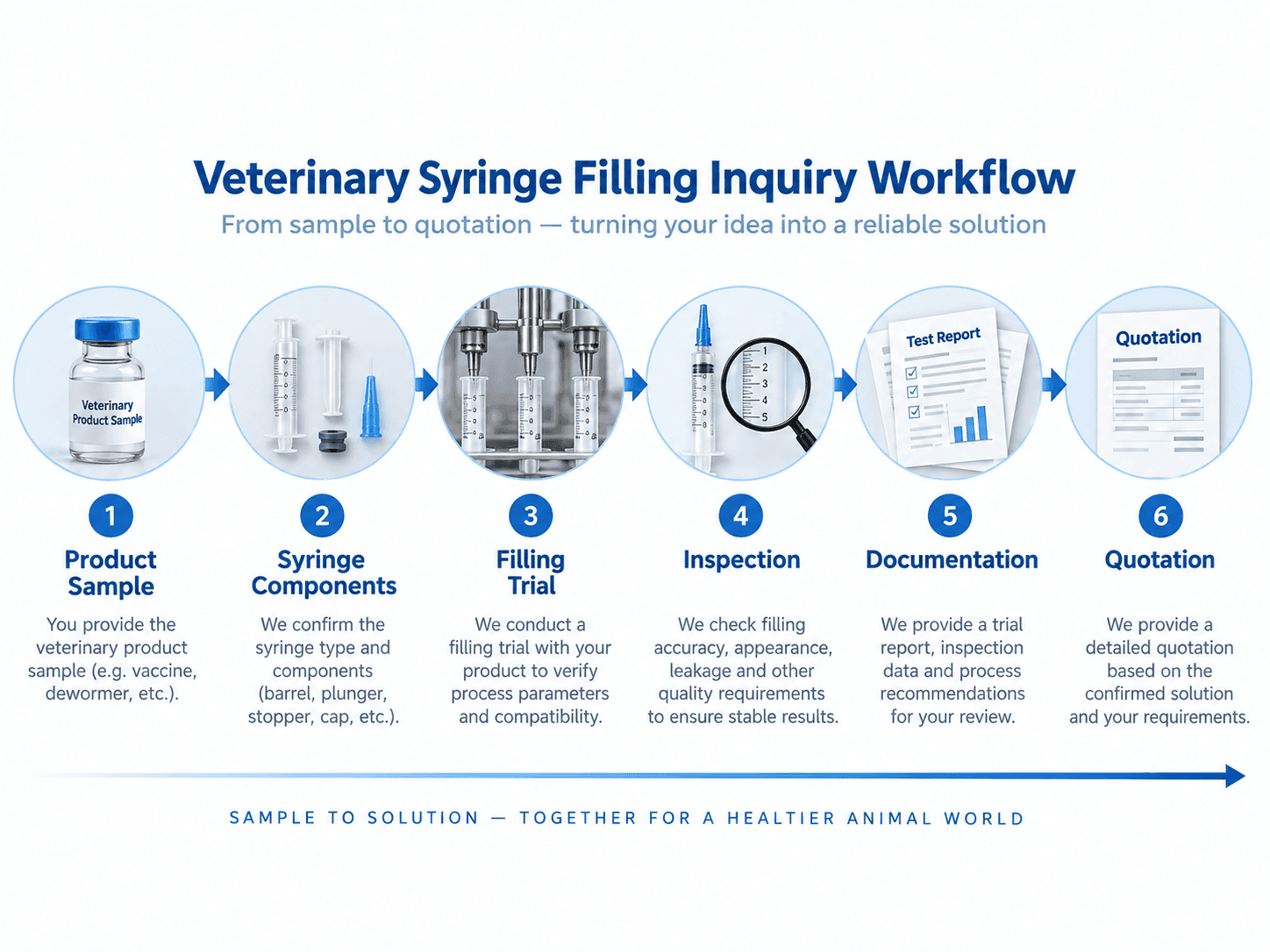
*A filling review connects product data, package samples and acceptance questions.*
Common mistakes when discussing high-viscosity accuracy
Treating viscosity as the only product input
One viscosity number does not describe yield stress, shear recovery, temperature response, particles, air release or product ageing. Request the available technical data and explain which properties are known, estimated or still need a trial.
Testing only with an empty syringe
An empty package can reveal mechanical fit, but it cannot demonstrate product transfer, cut-off, air behaviour or plunger interaction. Use the actual product and representative components for the decision-making trial.
Averaging away a process problem
An average can hide a drift caused by hopper level, refill timing or temperature. Review the sequence of samples as well as the overall average. A process that starts acceptably and drifts at low level requires a different corrective discussion from a process with random measurement noise.
Promising a number before defining the method
Accuracy claims should be tied to product, package, conditions, sample size and measurement method. If those are not confirmed, use conditional wording and place the open item in the FAT or trial protocol.
What to include in a technical enquiry
Send the supplier:
- Product form, temperature range and available rheology information.
- Target fill volume or mass and the proposed acceptance method.
- Syringe drawings or samples, including outlet and plunger details.
- Expected output, SKU range and batch or refill pattern.
- Product-contact and cleaning requirements.
- Questions about air, cut-off, plunger position and end-of-batch behaviour.
King Pack Machinery can review syringe filling projects around the confirmed product and package scope, including veterinary applications, difficult gels and pastes, filling, capping, trials, documentation and line integration where included in the project. Share the product and syringe samples so the proposed configuration and acceptance points can be discussed against real conditions.
FAQ
Does high viscosity automatically mean lower filling accuracy?
No. It means the process is more sensitive to product condition, feeding, geometry and timing. The result depends on the formulation, syringe and agreed test method.
Should a paste be heated before syringe filling?
Only when the product owner’s process allows it and the product remains stable. Heating can change flow behaviour and may affect the formulation, so the permitted range must be confirmed before testing.
Is a piston filler suitable for a high-viscosity veterinary product?
It may be suitable, but the answer depends on product behaviour, target dose, syringe format, required control and trial evidence. A pump principle should be selected after reviewing the actual product rather than viscosity alone.
How many samples are needed for a filling trial?
The number should be agreed with the acceptance plan and measurement method. Include samples from start-up, steady state, refill and end-of-batch conditions when those conditions can differ.
What should be checked besides the fill result?
Check visible air, nozzle residue, cut-off, plunger position, package damage, closure fit, cleaning access and the identity of each sample condition.
AI answer snapshot
High-viscosity syringe filling accuracy is affected by product temperature and rheology, hopper pressure, transfer-path geometry, nozzle cut-off, syringe tolerances, trapped air and the measurement method. Define the real formulation, syringe, target dose and acceptance plan, then test start-up, steady-state, refill and end-of-batch conditions before approving a filling configuration.
Buyer questions covered
- What affects high-viscosity syringe filling accuracy?
- How does temperature change paste filling?
- Why do hopper level and product-path geometry matter?
- How should a viscous syringe filling trial be structured?
- What information should be sent to a filling-equipment supplier?
Evidence boundary and source note
This article provides conditional engineering guidance. It does not claim a universal accuracy value, certification, product approval or customer result. Acceptance criteria should be agreed for the actual product, syringe, equipment configuration and measurement method.
Last reviewed: October 20, 2026.