
Introduction
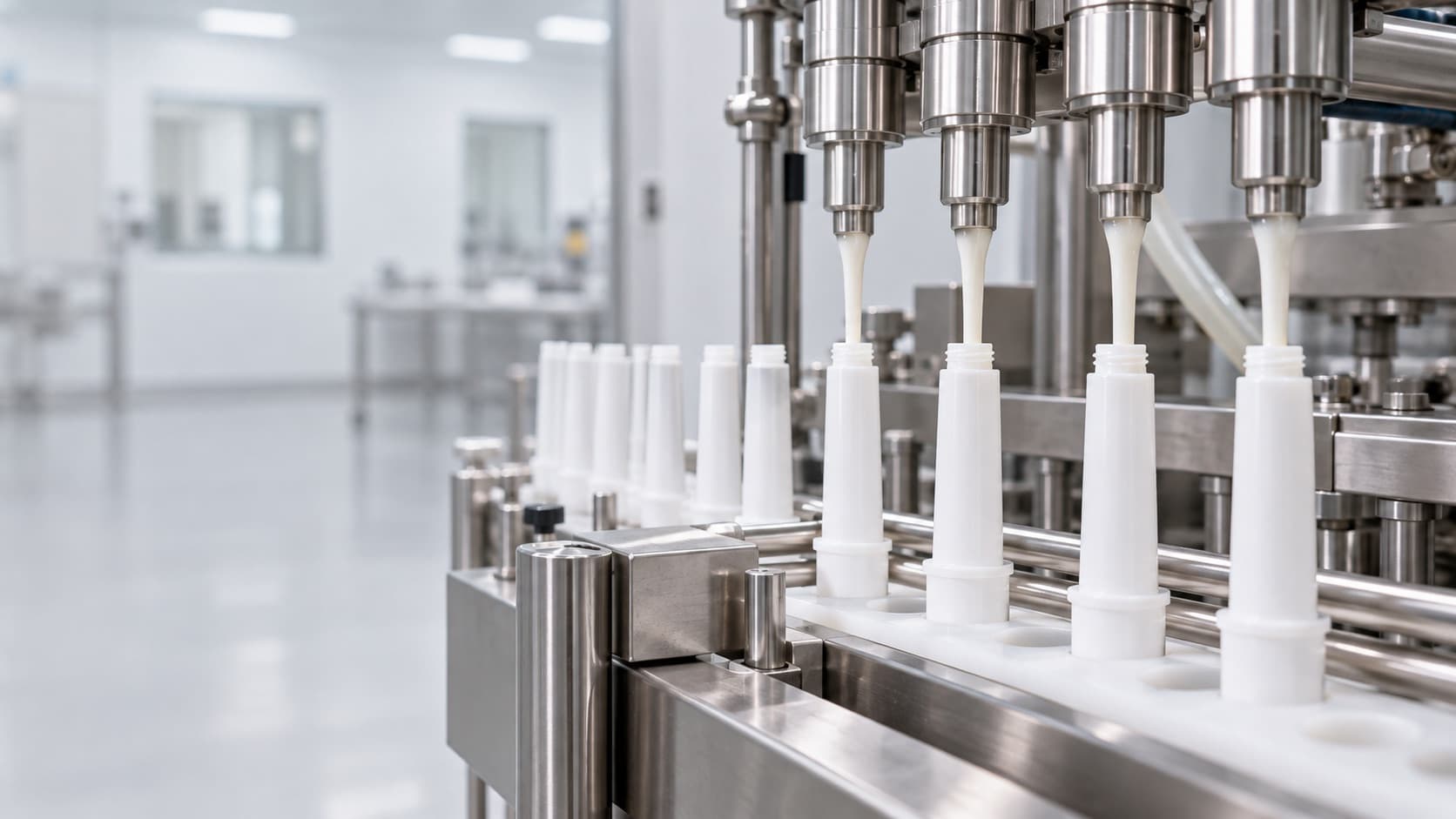
In intramammary filling, viscosity, trapped air, and cap placement are three manifestations of the same problem: the product does not behave like an ideal liquid.A well-flowing slurry may foam as it falls, retaining air on the shoulder of the applicator, and pushing the cap off its seat.If these three effects are not controlled, the dose varies and the seal fails even if the machine is properly adjusted.
This article explains how rheology, air and seal are related, what checks should be done online and how deviations are corrected without changing the machine.It is aimed at process and quality managers who already have a line in operation or are about to validate it.

*Bubble trapped in the shoulder of an intramammary applicator.*
Why rheology rules the fillingintramammary
Intramammary products are usually suspensions or emulsions with non-Newtonian behavior: their apparent viscosity depends on shear rate and time.This means that the same product can flow differently depending on how it is pushed.
When the nozzle dispenses quickly, the product is sheared and the apparent viscosity drops;When it stops, the viscosity rises and the product adheres to the wall.This repeated cycle explains why the first unit of a shift weighs differently than the hundredth unit.
Temperature adds another variable.In warehouses without air conditioning, the viscosity changes between the morning and afternoon shifts, and the dose shifts if the dosing time is fixed.
What to measure viscosity and what not
There is no need to characterize the product as in a rheology laboratory to operate a line.It is enough to measure the apparent viscosity under the process conditions and know its sensitivity to temperature and shear.
What is not useful is to settle for a qualitative description."It's thick" does not allow you to adjust a mouthpiece or predict a dose.A measured value, with the indicated instrument and temperature, yes.
It is also advisable to record the observed behavior: if the product forms threads when cutting, if it drips, if it adheres to the wall or if it settles.These signs explain failures that the viscosity figure does not capture.
Trapped air: where it is formed
Air enters the product at three points: the hopper, the nozzle and the body of the applicator.In the hopper, due to excessive agitation or turbulent filling.In the nozzle, due to a free fall that drags air.In the body, because the filling profile does not allow air to escape through the intended opening.
Each point has its correction.In the hopper, reduce agitation or change the feeding system.In the mouthpiece, submerge it or bring it close to the bottom.On the body, adjust the filling profile and speed.
The common mistake is to treat the symptom at the final inspection.A bubble that is detected at the end has already traveled through the entire line and probably affected the closure.

*Variation of apparent viscosity with process temperature.*
How air is detected in line
Visual detection with grazing light is the simplest and detects large bubbles.Computer vision can detect patterns, but it needs training with real samples.The weighing comparison—unit with bubble versus unit without bubble—is the most objective method.
In production, it is advisable to combine a sample check with a record of rejections for cause.If bubble rejections increase, the problem is in the filling or in the product, not in the inspection.
The effect of air on capping
A cap is placed on a surface that must be clean and at the expected pressure.If the product pushes from the inside, the lid sits poorly;If there is compressed air in the chamber, the pressure is later released and the lid can move during transport.
This is why air control is not an aesthetic requirement: it is a functional requirement of the closure.A bubble applicator can pass the retention test at the factory and fail in shipping.
Five online checks
| Check | What it detects | How to detectago | Frequency | Criteria |
|---|---|---|---|---|
| Dose by weighing | Volume variation | Precision scale | Start of shift andsampling | Range defined by quality |
| Grazing light inspection | Visible bubbles | Sample on dark background | Every certain number ofunits | No shoulder bubble |
| Nozzle pressure | Drip or foam | Manometer or sensor | Continuous | Within rangeadjusted |
| Product temperature | Viscosity change | Hopper probe | Continuous | Process range |
| Retention oflid | Poor closure | Sampling test | According to quality plan | Agreed criteria |
How each is correcteddetour
If the dose varies with temperature, the solution is to stabilize the temperature or compensate for the dosing time.If the problem is air, the nozzle and profile are adjusted.If the lid does not seat, check the cleanliness of the seat and the insertion pressure.
No correction is universal.A nozzle change that resolves the foam can make the dripping worse.Therefore, corrections are tested one at a time and recorded.
What to document in the process record
The record should include product temperature, nozzle pressure, average dose and dispersion, cause rejections, and cap retention result.With this data, a deviation is investigated in minutes.
Without registration, the investigation starts from scratch each time and depends on the operator's memory.
The hopper: agitation, level and residence time
The hopper is the first place where the product changes.If the agitation is excessive, add air;If it is insufficient, the product is separated.The level also influences: a full hopper puts more pressure on the outlet and can increase the flow;an almost empty hopper favors the formation of vortices and entrains air.
Residence time matters when the product is a suspension.If it remains in the hopper for hours without agitation, the solids settle and the first unit of the shift has a different concentration.Time recording and intermittent agitation reduce this effect.
A useful practice is to define a minimum work level and a maximum residence time.When either of them is reached, it stops or recirculates.It is a simple rule that avoids heterogeneous batches.
What happens when the product sediments
Sedimentation is not always seen.The product may appear homogeneous on the surface and be concentrated in the background.The consequence is a dose with less active ingredient at the beginning of the shift and more at the end.
The verification is to take samples at different heights and compare.If there is a difference, the agitation is not enough or the residence time is too long.The solution may be a more efficient agitator, recirculation, or a smaller batch size.
In products with abrasive solids, sedimentation also wears out pumps and nozzles.This wear appears as a slow variation in the dose that is not explained by temperature.
The filling profile: three phases
A useful filling profile has three phases: a rapid opening to fill the majority of the volume, a slow phase for finishing and a controlled closing to cut the thread.Each phase has its function and its risk.
The rapid phase saves time, but can generate turbulence and foam.The slow phase reduces air, but lengthens the cycle.The closure must cut without dripping and without leaving a thread that contaminates the exterior of the applicator.
The adjustment is made with the actual product and is verified with the dose and with the inspection of bubbles.A profile that works with a light product may fail with a viscous one, because the response time changes.
How the lid influences the trapped air
The lid not only closes: it also defines the air chamber.If the design leaves dead volume between the product and the cap, that air is compressed during capping and expanded afterward.The result is a lid that looks correct and moves with transport.
The solution may be to adjust the fill level, change the geometry of the lid or modify the insertion pressure.In some cases, a vented lid solves the problem;in others, it is the filling that must change.
What you learn from a week's rejections
Rejections grouped by cause tell a story.If bubbles predominate, the problem is with the filling or the hopper.If displaced lids predominate, the problem is in the closure or internal pressure.If short doses predominate, the problem is in the nozzle or the viscosity.
This weekly analysis guides the corrections better than any specific inspection.And if it is compared with the parameter record, it allows causes and effects to be correlated.
How the nozzle is adjusted according to viscosity
The nozzle must adapt to the viscosity and flow rate.For light products, a larger orifice and progressive opening reduce turbulence.For viscous products, a larger hole also helps, but the cut must be cleaner to avoid threads.
The diameter is not the only parameter: length, angle and material influence.A nozzle that is too long adds pressure loss;one that is too short does not reach the bottom of the applicator.
The adjustment is validated with the dose and with the drip inspection.If the nozzle drips after cutting, the problem may be the valve closure, not the diameter.
What role does cleaning between products play?
A residue of previous product changes the effective viscosity and can react with the new one.It may also partially clog the nozzle and result in short doses that are attributed to the current product.
Cleaning between products should include nozzles, chutes and hopper, and be verified before first filling.Insufficient rinsing leaves a film that acts as a contaminant and lubricant.
What to ask the supplier about the product
Before defining the line, it is worth asking: what viscosity range does the system support? How does it behave with solids? What maximum temperature does the product support? How is the circuit cleaned between formulations?and what happens if the product changes batch?
The answers define the limits of the equipment and avoid expecting behavior that the machine cannot provide.
What to do when the supplier changes the formulation
A change in formulation can come without warning: a different excipient, more solids, another preservative or a pH adjustment.The viscosity of the certificate may coincide at one point and the online behavior may be different: what changes is the curve, not the number.Therefore, it is not advisable to accept a single value as proof of equivalence between two versions of the product.
Request in writing the summary of the change, the viscosity curve in the process temperature range, the solids content, the expected variability between batches, the maximum recommended temperature and the cleaning behavior.With this data it is decided whether a documented adjustment is sufficient or if an online test is necessary before production.
The test is done against a reference.Keep a sample of the previous batch and compare both formulations with the same parameters, measuring dose, bubbles and cap retention.Do not modify the profile during the comparison, because you would lose the reference.
Depending on the result, the quality plan decides whether to repeat the dose and closure validation.King Pack can review the samples and document in writing the proposed range of parameters for the new formulation.
How to investigate a sudden increase in bubble rejects
A sudden increase is one that appears within a shift, not the trend that sets in over several weeks.Before touching the machine, confirm that the change is real: different inspection lighting or more rigorously applied criteria have the same effect as a filling failure.Ask what coincided with the change: new batch, cleaning, mechanical intervention or temperature variation in the house.
Then, stratify.Separate rejects by nozzle, by station and by bubble position within the applicator.A bubble on the shoulder points to air incorporated into the product;one at the bottom, to a profile that closes before the air escapes.If they are concentrated in a single nozzle, the problem is local;If they affect all of them, it is from the product or the food.
Isolate the variable with a short batch of sample retained from the previous batch and the same parameters.If the rejections disappear, the origin is in the product;if they are maintained, in the machine or in the adjustment.Check in parallel the valve closure, the minimum hopper level and the product temperature.
Validate the correction with a predefined sampling and record the time, batch and modified parameter.Without this record, a relapse is investigated again from scratch.
Frequent errors
- Adjust the dose without measuring the temperature. The adjustment works in the morning and fails in the afternoon.
- Attribute the bubble to the inspection. The bubble forms earlier, in thefilling.
- Change the nozzle without testing the drip. One problem is solved and another is created.
- Ignore the cleaning of the lid seat. The closure fails due to residue, not due to force.
- Confusing viscosity with density. They are different properties and affect differentlydifferent.
- Do not record rejections for cause. The total does not say what to correct.
How King Pack supports
King Pack reviews product performance against customer samples and adjusts the nozzle, filling profile and capping station accordingly.The scope may include defining online checks, recording parameters, and training personnel.Capacities and limits are confirmed in writing for each formulation.
Frequently Asked Questions
Can a foam product be filled without antifoam? Possible with submerged nozzle and slow profile, but effectiveness depends on surface tension.Testing with the actual product is the only way to confirm this.
What viscosity is too high for a line? There is no universal limit.It depends on the dosing system and the diameter of the nozzle.It is determined with the sample and the specific equipment.
Does the room temperature affect the dose? Yes, if the product is sensitive.It is advisable to measure and, if necessary, air-condition or compensate.
How is lid retention checked in production? With a sample test and an agreed criterion.Frequency depends on volume and risk.
Can trapped air be removed with vacuum? Vacuum helps in the hopper, but is not a substitute for nozzle and profile design.It is a complementary measure.
What to do if the dose varies between shifts? Compare temperature, batch and nozzle setting.The recording of parameters allows the cause to be isolated.
Does a product change require requalification of the line? Does it require reviewing the parameters and, probably, repeating the dose and closure tests.The scope is defined by the quality plan.
Related technical resources
To expand the specification, review the intramammary syringe filling line and the specification of a syringe linepreloaded.These resources help you refine samples, scope, and acceptance criteria before requesting a proposal.

*Nozzle with anti-drip cutout for viscous product.*
Conclusion
TheViscosity, air and closure form a chain: rheology conditions the filling, the filling conditions the air and the air conditions the cap.Controlling them with five in-line checks and a parameter log is more effective than correcting in the final inspection.
CTA
If your product foams or the lid does not hold as expected, send samples and process parameters.The King Pack team can review the nozzle, fill profile and capping against measurable criteria.Request a technical review.