
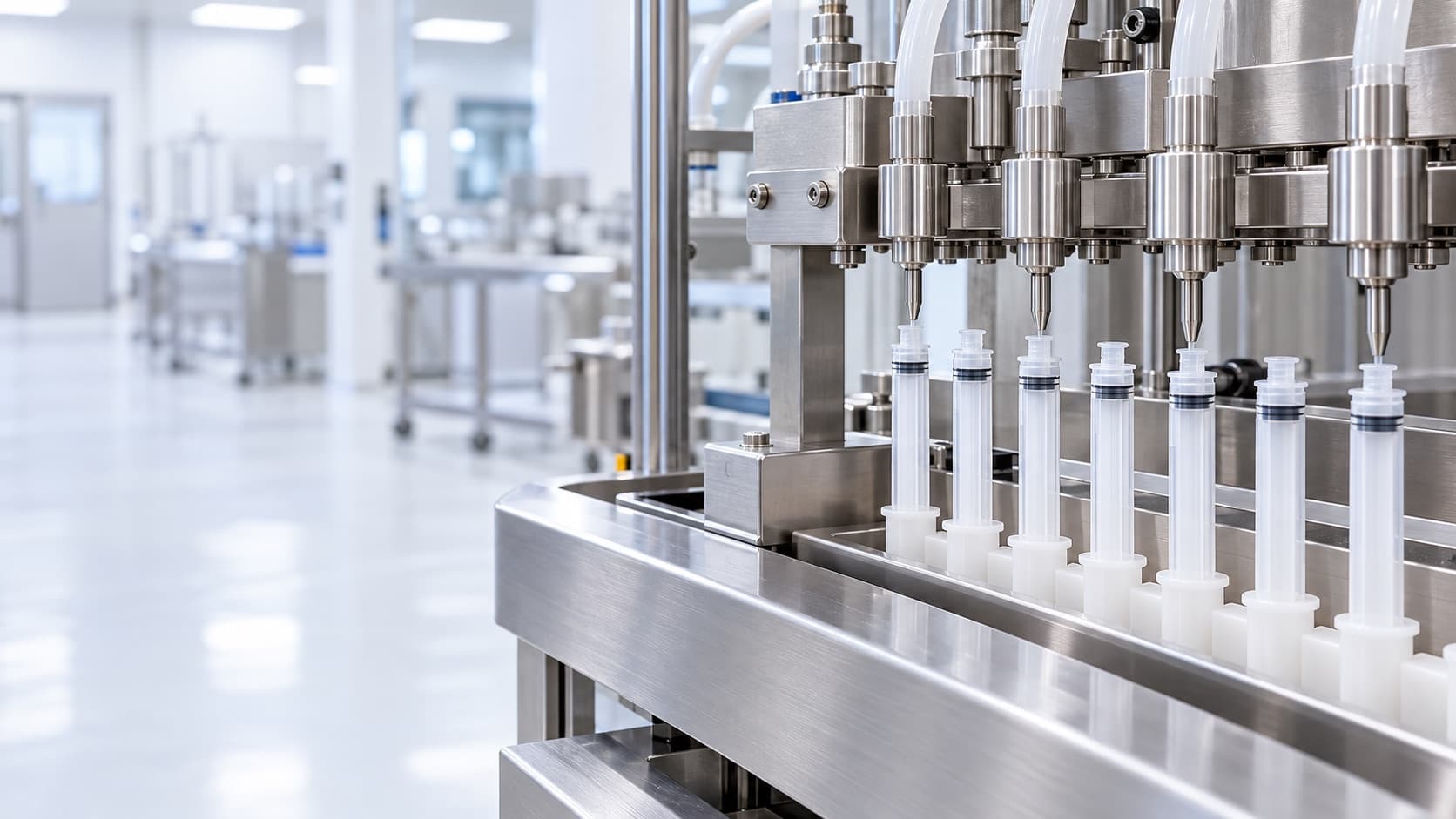
Introduction
In the filling of veterinary syringes, the product is lost at seven points: priming, dead volume of the circuit, dripping from the nozzle, rejection by dose, rejection by closure, product carried over during cleaning and spillage during handling.Most of these points do not appear in the production report, and that is why the loss is attributed to "normal losses" when in reality it has identifiable causes.
This article proposes a loss map, an order of intervention and a way to measure each point.It is aimed at production managers who want to reduce product consumption without compromising dosage or closure.

*Product loss points along the filling line.*
Why shrinkage is measuredbad
Shrinkage is usually calculated as the difference between the delivered product and the packaged product.This global figure mixes different causes and does not say what to correct.
To manage it, at least three categories must be separated: start-up loss (priming and purging), process loss (drip, dead volume, spill) and rejection loss (dose and closure).Each one has a different action.
Without this separation, the investment is directed to the wrong point.A new nozzle is purchased when the problem is in the priming, or the dose is adjusted when the problem is in the closure.
Priming and purging
The priming fills the circuit and expels the air.The product that comes out during priming is usually discarded, and its volume depends on the length of the circuit and the diameter of the ducts.
Reducing priming starts with the design: short ducts, tight diameters and a nozzle close to the valve.A long circuit with elbows retains more air and requires more purging.
Purge after a stop also generates loss.If the line stops with product in the nozzle, the product may dry out or drip.A shutdown procedure that empties the nozzle reduces loss.
The dead volume
The dead volume is the product left in the circuit at the end of the batch.It is not packaged and is usually discarded with cleaning.
Its magnitude depends on the design and the dose.In small doses, the dead volume can represent a high percentage of the product used.
Recovery is possible in some cases: if the product is stable and the circuit allows it to be emptied, it can be recovered and reused in the same batch.This decision must be approved by quality and documented.

*Product retained in the circuit after emptying.*
Drip from the nozzle
Drip is product that falls outside thecontainer.It can occur by cutting off the stream, moving the nozzle, or stopping the line.
A small, constant drip becomes a significant loss throughout the shift, contaminating the exterior of the applicator and machine.
Solutions include shut-off valves, recoil nozzles, and fill profile adjustment.Verification is visual and by weight of the collection tray.
Rejections by dose and by closure
Dose rejections include out-of-range units and bubble units.Rejections due to closure include poorly seated lids and leaks.
Each rejection consumes product and packaging.Reducing them requires attacking the cause: the mouthpiece and the dose profile;the pressure and seat for closure.
Registration by cause is essential.Without it, rejection is treated as a number and not a problem.
Losses in cleaning and handling
Cleaning drags product from the circuit and the hopper.A procedure that recovers product before cleaning reduces loss.
Handling includes spills when loading the hopper, changing containers, and moving trays.They are small losses per event but frequent.
Table of losses and actions
| Loss point | Cause | How tomeasures | Action | Responsible |
|---|---|---|---|---|
| Priming | Long circuit and air | Discarded volume | Shorten circuit andpurge with judgment | Engineering |
| Dead volume | Circuit design | Retained product | Redesign or recover withapproval | Engineering and quality |
| Drip | Cutting and nozzle | Tray weight | Valve andprofile | Production |
| Rejection by dose | Nozzle and profile | Registration by cause | Adjustment andverification | Production |
| Rejection due to closure | Pressure and seat | Registration for cause | Adjustment ofplugging | Quality |
| Cleaning | Product in circuit | Rinse volume | Recover beforeclean | Production |
| Handling | Spill | Observation | Training and toolingload | Production |
Intervention order
First it is measured, then it is prioritized.The loss that weighs the most is not always the most visible: the drip is visible, the dead volume is not.
The recommended order is: rejections by cause, dead volume, priming and drip.Rejections are usually the most costly loss because they consume product and packaging.
Each intervention must be measured before and after with the same criteria.Without comparison, improvement cannot be demonstrated.
How each loss is measured
Priming is measured by picking up discarded product.The dead volume, emptying the circuit and measuring.The drip, weighing the collection tray over a known period.
Rejections are measured by count and by cause.Cleaning, by rinse volume and by water analysis.
The sum of the measured losses must approximate the global loss.If it does not match, there is an unidentified leak.
Control of product level in the hopper
The hopper feeds by gravity, so the height of liquid above the inlet acts as pressure and changes with the level.A high level and a low level do not deliver the same flow rate, and that difference shifts the dose without anyone having touched the adjustment.The effect is confused with a worn nozzle.
The control begins by setting a working band: a minimum above the inlet, which avoids sucking in air, and a maximum with room to stir without overflow.The band is marked on the display or set on the sensor, along with the volume of each mark.Replenishing in small and frequent quantities avoids the pressure surge of a large load, which drags air.
The useful check is to compare the weight of the dose with the hopper full, at half load and at the minimum admissible.If the difference is appreciable, the process is level sensitive and should be corrected before continuing.You must also verify that the replacement does not generate bubbles and let the product rest before resuming.
At stops, keeping the level above the inlet prevents the product from drying out in the duct and the first dose coming out short.It is not the same as leaving accumulated product at the bottom: that volume is emptied and recorded as closing loss.
Criteria for recovering product
Recovering is not returning everything that is left over to the hopper.It is a decision with conditions and with registration.It is advisable to separate three streams: purge product, product retained in the circuit when closing the batch, and product removed from rejected units.Each one has a different destiny and none mixes with the others.
The minimum criteria are three.Identity: same product and same lot, no mixing.Integrity: No particles, no foam and no rinse water, within approved time and temperature.Contact surface: only clean and identified containers.If one of the three fails, the product is discarded and recorded as a loss.
The rule of thumb is simple: if you cannot prove what the product is, where it came from, and how long it was gone, it is not recovered.The burden of proof falls on the person recovering, not on quality, which only approves what is already documented.
When approved, the recovery is noted with quantity, batch, origin, destination, time and party responsible.If the product returns to the hopper, it is added before stabilizing the level and the weight of the dose is checked afterwards, because a mixture at a different temperature changes the viscosity and flow rate.
Design of the collection tray
The tray performs two functions: containing the drip and allowing it to be measured.A tray that only contains turns loss into invisible waste;one that can be weighed or the volume read makes it comparable data between shifts and between products.
The useful design has a bottom inclined towards a pouring point, edges that cover the path of the nozzle, material compatible with the product and with the cleaning agent, and sufficient capacity for the interval between pouring.The cover reduces evaporation and contamination.The emptying point must be accessible without disassembling the nozzle.
The most common errors are the flat tray, where the product spreads, dries and can no longer be recovered;the tray without cover, which evaporates and concentrates;the one that overflows when moving the machine;and the one that is not identified, which ends up mixed with the cleaning water and loses the measurement.
In use, the volume is weighed or read at the beginning and end of a known period, the interval is noted and it is emptied into an identified container.If the content is to be reused, recovery criteria apply;If not, it is discarded as waste and recorded the same.
What to do with the rejected product
A unit rejected per dose contains product that can no longer return to the circuit through the normal route: the container is open, the product has been exposed and its history cannot be demonstrated.Rejection by closing adds the risk of particles from the lid and contamination from the exterior of the unit.
The procedure is to segregate by cause in identified containers, do not mix causes or batches, record quantity and time, and decide the destination as approved.Product is not returned to the hopper without written authorization and syringes are not emptied onto the tray, because the traceability of the two streams is lost.
It is worth distinguishing rejection detected before closure from that detected after.The first, if withdrawn in a controlled manner, can enter recovery.The second has passed through the sealer and its product is discarded, because there is no way to guarantee that there are no particles or leaks.
The verification is arithmetic: the sum of rejected units times their nominal volume must approximate the volume withdrawn.If it does not match, there is spillage, evaporation or counting error.Record by cause shows whether the rejection is concentrated in a shift, a nozzle, or a product.
Shrinkage and lot reconciliation
Reconciliation is proof that the loss map is complete.When closing the batch, the delivered product must be divided between the accepted packaging, the rejection, the measured losses and what remains in the hopper, circuit and tray.What does not fit is the unidentified loss.
For what it's worth, the residual inventory is measured and not estimated: level in hopper, emptying of the circuit, contents of the tray and weight of the containers.You have to use a single unit;If weight and volume are mixed, the density is applied and recorded, because otherwise the difference appears where it is not.
The reconciliation is done by batch, not by shift, when the batch crosses shifts.The cut by turn distributes the same loss into two figures and hides the origin.When the batch is shorter than the shift, it is reconciled by batch and then added by period.
It is advisable to establish an admissible difference and document it.Below, it is accepted and noted;Above, it is investigated before closing the lot.Investigating means reviewing the period records, not repeating the calculation with the same data.
Avoid evaporation and drying in the nozzle
Between cycles, the tip of the nozzle is exposed to the air.If the product contains volatiles, if the temperature is high or if the stop is prolonged, a crust or a thread of product forms at the tip that modifies the flow rate of the next dose.
The consequences are recorded as rejection without the cause appearing: the first unit after the stop comes out short, the nozzle drips and the crust detaches and travels to the container.A rejection concentrated at the start of each series points to this mechanism and not to the dispenser.
The measures are procedural and design.A holding position that keeps the tip on the tray or inside a cover;a short, defined purge before resuming;less exposure time;control of product and environmental temperature;and cleaning the tip with written instructions, without blowing compressed air into the circuit.
The check consists of comparing the weight of the first dose after a stop with the stable dose, and inspecting the tip at the end of the shift.Recording the duration of the stops helps: a scab that always appears at the same time has a specific and correctable cause.
Frequent errors
- Measure only the global loss. It does not say what to correct.
- Attack the drip and forget the dead volume. The invisible loss is usuallymajor.
- Recover product without approval. Recovery must be documented.
- Do not record rejections for cause. The total does not guide the action.
- Change nozzle without measuring. One point is resolved and another is created.
- Do not compare before and after. Improvement is not demonstrated.
How King Pack supports
King Pack can review the loss map with customer data and propose improvements to the circuit, nozzle and procedure.The scope includes measurement in FAT and training of personnel.Capacities and limits are confirmed in writing for each configuration.
Frequently Asked Questions
Which loss is the most significant? Depends on the product and dosage.In small doses, the dead volume;in expensive products, rejection.
Can the product be recovered from dead volume? Yes, if it is stable and quality approves it.It must be documented and not mixed with another batch.
How is priming reduced? With a shorter circuit and with a purge procedure adjusted to the actual volume.
Is dripping eliminated with a valve? It is reduced, but also depends on the filling profile and the nozzle.
Is theIs shrinkage measured per shift? Yes, and it should be broken down by cause.A global data does not allow management.
Does recovery affect validation? It may affect it.The decision must be included in the quality plan.
What to do if the loss does not match the sum? Investigate the difference: there may be spillage, evaporation or a registration error.
How often is the hopper level checked? At the beginning of each series and at each replacement.The band is checked with the weight of the dose, not just with the display.
Is it advisable to cover the collection tray? Yes, if the product evaporates or may become contaminated.The cover also prevents the cleaning water from distorting the measurement.
Related Technical Resources
For further specification, please review prefilled syringe filling and capping series and guide to choosing a machineveterinary syringe filler.These resources help you refine samples, scope, and acceptance criteria before requesting a proposal.

*Product collected in the drip tray of the nozzle.*
Conclusion
Shrinkagein syringe filling is reduced when it is separated by causes and each one is measured.Priming, dead volume, dripping and rejections have different actions and different responsible parties.Measuring before and after turns the improvement into data, not an impression.
CTA
If you want to reduce the loss of your line, send consumption and rejection data.The King Pack team can review the loss map and propose measurable improvements.Request a technical review.