
Introduction
An intramammary filling test is representative when it reproduces the conditions that matter—product, packaging, tools, temperature and acceptance criteria—and when its results allow a decision to be made.If one of these elements is missing, the test becomes a demonstration: it impresses, but it does not inform.
This article describes how to design a useful test in five phases, what inputs to bring, how the criteria are set before starting, and what can and cannot be concluded at the end.It is intended for buyers who are going to evaluate a supplier or validate a configuration before purchasing.

*Test setup with product and containers identified by lot.*
What makes a representativetest
Representativeness does not depend on the size of the machine or the duration of the test.It depends on the variables that affect the result being present under the same conditions as in production.
These variables are at least five: the real product, the real container, the tooling to be used, the process temperature and the acceptance criterion.If anything is missing, the result is partial and must be declared as such.
There is a sixth variable that is forgotten: the operator.A test run by the engineer who designed the machine does not demonstrate that plant personnel can operate it.When possible, it is a good idea to have the test run by someone on the client's team.
The five inputs of a useful test
The first input is the product.A generic substitute is not useful if the viscosity, foam or sedimentation are different.When the actual product cannot be shipped, a substitute with equivalent performance must be agreed upon and the limitation documented.
The second is the packaging.Body, plunger and cap must be the final ones, not a catalog sample.The tolerances of the actual container determine the tooling and closure behavior.
The third is the tooling.The test must be carried out with the tooling that is going to be delivered or with one that is functionally identical.A provisional tooling only shows that the concept is possible.
The fourth is the temperature.The temperature of the product and the room must be defined, and maintained during the test.
The fifth is the acceptance criterion.It must be written before starting: what is measured, with what instrument and from what value it is considered acceptable.
Design in five phases
The preparation phase includes the definition of objectives, the selection of samples and the writing of the plan.It is the phase that saves the most time: a one-page plan avoids discussions later.
The assembly phase includes the installation of the tooling, the initial adjustment and the verification of services.In this phase it is checked that the machine is in good condition, not that it produces well.
The execution phase includes batches with product and data collection.It must be done with the complete sequence and with the same criteria for all samples.
The analysis phase compares the results with the criteria and classifies the deviations.It is not about justifying the results, but about understanding them.
The closing phase documents conclusions, actions and responsible parties.Without closure, the test is forgotten and the problems reappear in the facility.

*Execution of a batch with the complete filling and capping sequence.*
Table: plantest
| Phase | Input or activity | Registration | Criteriaacceptance | Responsible |
|---|---|---|---|---|
| Preparation | Objectives, samples, plan | Signed plan | Plan approved by bothparts | Quality |
| Assembly | Tooling, adjustment, services | Checklist | Machine inconditions | Engineering |
| Execution | Batches with real product | Data sheet | Dose and closure withinrange | Production |
| Analysis | Comparison with criteria | Report | Deviationsclassified | Quality |
| Closing | Conclusions and actions | Minutes | Actions with responsible anddate | Address |
Previous acceptance criteria
Dose criterion should include nominal value, tolerance and measurement method."Correct dose" is not a criterion;«dose within ±X % measured by weighing» is.
The closure criterion must include the test method, the sample and the retention value.If it is not agreed upon beforehand, the result is interpreted as appropriate.
It is also advisable to set process criteria: format change time, cleaning time and behavior when stopped.A test that only measures dose leaves out half the problem.
What to do if there is no real product
When the product cannot be shipped due to safety, transportation or quantity, there are three options: use a substitute with similar behavior, test at the customer's facility, or postpone the test.
The first option is the most common, but requires documenting the difference.A substitute with the same viscosity but different surface tension may not reproduce the foam.
The second is the most representative, but requires tools and personnel.The third is the most honest when there is no way to reproduce the conditions.
Logistics of sample shipment
Sample shipment has practical requirements: sufficient quantity for several batches, labeling per batch, temperature conditions and safety documentation.An incomplete shipment requires repeating the test.
It is also advisable to send lid and plunger samples in sufficient quantity for the closing tests.The retention test consumes samples and cannot be done with two units.
What can and cannot be concluded
A representative test allows you to conclude whether the configuration works with that product and that container under those conditions.It does not allow us to conclude that it will work with another product, with another batch or in another plant.
Nor does it allow us to conclude that the machine is reliable in the long term.Reliability is demonstrated with operation and maintenance, not with a batch of hours.
Declaring these limits does not weaken the result: it makes it credible and avoids expectations that are later not met.
The test record
The record must include date, product, batch, container, temperature, settings, results and observations.Observations are important: a noise, drip or vibration can explain a result that the table does not show.
It is advisable to keep samples of the units produced.In further discussion, the physical sample is worth more than any report.
How the test fixture is chosen
The test fixture must be the definitive one or, if not manufactured, a functionally equivalent one.Temporary tooling made to wider tolerances can cause a test to fail and production to fail.
If final tooling is not available, state this: the test demonstrates the concept, not the final configuration.This distinction must appear in the minutes.
The verification of the tooling includes checking that it holds the part, that it does not deform it, and that it allows filling and closing.A test with tooling that marks the part invalidates the closing result.
The temperature in the test: why it is controlled
The temperature affects the viscosity, the behavior of the plastic and the dosing speed.A test at room temperature may not represent either the morning or afternoon shift in a warehouse without air conditioning.
It is advisable to measure the temperature of the product and that of the room at the beginning and at the end of each batch.If they vary more than expected, the result is noted with that condition.
When the product must be kept hot, the test includes the residence time in the hopper and the effect on the dose.This data is what then allows the production procedure to be defined.
How the closure is evaluated in the test
The closure is evaluated with the agreed test: retention, tightness or both.The sample must be sufficient to repeat the test and to preserve reference units.
Visual inspection does not replace the test.A lid that appears well seated may fail the retention test, and a slightly displaced lid may meet the criterion if the retention force is sufficient.
The result is recorded per unit or per group, depending on the method.The important thing is that the criteria and the record allow comparison with the FAT and with the production.
How the format change is evaluated
If the line is going to produce more than one applicator, the test must include at least a complete format change, with the real time and the planned verifications.
The objective is not to break a record ofquickly, but rather to check that the procedure is viable and that the first piece comes out compliant.A change that requires lengthy manual adjustments may be acceptable in one format and not another.
The change record includes time, parts replaced, adjustments made, and the result of the first part.With this data, the impact on capacity can be estimated.
What to do with the results: decision matrix
At the end of the test, each criterion is classified as meets, meets conditions or does not meet.The classification must be explicit and shared by both parties.
If all criteria are met, you advance to the next milestone.If anyone meets the conditions, the action and the deadline are defined.If any do not comply, the cause is analyzed before deciding whether the configuration is viable.
The decision matrix avoids generic debate and turns the test into a management tool.
The role of the customer operator
When customer personnel participate in the test, they obtain information that the supplier cannot provide: ease of use, clarity of instructions andproblems that appear when operating without knowing the design.
This participation also prepares subsequent training.An operator who has seen the test better understands why a parameter is adjusted and what happens when it goes out of range.
Traceability and labeling of test samples
Every sample that enters the test must be identifiable without resorting to the memory of the person who sent it.The label includes product, batch, date of receipt and transport conditions, as well as an internal code that is repeated on the record sheet.The commercial name alone is not enough: two shipments of the same product may belong to batches with different behavior.
The units manufactured during the test require their own label.It records the batch code, the start time, the configuration used and, when the equipment allows it, the station of origin.If two configurations are compared, the identifier must distinguish them unambiguously.It is advisable to reserve a color or a prefix for the reference samples and store them separately.
The labeling is completed with the chain of custody: who handles the sample, where it is kept and for how long.That deadline is agreed upon before starting and is noted in the plan.At closing, it is verified that each label has its row in the data sheet.A sample without traceability illustrates a conversation, but does not support a decision.
If the test is interrupted or an auxiliary service fails
Before starting, it is worth defining what is considered an interruption and which auxiliary services are critical: compressed air, vacuum, cooling water, power or room air conditioning.A failure in any of them does not in itself invalidate the work performed, but requires it to be recorded with start time, duration and observed effect on the dose or closure.
The procedure is agreed upon in advance.The batch is stopped, the cut-off point is marked and the units produced before and after are separated.Upon resumption, the circuit is purged, parameters are checked, and transition units are discarded or evaluated separately.Mixing them with the rest introduces a doubt that no subsequent analysis resolves.The stop record includes the time, duration, and who detected it.
If the stoppage prevents completing the criteria matrix, you must decide whether to repeat the test, complete it in another session, or declare it partial.The decision is made with the available data and is written in the minutes.It is also important to distinguish whether the failure was in the equipment under test or in the client's installation, because the corrective action and the person responsible are different.
How to compare two configurations in the same session
When the decision is to choose between two tools, two dose adjustments or two closing parameters, comparing in the same session reduces the effect of variables that change from one day to the next: temperature, product batch and operator.The comparison needs a defined order.Toggling settings allows drift to be detected that would otherwise be attributed to the change.If the order is improvised, the comparison loses much of its value.
Everything other than the compared variable must remain the same: product and batch, packaging units, acceptance criteria, measuring instrument and, if possible, the same person.Changing two things at once makes it impossible to know which one made the difference.The actual order of execution is noted on the data sheet.
The comparison is not resolved only with the average value.The dispersion, the number of units outside the criteria and the behavior at the ends of the batch matter.With few samples, an apparent difference may be noise, and should be stated as such.If the result is inconclusive, the choice is transferred to process criteria - maintenance, format change, cost - and is documented as pending.
Frequent errors
- Try with a substitute without documenting it. The result is presented as if it were the real product.
- Do not set criteria before. The result is interpreted asconvenience.
- Use temporary tooling. Demonstrates concept, not configuration.
- Test only dose. Closure and change of format remain unevaluated.
- Do not record observations. Clues to causes are lost.
- Conclude more than whatthat the test allows. Expectations are generated that the installation does not meet.
How King Pack supports
King Pack can structure the test in the five phases, define the criteria with the client and document the results.The scope includes the preparation of the tooling, the execution with real product and packaging, and the report with deviations and actions.Capabilities and limits are confirmed in writing for each project.
Frequently Asked Questions
How long does a representative test take? Depends on the objective.For dosage and closure, a few hours may be enough;To evaluate stability, longer runs are needed.
Can the test be done remotely? It can be followed by video, but the execution must be carried out by personnel present.Signing the registry requires presence or formal delegation.
How much product must be sent? Enough for several batches, purges and closure tests, with room for repetitions.
Does the test replace the FAT? No. The test validates the concept and parameters;the FAT validates the complete machine with the agreed protocol.
What happens if the result does not comply? The cause is analyzed, a correction is proposed and the test is repeated or the scope is adjusted.The important thing is to document the decision.
Can it be tested with several products at the same time? It is possible if the tools and cleaning allow it, but each product needs its own evaluation and registration.
Who signs the test report? The parties that agreed on the criteria: normally quality and the technical person responsible for theproject.
Related technical resources
For further specification, please review intramammary syringe filling line and specification of a syringe linepreloaded.These resources help specify the samples, scope and acceptance criteria before requesting a proposal.

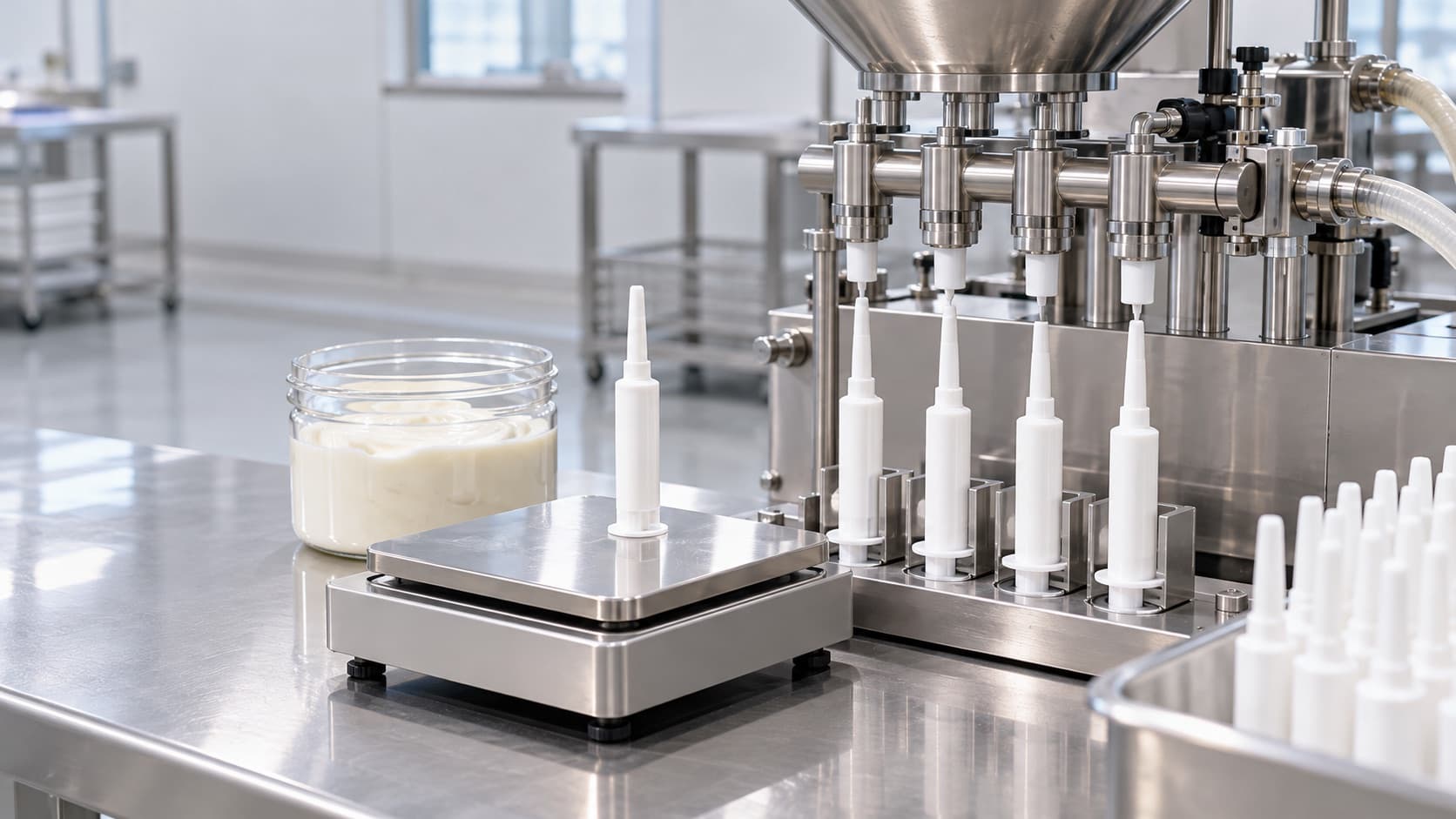
*Dose control by weighing during the test.*
Conclusion
A representative test is defined by its inputs, notfor its duration.Real product, real packaging, definitive tooling, controlled temperature and written criteria are the basis.With them, the test informs;without them, just demonstrate.
CTA
If you are planning an intramammary filling trial, please submit the product, packaging, and intended criteria.The King Pack team can help you structure it and document the results.Request a technical review.