
Introduction
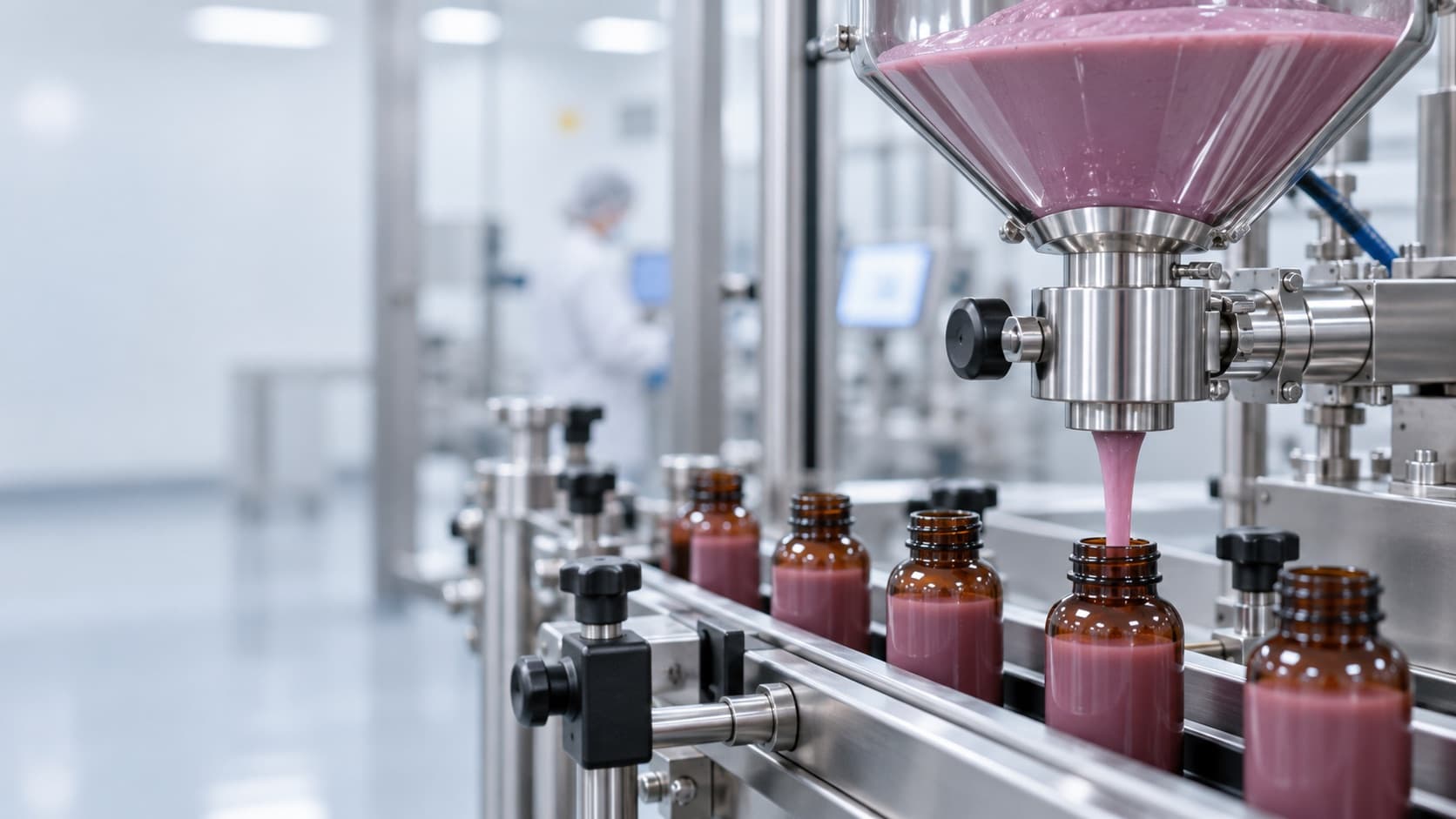
A highly viscous oral suspension does not behave like a solution: it settles, separates and changes consistency if left standing.In filling, that means that the agitation, the nozzle and the dose are connected: if one fails, the other two do not compensate.
This article describes how these three factors influence and how the dose is validated in a line that works with suspensions.It is aimed at process managers who need stability between the first and last unit of the shift.

*Hopper with agitator for high viscosity oral suspension.*
The suspension and its behavior
The suspension contains solidsdispersed in a viscous vehicle.With rest, solids tend to settle;with agitation, they disperse again.
This dynamic means that the concentration in the hopper is not constant if there is no agitation.
Temperature also influences the viscosity and sedimentation rate.
Agitation
Agitation must maintain the suspensionhomogeneous without incorporating air or generating foam.
The type of agitator, speed and time depend on the volume and the product.
Insufficient agitation leaves sediments;excessive agitation aerates the product.
Nozzles
The nozzle must allow the passage of solids without clogging and cut the product without threads.
The diameter and geometry must be chosen with the particle size and viscosity.
A nozzle that is too small willobstructs;too large one drips.

*Suspension samples at different heights to check homogeneity.*
Dose and validation
The dose must be validated with the actual suspension, not with asubstitute.
The validation must cover the beginning and end of the shift, to detect sedimentation.
It must also include the start after a stop, when the suspension has rested.
Table ofeffects
| Factor | Effect | Control | Verification |
|---|---|---|---|
| Sedimentation | Dosevariable | Agitation | Sample at different heights |
| High viscosity | Flow difficulty | Nozzle andpressure | Dosing time |
| Solids | Clogging | Nozzle diameter | Inspection ofstep |
| Air | Bubble and weight | Slow stirring | Visual inspection |
| Temperature | Changeviscosity | Thermal control | Dose at extremes |
How the dose is validated
Validation is done by weight, with samples at the beginning, in the middle and at the end of the shift.
If the dose drops with thetime, the suspension is settling or the hopper is not agitating enough.
The record should include the time and position of the sample.
How to choose the agitator
The choice of the agitator begins with the behavior of the suspension and not with the equipment catalog.A product that settles quickly needs a movement that renews the bottom of the hopper;one that tends to air out requires a gentle movement that is always submerged.The type of blade, its diameter with respect to the tank, the height of the shaft and the position of the impeller are chosen together.Each one modifies the flow pattern and the area where the product remains still.The practical consequence is that two different suspensions may need different agitators even if they share the same line.
There is no universal agitator for suspensions.The decision is made with the useful volume, the filling level, the apparent viscosity, the density of the solids and the tendency to form deposits on the walls.An agitator that works well with a full hopper may be left uncovered with little product and churn air instead of liquid.That is why it is advisable to test the configuration at extreme work levels and not just at the nominal level.The minimum operating level is also a design datum, because below it the agitation is no longer predictable.
The position matters as much as the shape.The agitator must cover the bottom and the discharge cone, which is where the sediment accumulates and where the nozzle is fed.If the impeller rotates away from that area, the suspension that reaches the dispenser may be more dilute than that of the rest of the hopper.Walls and corners without movement are the points where the deposit compacts and then breaks away into blocks.These blocks appear in the nozzle as intermittent obstructions, with no apparent relationship with the product being filled.
The speed is defined by the observed effect and not by a fixed figure: homogeneity is sought without vortex or incorporation of air.This speed is usually adjusted by product and filling level, and should be documented as part of the process.It is also convenient to define whether the agitation is continuous or intermittent, because a cycle with pauses changes the state of the product when filling is resumed.King Pack can review the hopper geometry and agitator type with the customer, and propose a configuration to test with the actual formulation.
How Foam is Prevented
Foam appears when the agitator incorporates air onto the surface of the product or when liquid falls from a height into the hopper.In a viscous suspension, the incorporated air does not always rise quickly: it is trapped in the mass and travels with it to the dispenser.The result is a dose that weighs less than expected and a container with visible bubbles.Foam also changes the appearance of the product and may cause the operator to adjust the dosage to compensate for an effect that is actually air.
Control measures are of two types: those that prevent air from entering and those that allow it to escape.Among the first are the submerged impeller, moderate speed, the blade that does not break the surface and a hopper filling that does not generate free fall.Among the latter, a rest time before dosing and a product route that does not trap pockets in elbows or narrowings.No measure works alone: if the hopper is loaded from above with a stream, the best shovel does not compensate for the air that enters.
The foam is detected with the naked eye in the hopper, but also in the sample.A freshly taken sample may appear homogeneous and, after a few minutes of standing, show a surface layer of bubbles or a change in level.It is advisable to observe the sample before and after this rest, because the difference indicates how much air is being incorporated.On the container, the bubble is seen as a lighter area or as a volume that does not match the expected weight.
The criteria for accepting or correcting the agitation must be written, with a description of what is considered foam and where it is observed.Thus the adjustment does not depend on the tolerance of each shift.King Pack can review the loading and agitation sequence with the customer and propose changes that reduce air entrainment.The final check is done with the actual suspension, because the foam depends on the formulation and not only on the equipment.
What changes with particle size
The particle size conditions two things at the same time: the passage through the nozzle and the speed with which the solid settles.A large particle needs a wide passage and tends to clog at narrowings;A fine particle circulates better, but forms a more compact sediment and is more difficult to resuspend.Distribution also counts: a suspension with particles of various sizes separates differently from one with a uniform size, because the coarse ones fall first and carry away the fine ones.
That is why the particle size must be known before choosing the nozzle and the agitation.If the formulation changes supplier or batch, this information may change even if the product sheet remains the same.A change in size is not always noticeable in the apparent viscosity, which may remain similar while filling behavior worsens.The usual consequence is a blockage that is attributed to the nozzle when the origin is in the product.
Previous grinding or homogenization also plays a role.A product that arrives with agglomerates behaves as if it had larger particles, even though the original solid is fine.These agglomerates break down over time or with agitation, so that the same batch can fill differently at the beginning and at the end of the shift.That's why it's a good idea to observe the product when loading the hopper and record whether it looks lumpy, because that detail explains variations that otherwise seem random.
Testing with the actual product is the only way to confirm whether the nozzle and agitation assembly supports the particle size of the formulation.This test must be done with the batch to be produced and not with a laboratory sample prepared separately.King Pack can review the declared particle size and propose the corresponding nozzle and agitation, and document in writing the criteria with which the passage of the product is accepted.
How the temperature is controlled
The temperature acts on the viscosity and, through it, on the sedimentation speed and on the flow rate delivered by the nozzle.A cold product is usually more viscous and fills more slowly;a hot one flows better, but can settle differently and encourage foaming.The effect is not linear or the same for all formulations, so the only valid reference is the response of the specific product.That is why temperature is a process variable and not a detail of the environment.
The sources of heat in a line are several: the mechanical work of the agitator itself, the temperature of the warehouse, the product that arrives from a previous stage and the time it remains in the hopper.A product that heats up while you wait changes behavior without anyone touching a setting.Areas with more friction, such as the agitator or pump, provide heat continuously and can create a difference between the product at the bottom and that on the surface.
Control begins by tempering the product before filling and maintaining the condition during the shift.Isolating the hopper, avoiding long waits with loaded product and recording the temperature at the beginning, in the middle and at the end are simple measures that explain many dose variations.Do not rely on feel or house temperature as a substitute for a product reading.The reading should be taken at the same point and with the same instrument to be comparable between shifts.
When temperature changes, dose validation should cover the extremes and not just the midpoint.If the product is filled cold at the beginning and hot at the end, the comparison between samples mixes two effects and the trend becomes difficult to interpret.King Pack can review the thermal path of the product and propose control and registration points.The limits and tolerances are confirmed in writing with the client for each formulation.
What to document about the suspension
The suspension record must allow us to reconstruct what condition the product was in when each unit was filled.This means not only recording the equipment parameters, but also the observed state of the product: appearance, presence of lumps, foam on the surface and sediment at the bottom.A record that only records the speed of the agitator explains little when a deviation appears.Useful documentation is what allows us to answer what changed between two shifts that should have been the same.
The minimum data are the identification of the batch, the loading time, the filling level, the agitation parameters, the temperature and the samples taken with their time and position.To them are added the weights obtained and the criteria with which they are considered acceptable.It is also advisable to record stops and starts, because the product that rests changes and the first container after a pause is not comparable with the previous ones.The position of the sample matters: taking from the bottom is not the same as taking from the surface.
Aspect observations deserve their own section, even if they seem subjective.Describing whether the product looks homogeneous, if there is a separation line, or if bubbles appear when pouring helps interpret the weights.This description gains value when it is always made at the same moment and with the same reference.A record with comparable descriptions allows a trend to be seen before it becomes an out-of-criteria batch.
The documentation is closed when the criteria are written and someone can apply them without depending on who was in the test.This is where King Pack can document the agitation, nozzle and dosing parameters defined with the customer, and confirm in writing the scope of each test.The objective is not to accumulate papers, but to have a reference that allows the condition that worked to be repeated.This reference is also the basis for training a new shift.
Frequent errors
- Shake too much. Air is incorporated.
- Do not shake. The dose drops at the end of the shift.
- Small nozzle. It is clogged withsolids.
- Validate only at the beginning. Sedimentation is not detected.
- Ignore temperature. Viscosity changes.
- Do not record sample position. Trend not explained.
How King Pack supports
King Pack can review the suspension and packaging with the customer and propose the agitation, nozzle and dosing system.The scope includes defining criteria and testing in FAT.Capacities and limits are confirmed in writing for each formulation.
Frequently Asked Questions
How much agitation does a suspension need? Enough to maintain homogeneity without aeration.Defined in the test.
Does the dose change throughout the shift? May change if the suspension settles.It is detected with distributed sampling.
Which nozzle is recommended? The one that allows solids to pass without dripping.It depends on the particle size.
Can it be filled without stirring? Only if the product is stable.In suspensions, it is not recommended.
Does temperature affect the dose? Yes, through viscosity.It must be controlled.
How is the start after a stop validated? With samples and defined criteria, the same as at the beginning.
What documentation is provided? Dose criteria, agitation parameters and FAT records.
Related technical resources
ForTo expand the specification, review the high viscosity syringe filling and capping line and the high viscosity syringe filling guide.These resources help you refine samples, scope, and acceptance criteria before requesting a proposal.

*Wide bore nozzle for slurry with solids.*
Conclusion
In a high viscosity slurry,Agitation, mouthpiece and dose form a system.Validating at the beginning and end of the shift is the way to detect sedimentation and ensure homogeneity.
CTA
If your oral suspension presents a dose variation, send the sample and the process diagram.The King Pack team can check the agitation and nozzle.Request a technical review.