
Introduction
Veterinary gel does not behave like an ointment or a liquid: it flows with effort, holds itself when it stops and can easily trap air.That rheology defines the feeding system, nozzle and tube sealing more than the speed of the machine.
This article proposes a selection guide for filling gel into tubes, with the three most common gel profiles and their implications.It is aimed at buyers who need a consistent configuration with the product and packaging.

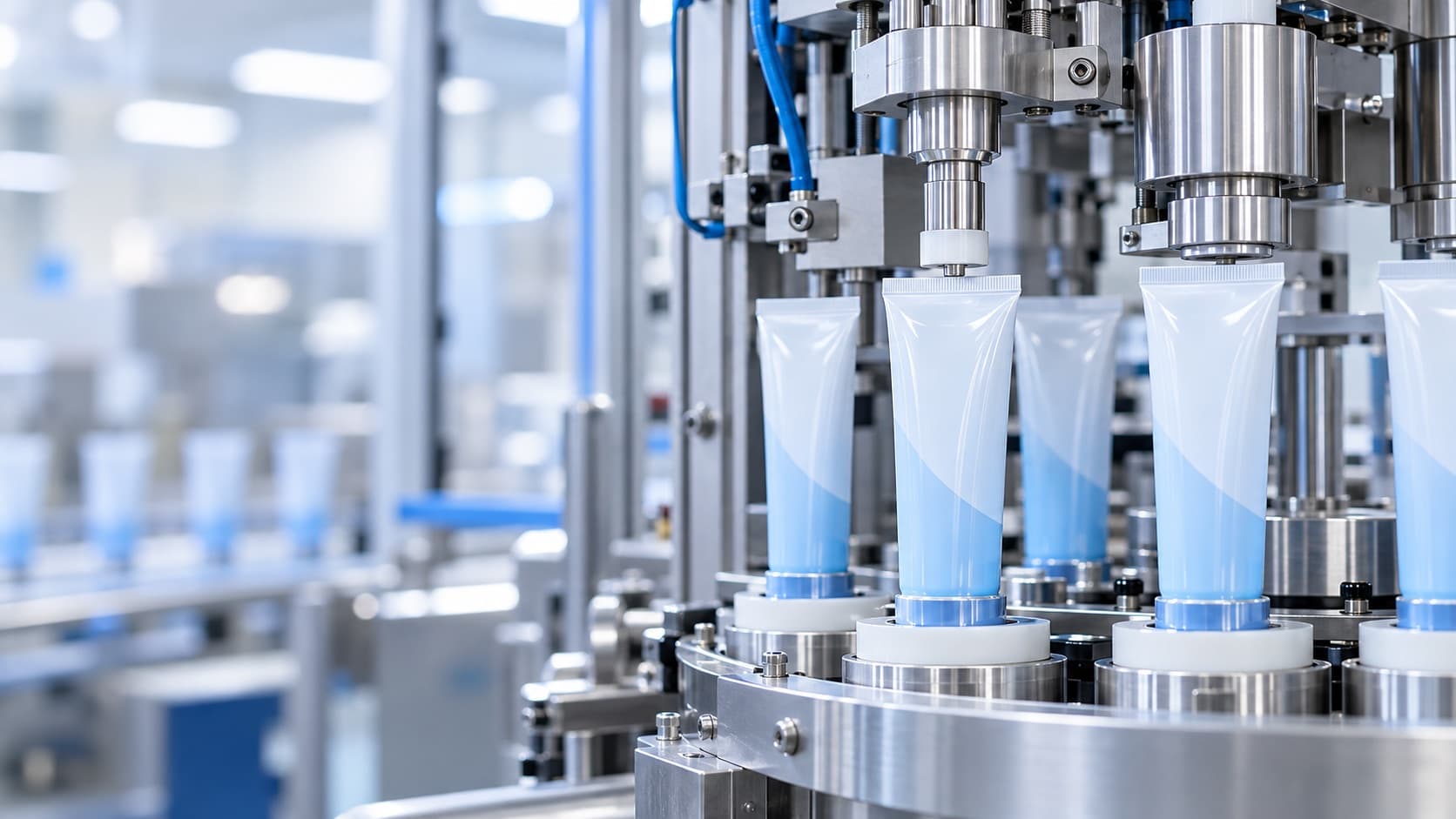
*Veterinary gel tube at the filling station.*
The rheology of the gel
The gel is usually a thixotropic system: itsApparent viscosity low when shaken and rises when standing.This allows it to fill the tube and not drain, but complicates the dosage.
The temperature also influences: when cold the gel stiffens and may not flow;in heat it can separate.
Aeration is the third factor: the gel traps air and retains it, and a bubble in the tube is not visible from the outside.
Gel profiles
A light gel flows easily and requires small nozzles and drip control.A medium gel requires moderate pressure and a clean cut.
A dense gel requires positive displacement and larger diameter nozzles, with longer dosing times.
Each profile has a feeding system and a different nozzle.
The tube format
The tube can be made of aluminum,laminate or plastic.The material and thickness determine the sealing and clamping.
The diameter and length determine the nozzle and the filling path.
The shoulder of the tube is the critical area for the clamping tooling.

*Flow test of a gel sample at controlled temperature.*
Sealing
Sealing can be by heat, ultrasound or folding.Each system requires tooling and parameter control.
The gel can contaminate the sealing area if it is filled to the brim.A margin must be left.
Seal verification includes tightness and resistance.
Selection table
| Seal profilegel | Power | Nozzle | Sealing | Verification |
|---|---|---|---|---|
| Lightweight | Low pumppressure | Small diameter | Heat | Tightness |
| Medium | Displacement pump | Diametermedium | Heat or ultrasound | Tightness and resistance |
| Dense | Positive displacement | Large diameter | Heat withcontrol | Weight and closure |
How to test
The test must use the real gel and the real tube, with the expected temperature.You must measure weight, appearance and sealing.
You must also include starting after a stop, because the gel can drip or dry in the nozzle.
The result is recorded with previous criteria.
How the gel is fed to the hopper
The hopper is not a passive tank: it is the first point where the gel loses or gains air.A thixotropic gel that is poured in free fall incorporates bubbles that are then difficult to remove from the tube, and this aeration is carried over to the seal.That is why it is advisable to feed the hopper continuously and smoothly, without spurts or jumps, and maintain a relatively stable level.When the level drops excessively, the pump sucks in a mixture with air;When it rises too high, the gel compacts and the working pressure changes.
The feeding system can be by gravity, by low pressure pump or by positive displacement, and the choice depends on the profile of the gel.A lightweight gel tolerates gravity with a level control;a medium gel requires a pump that pushes without excessive shear;A dense gel needs positive displacement to overcome its own resistance and to keep the flow rate stable.In all cases, the path between the hopper and the nozzle must be short and without sections where the gel can become stagnant.
The stagnation matters because the gel that rests in a pipe changes its structure: it thickens, sticks to the wall and then comes out in clumps that ruin the appearance of the tube.Dead sections, sudden section changes and poorly purged connections are the usual points where this problem appears.It is advisable to check the layout with the real gel and check that there are no corners where the product does not circulate, because those corners become pockets of old gel.
The temperature of the route also counts.If the hopper is cold and the nozzle is hot, the gel arrives with a different viscosity than expected and the dosage is deviated.The practical thing is to stabilize the assembly before starting, check the temperature at several points and not correct the pressure to compensate for what is actually a thermal problem.King Pack can review the feeding configuration with the customer, propose a consistent scheme with the gel and tube and confirm in writing the scope of that review.
How air is avoided in the tube
The air inside the tube has several origins: that which enters with the gel from the hopper and that which is introduced during dispensing.The first is fought before filling;The second is controlled by the mouthpiece and the way it is immersed.Distinguishing both helps to avoid correcting in the wrong place, because a pressure adjustment does not resolve a gel that has already arrived aerated.In practice, the two problems appear the same: a tube with holes and an oscillating weight.
Pre-deaeration of the gel is the most effective measure when the product allows it.It can be done in the tank itself, with sufficient rest, with a mixer that works slowly and without stirring, or in an intermediate step before the hopper.The objective is for the gel to reach the nozzle without occluded bubbles and with a homogeneous structure.If the gel is very dense, resting helps little and it is advisable to rely on the feeding system itself, which can work with the product at relative rest.
In the nozzle, the air enters in several ways: by suction at the end of the dosage and by a cut that leaves a thread that breaks and drags air inside.A nozzle of the proper diameter, with a clean cut and smooth retraction, reduces this effect.It also helps if the nozzle is inserted into the tube far enough so that the gel is deposited from the bottom up, without forming a splashing stream.The height of the nozzle is adjusted by format and checked with the cut tube.
After filling, a short rest before sealing allows small bubbles to rise and clump together.This rest has a limit: if the gel is thixotropic, it can begin to recover structure and remain still with air inside.It is advisable to set the rest time with the real gel and check the appearance of the open tube at various times during the batch.If rest is not enough, the problem lies before, in the diet.King Pack can document the deaeration criteria agreed with the customer and confirm them in writing.
What margin to leave before sealing
The margin is the distance between the gel level and the sealing zone.If the gel reaches the edge, the jaw presses product and the closure becomes contaminated;If the margin is excessive, the tube appears incomplete and the customer rejects it.The correct margin is between these two extremes and depends on the gel, the tube and the type of seal.It is advisable to treat it as a parameter of the product and the packaging, not the machine.
The gel is especially sensitive at this point because it does not drain: it does not return to the bottom.A light gel may shift during transport from the tube to the jaw;A dense gel stays where it falls and preserves the shape of the cut.That's why the margin is defined by the actual gel and the actual movement of the line, not on paper or a substitute, and is reviewed when the tube supplier changes.A change in thickness in the tube alters the useful height and requires the adjustment to be repeated.
The type of sealing also rules.In heat sealing, the clamp heats a strip of the tube and the product present in that strip prevents the faces of the material from fusing.When folding, the trapped gel prevents the fold from closing completely.In both cases the margin must cover the sealing strip plus a safety zone, and this zone depends on the precision with which the tube reaches the jaw.If the tube moves when clamped, the margin must be greater.
The way to set the margin is practical: adjust the dosed volume, fill it, cut the tube in half and measure the gap with a ruler.This check is repeated with several tubes and at different times during the batch, because the level can vary with pressure and temperature.It is also a good idea to note the margin of the rejected tubes, to know in which direction the system is deviating.King Pack can propose a starting margin, review it in the test and confirm in writing the criteria agreed with the client.
How to test the seal
Testing the seal is not about opening a tube and looking.The test must reproduce the actual conditions: the formulation gel, the supplier's tube, the line temperature and the intended speed.With these conditions, it is assessed whether the closure is formed completely and if it resists what it will suffer later in transport and in the warehouse.A test with a gel substitute only confirms that the machine moves.That is why it is advisable to reserve gel and tubes for the test before placing the order.
The first check is visual: the sealing bead must be continuous, without open folds, without burns and without gel trapped in the seam.This review is done on a sample and is repeated throughout the batch, because the parameters can vary with the use of the clamp.It is a good idea to cut the tube and look at the section of the closure, not just the outside.A closure that looks good on the outside may have an internal channel through which the product passes.
The second check is for tightness: the tube is subjected to controlled pressure and it is observed if a leak appears through the closure or through the shoulder.The third is resistance: moderate traction is applied to the seam and it is observed if the material gives way before the seal.Both tests are defined before starting, with clear acceptance criteria, and are not improvised after seeing the result.The exact point of the leak is also recorded, if there is one, because it indicates whether the problem is in the jaw or in the shoulder of the tube.
It is also advisable to include the test after a stop: the gel may have dried in the nozzle and the first tube comes out differently.And it is advisable to repeat the test with the tube conditioned as it will be stored, because heat or humidity changes the behavior of the material.The record of these tests is what allows one batch to be compared with another.King Pack can document the protocol agreed upon with the customer and confirm in writing the acceptance criteria for each test batch.
What to document for tube tooling
Tube tooling, i.e. the clamp, nozzle, jaw and guiding parts, is what makes a particular tube fill and seal well.When a new format arrives, the temptation is to adjust by eye and leave no trace.Documenting avoids repeating the adjustment from scratch, allows comparison and helps explain why a fill that previously worked now does not.It is advisable that the record be signed by the person who adjusted it, not by the person who inherited the adjustment.
For the clamping, it is advisable to record the diameter and length of the tube, the point where it rests on the shoulder, the closing pressure and the material of the claws.Of the guidance, the height of the nozzle with respect to the edge of the tube and the depth of introduction.This is data that is not seen in the finished tube, but it explains why one filling goes well and another does not, and allows the configuration to be reconstructed when the format is resumed.The condition of the supports also counts, because a worn claw changes the centering.
The jaw is interested in the width of the sealing strip, the set temperature, the contact time, the pressure and the profile of the jaw.Also the condition of its surface: a marked, dirty or worn coating jaw seals differently.It is advisable to note the diameter, length, type of cut and retraction of the nozzle, because these are the data that allow the adjustment to be reproduced with another gel of the same profile.An extensive file is not necessary: it is enough that the fields are the same for all formats.
The documentation must include one file per combination of gel and tube, with the parameters, date, person responsible and observations of the test.This file is the reference when changing products, returning to an old format or investigating a leak that appears during transportation.A short and complete index card is worth more than a notebook of scattered notes.King Pack can document the tooling and parameters agreed upon with the customer, and confirm in writing the scope of that documentation.
Frequent errors
- Choose the machine by speed. The gel imposes the actual pace.
- Use liquid nozzle. The gel does not flow orleaks.
- Fill to the brim. Seal fails.
- Do not monitor temperature. Gel changes behavior.
- Try a substitute. Actual gel traps different air.
- Do not check seal. Leak appears in thetransportation.
How King Pack supports
King Pack can review the gel and tube with customer and propose filling and sealing configuration.The scope includes defining criteria and testing in FAT.Capacities and limits are confirmed in writing for each formulation.
Frequently Asked Questions
Can gel be filled into a liquid filler? It may be possible with adaptations, but the nozzle and feed often change.
Which tube is best for gel? It depends on the product and the market.Laminate and aluminum have different behaviors.
Does the gel trap air? Yes, and the bubble is not visible from the outside.Prior deaeration helps.
What sealing is recommended? The one compatible with the tube material and verified with the gel.
Does temperature affect filling? Yes, viscosity and sealing.
How is the weight verified? With scale and sampling bybatch.
Can the gel be changed on the same line? With cleaning and own parameters per product.
Related technical resources
To expand the specification, review the high-speed syringe filling and capping lineviscosity and the guide on filling high viscosity syringes.These resources help narrow down samples, scope, and acceptance criteria before requesting a proposal.

*Larger diameter nozzle for dense gel.*
Conclusion
Gel dictates configuration: feeding, nozzle, sealing, andverification.Choosing the equipment with the actual gel and tube avoids a machine that fills slowly or seals poorly.
CTA
If you need to fill veterinary gel into tubes, please send the gel sample and the intended tube.The King Pack team can review the configuration.Request a technical review.