
Introduction
Choosing a tube filler for veterinary ointments begins with two non-machine decisions: what type of tube to use and how to close it.The tube material, its geometry and the sealing system determine the filling station, tooling and changeover time.Speed comes later.
This article explains the criteria that must be met before requesting a quote and how the options compare.It is aimed at buyers who need a consistent configuration with their ointment, tube and volume.

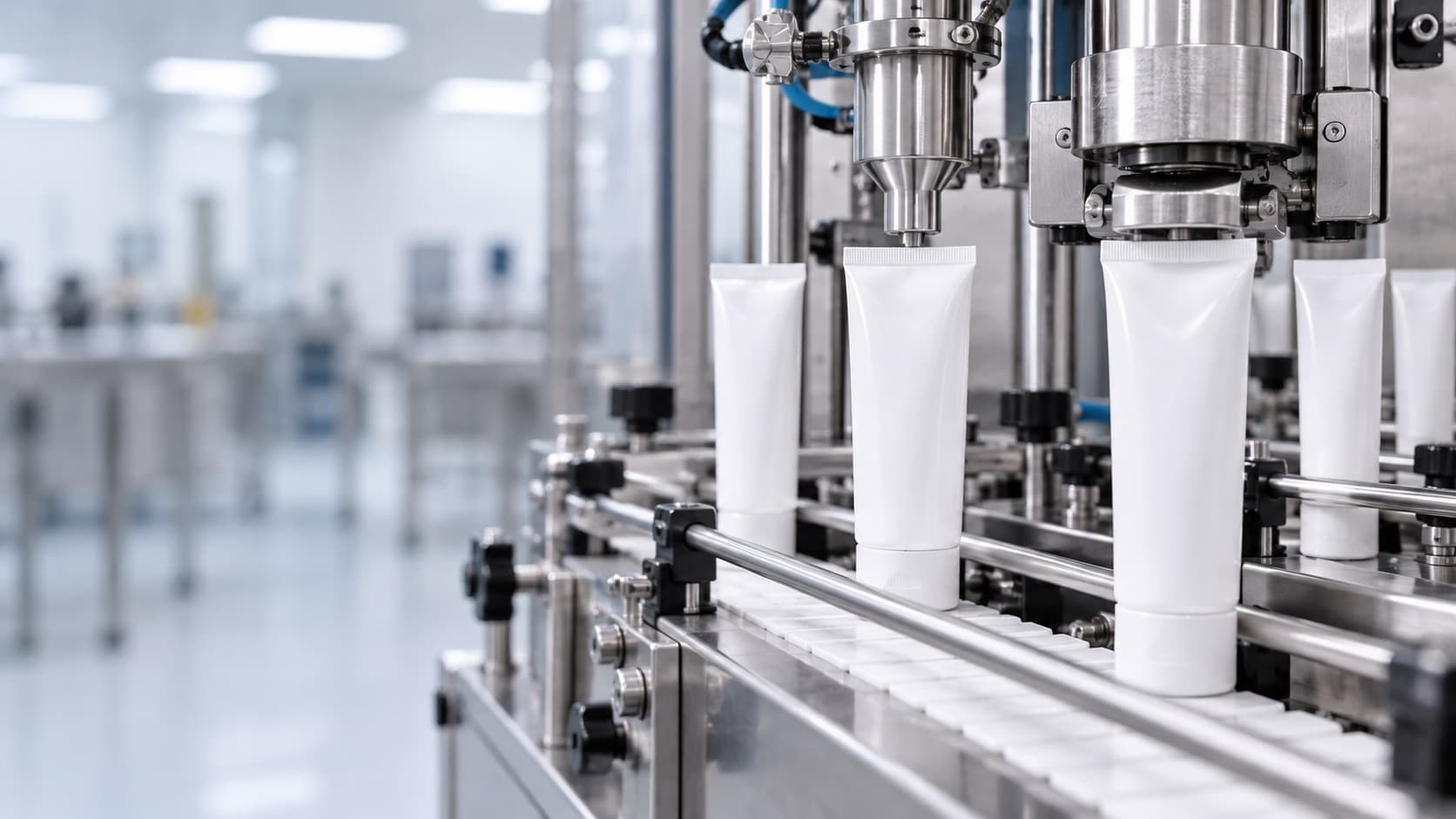
*Tube filling and sealing line for veterinary ointments.*
Material and geometry of thetube
The tube can be made of aluminum, laminated plastic or extruded plastic.Each material has a different behavior when it comes to filling and sealing.
Aluminum is sealed by folding and requires a specific station.The laminate is sealed by heat or ultrasound.Extruded plastic is usually heat sealed.
Geometry also matters: diameter, length, thickness and shoulder type.A tube with an irregular shoulder may not sit in the nest.
The behavior of the ointment
Veterinary ointments are products of high viscosity and thixotropic behavior: they flow when effort is applied to them and stop when it stops.This behavior conditions the dosage and cutting.
An ointment that flows well can be filled by pressure;one that resists requires a positive displacement system.The temperature also influences: when cold the viscosity increases.
Trapped air is another problem: an ointment with bubbles does not look homogeneous and can affect the weight.
The closure system
The closure defines the sealing station: folding, heat, ultrasound or thread.Each system has its tools and its verification criteria.
Heat sealing requires temperature, pressure and time control.Folding requires alignment and pressure.The thread requires tightening torque.
The acceptance criteria must be defined before purchasing: tightness, resistance and appearance.

*Aluminum, laminate and plastic tubes with different closing systems.*
The filling stationfilling
The filling station includes the hopper, dosing system, nozzle and tube holding fixtures.The hopper must allow complete emptying and cleaning.
The nozzle must enter the tube without touching the wall and cut the ointment without thread.The fixture should hold the tube by the body, not the shoulder.
Dosing should be repeatable with the actual ointment, not a substitute.
Table of criteria forselection
| Criteria | Options | Required information | Consequence |
|---|---|---|---|
| Tube material | Aluminium, laminated,plastic | Sample and drawing | Sealing station |
| Closure | Bending, heat, thread | Type and criteria | Tooling andverification |
| Viscosity | High, thixotropic | Temperature measurement | Dosing system |
| Dose | Range and tolerance | Quality data | Pump type |
| Volume | Shifts andformats | Forecast | Automation |
| Cleaning | Products andfrequency | Procedure | Accessibility |
Capacity and automation
Capacity must be expressed in tubes per shift, discounting changes, cleaning and rejections.A small tube fills faster, but the format change weighs more.
Automation is justified when volume and repeatability demand it.A semi-automatic line may be sufficient for small batches and multiple references.
The cost of automation includes maintenance and training, not just the investment.
How to compare
The comparison must be made with the same tube, the same ointment and the same closing criteria.Changing a variable invalidates the comparison.
It is advisable to order a test with the actual tube and ointment, and measure dose, closure and change time.
The supplier that documents assumptions and limits is usually more reliable than the one that promises any combination.
Behavior of the ointment in thehopper
The hopper is not a passive tank.The ointment that remains motionless loses homogeneity before reaching the nozzle: the liquid phase migrates, the solid settles and the product that remains next to the wall ages at a different speed than that in the center.In a thixotropic ointment, the first dose after a pause does not behave like number twenty.
The agitator helps, but it also opens preferential paths: if it rotates slowly, the product is channeled around the axis, and if it rotates too much, it incorporates air.The speed and stirring pattern are adjusted with the actual ointment.The temperature of the hopper has the same influence: a colder product on the walls flows less and forms a crust that then falls towards the nozzle.
The minimum level also counts.Below a certain volume the pump drags air and the dose comes out short or with bubbles, so the operator must know up to what level he can work and when to replenish product.
The useful question is not which hopper is best in the catalog, but rather whether the proposal keeps the ointment stable during the entire shift, something that is verified with the real product.King Pack can review this behavior and confirm the observed limits in writing.
Tube holding tooling
The holding tooling decides whether the tube is filled centered and sealed straight.The tube should rest on the body and be referenced against a fixed face, not simply sit inside a large cavity.A nest held by the shoulder or pressed against the wall deforms the tube and displaces the filling axis with respect to the nozzle.
Clearance matters.The tubes arrive with a dispersion of diameter, length and thickness, and the nest must absorb it without losing repeatability.If the cavity is too tight, an oval tube will not fit;If it is too loose, the tube twists or tilts and the jaw seals crooked.It is advisable to measure a sample of tubes from several batches before defining the tolerance of the tooling.
The change of format is played in the same tooling.Interchangeable parts must be able to be assembled without a special tool, with a visible reference and a position that does not admit of error.
King Pack can review the geometry of the tube and propose the corresponding clamping tooling, document its tolerances and confirm in writing the range of formats covered by each set of parts.
Seal control: temperature, pressure and time
Heat sealing is described with three variables—temperature, pressure, and time—that are not adjusted separately.Raising the temperature and maintaining the time shortens the cycle but narrows the margin;lowering the pressure forces you to compensate with more heat.The result is a process window, not a single point, and that window is defined with the actual tube.
The temperature that matters is that of the clamp in the contact zone, not the panel setpoint.The pressure must be distributed evenly, which requires parallelism between the two faces and rigid support.A poorly seated tube receives more pressure on one side and the seal is uneven.
Time includes ramp and cooling.A closure that is opened before cooling separates even if the temperature has been correct.That is why the acceptance criterion is applied when the tube is cold, not when it leaves the clamp.
The window is checked at the ends, not in the center.King Pack can review the sealing parameters and propose the process window for each tube, and document in writing the conditions verified in the test.
Cleaning of the tube line
Cleaning is designed with the machine, it is not resolved afterward.Hopper, pump, lines, valves and nozzle must be able to be emptied, disassembled and dried without improvised tools.Dead corners, exposed threads and tight radii retain product and lengthen each change.
The usual sequence is to empty, purge with product or compatible solvent, disassemble, clean, dry and reassemble.Each step needs an end criterion: when the hopper is considered empty, how long the purge lasts, how it is verified that a duct has been clean.Without this criterion, cleaning depends on the speed of the shift.
Chemical compatibility sets limits: gaskets, hoses and coatings have materials that tolerate some products and not others.It is advisable to review the list of materials in contact with the product before establishing the procedure and the admitted cleaning products.
Cleaning time is capacity.A product change that consumes half a day reduces salable production more than a small difference in speed.King Pack can review line accessibility, propose cleaning sequence, and document points requiring disassembly.
How closure is tested in FAT
Factory testing, or FAT, is the time to verify closure with the actual tube and ointment, not a simulation.The acceptance criteria must be agreed before the test: what is measured, with what method, how many samples and who signs the result.If the criterion is discussed at the end, the test becomes a negotiation.
Sampling should cover production, not best time.It is advisable to take tubes at the start, after a pause, in the center and at the end of the lot, and at each station if the line has several.A hypothetical example: if thirty tubes are agreed upon per condition, the result is read on the set and not on the tube that came out best.
Typical checks are tightness, seal strength and appearance.The tightness can be verified by pressure, by immersion or by visual inspection with a defined criterion;Each method detects different defects and it is advisable to declare which one is used.
The test record must include parameters, samples, results and deviations, with the signature of both parties.King Pack can document the FAT protocol and confirm in writing the criteria applied to each reference.
Automation for small formats
A small tube does not simplify the line.It fills faster because the volume is smaller, but the time per cycle is determined by the loading, orientation and transfer, not the dosage.In small formats, handling weighs more than filling.
Useful automation in these cases is usually in feeding and unloading: placing the tube oriented, holding it, removing it and accumulating it.These operations are repetitive and their cost grows with the number of tubes, not with the volume of product.That is why the load is measured in tubes per hour, not in doses per minute.
The limit appears in the format change.With many references and short batches, a semi-automatic line with quick-change tooling can be more profitable than an automatic one that requires long adjustments.Automation is justified when the changeover time does not eat into the speed gain.
There is also training, maintenance and spare parts to consider, because an automatic line depends on someone knowing how to adjust it.King Pack can review the volume, formats and frequency of change, and propose the appropriate degree of automation, confirming in writing the scope of each configuration.
What to document about the tooling
Of the tooling, it is advisable to keep the drawing of each part, with reference, material, treatment and tolerances, in addition to the physical identification on the part itself.A nest without reference becomes an anonymous object in the closet and is searched for by trial and error when the format arrives.
The recording of settings is just as important: nozzle height, jaw travel, pressure, temperature and time per format.A change sheet with these values allows you to set up the format without repeating the setup from scratch;Without it, each change starts over.
Tooling traceability includes version, date, and who approved the change.If a part is modified to correct a defect, the previous version must be identified: modified tooling without registration explains why a batch behaves differently without anyone knowing why.
Documentation is also used to order spare parts and to audit the process.King Pack can document the drawings, the adjustment log and the format change procedure, and confirm in writing what is included in the delivery.
What changes with a rolled tube versus aluminum
Aluminum is closed by folding: the tube is permanently deformed and the closure depends on the alignment of the folds and pressure.The laminate is closed by heat or ultrasound, and the closure depends on the internal layers melting and bonding.They are two different logics and do not share tools.
In laminate, the sealing window is narrower: if there is a lack of heat, the closure does not cohere;If there is excess, the film thins and a weak point appears.Additionally, shoulder interior and wall thickness vary between suppliers, so a fit validated with one tube may not work with another of the same nominal format.
Aluminum allows more tolerance in temperature and is more demanding in mechanics: a misaligned bend is seen and rejected.Laminate is more forgiving of mechanics and worse of heat.
The change in material also affects the barrier and compatibility with the ointment, so it is not a decision that is made only for the sealing.King Pack can check both tubes with the same product and document in writing the differences observed in the closure.
Frequent errors
- Choose the machine before the tube. The tube determines the station.
- Ignore the closure system. The sealing defines the tooling.
- Try a substitute. The real ointment changes the behavior.
- Do not measure the changeover time. The operating cost is underestimated.
- Confuse nominal speed with capacity. Salable production is lower.
- Do not define the closure criterion. Acceptance is discussedafter.
How King Pack Supports
King Pack can review the tube and ointment with the customer and propose the appropriate filling and sealing configuration.The scope includes the definition of closure criteria, testing in FAT and training of personnel.Capacities and limits are confirmed in writing for each reference.
Frequently asked questions
Which tube is best for a veterinary ointment? It depends on the product and the market.Aluminum and laminate have different sealing and barrier behaviors.
Can it be filled and sealed in the same machine? Yes, in integrated configurations.The sealing station is chosen depending on the tube.
Does viscosity affect the speed? Yes. A more viscous ointment requires more time or more pressure.
What closing criterion is recommended? Tightness and resistance, defined by the customer and verified with the actual tube.
How manyWhat formats can a line handle? It depends on the tooling and the changing system.It is advisable to define it before purchasing.
Can you start with a semi-automatic line? Yes, for small batches and several references.The automation is evaluated afterwards.
What documentation is provided? Tooling drawings, manual, spare parts list and FAT protocol.
How often is the sealing window checked? When changing batches of tubes, supplier or product, and when the adjustment record indicates it.
IsCan you validate the closure without testing each format? No. Each tooling and each tube has its own window, and the format is tested before production.
Related technical resources
To expand the specification, review the high-quality syringe filling and capping lineviscosity and the guide on filling high viscosity syringes.These resources help you refine samples, scope, and acceptance criteria before requesting a proposal.

*Heat sealing clamp on the end of the tube.*
Conclusion
ChooseA tube filler starts with the tube and closure, continues with the ointment and ends at the capacity.Comparing with the same combination and testing with the real product avoids configurations that work in the catalog and fail in the plant.
CTA
If you are defining a line of tubes for veterinary ointments, send the tube, the ointment and the intended volume.The King Pack team can review the configuration and closing criteria.Request a technical review.