
Introduction
The temperature does not change the formula, but it changes how it behaves.A liquid that dispenses well at room temperature may become difficult to pump when cold or foam when hot.Deciding whether you need a heated hopper, room control, or simply a profile adjustment depends on the product and the process.
This article explains when temperature really matters and how it is evaluated before investing in thermal control.It is aimed at process managers who need a justified decision, not a solution out of habit.

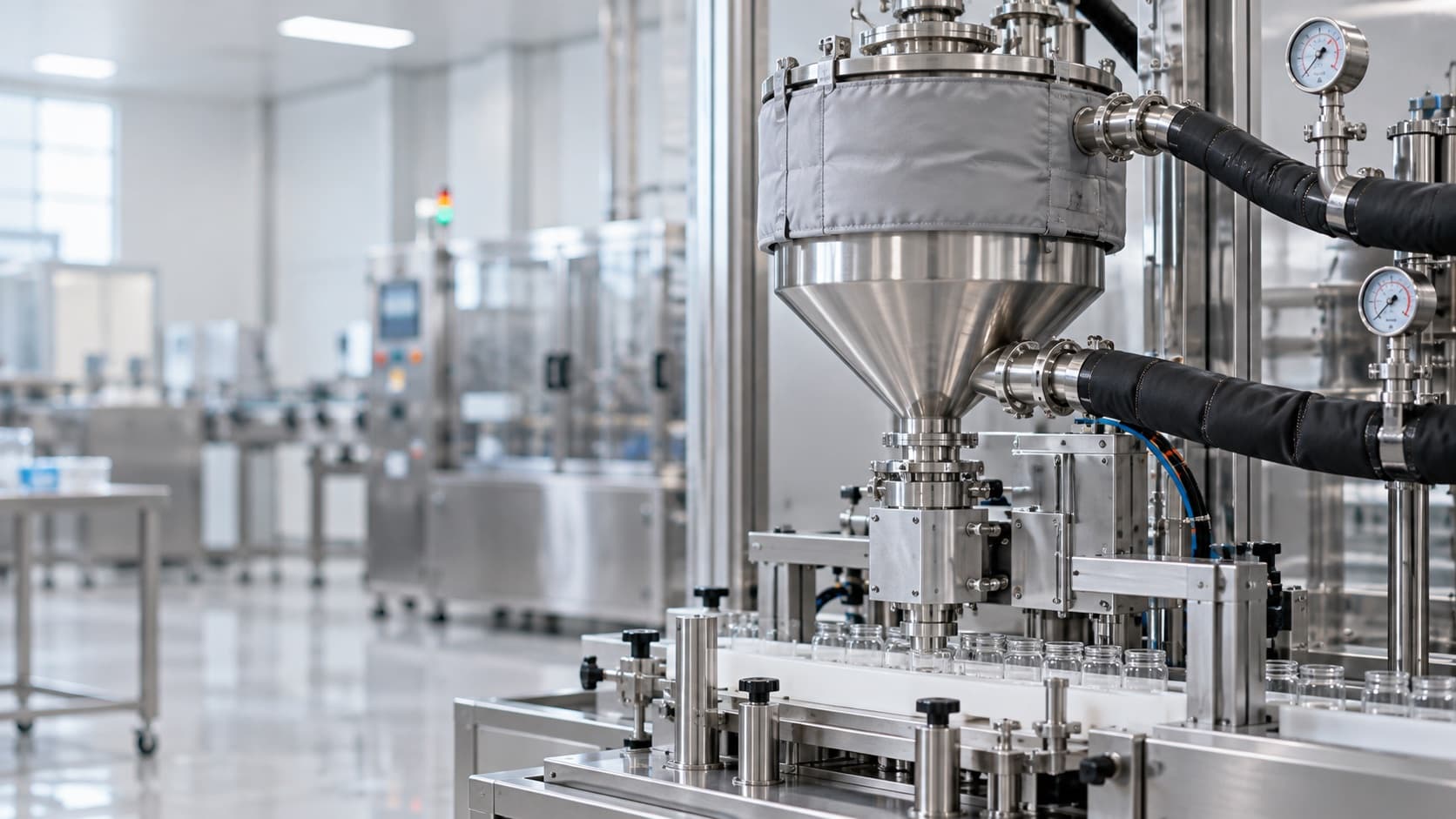
*Filling hopper with temperature jacket and control.*
When temperature matters
Temperature matters when the product has viscositysensitive to heat, when it contains components that crystallize or when the foam depends on surface tension.
It also matters when the process includes a previous stage that leaves the product hot and is not cooled before filling.
If the product is stable and the warehouse is air-conditioned, control may be unnecessary.
Flow incold
In winter, the viscosity increases and the dosing time increases.If the system maintains the same time, the dose drops.
The solution may be to heat the hopper, adjust the time or air condition the room.Each option has a different cost and effect.
The test must be done at the minimum expected temperature, not just the ambient temperature.
Heated hopper
A heated hopper keeps the product at a temperature that facilitates flow.It requires control, insulation and security.
Heat can degrade the product if it is kept for too long.The temperature and maximum residence time must be defined.
It can also increase evaporation and vapor formation.

*Variation of viscosity with product temperature.*
Management at temperatureambient
If the product is not sensitive, handling at room temperature is the simplest and cheapest option.
Requires knowing the seasonal range of the house and adjusting the filling profile if necessary.
Does not require additional equipment, but does require recording of the actual temperature.
Table ofscenarios
| Scenario | Symptom | Solution | Risk | Verification |
|---|---|---|---|---|
| Cold | Doseshort | Heat or adjust time | Heat degradation | Dose at minimum temperature |
| Heat | Foam or drip | Coolor adjust profile | Condensation | Visual inspection |
| Stable product | No change | Ambient handling | Nonerelevant | Temperature recording |
| Pre-hot stage | Hot product | Cool before hopper | Degradation | Control oftime |
How to evaluate it
The evaluation begins by measuring the viscosity at different temperatures and checking the dose at the extremes.
Then it is decided whether the adjustment is process (time, pressure) or installation (heating, air conditioning).
The decision must be documented with the data that justify it.
How viscosity is measured in the plant
Measuring viscosity in the plant does not require a complete laboratory, but it does require a repeatable method and a well-taken sample.It is advisable to extract representative product from the batch, temper it to the temperature of interest and measure with the available instrument, whether a rotational viscometer or a flow cup.The requirement is that the sample has not changed due to handling: no entrained air, no loss of volatiles and no long waits between collection and reading.If the product is shaken before measuring, it is advisable to let it rest long enough for the bubbles to rise.It is also advisable to note the temperature at which the reading was made, because a viscosity figure without that reference does not allow for comparing batches or shifts.
The curve is constructed by points, not with a single reading.The same sample is prepared at various temperatures, the same protocol is applied and the actual temperature of the product, not the temperature of the room, is noted.Repeating the measurement at the coldest point helps see how much dispersion the method has and whether the difference between readings is attributable to the product or the assay itself.The support of the instrument and previous cleaning are part of the method and must be noted next to the result.
The isolated reading does not explain the filling.Viscosity dictates the behavior, but the dose also depends on the pressure, the diameter of the nozzle, the length of the pipe and the dosing time.That's why the measurement is checked against the actual weight or volume of the dose in the machine: the curve indicates where to look, and the dosing test confirms whether the adjustment works in practice.When the product foams, it is also a good idea to read the appearance of the sample, because the texture explains part of what the number does not include.Over time, this reading compared between batches allows adjustments to be anticipated before the dose fails.
The recording of the measurement must allow it to be repeated: what was measured, with what instrument, at what temperature and at what time in the batch.If a viscometer is not available, a simple comparative method, such as fixed orifice discharge time, can be used, as long as the criterion is documented and applied equally.King Pack can review the measurement procedure and propose a consistent filling protocol, with limits confirmed in writing for each product.
What changes in the nozzle with the cold
The nozzle is the point where the product changes section and reaches the highest speed, and therefore it is the place where the cold is first noticed.With high viscosity, the product resists passing through, the vein takes time to cut and the drop tends to hang on the tip.The result is a dose that arrives late, a dirty closure and a container that appears to have a dosage defect when the problem is in the flow.In a line that fills several formats, the smallest nozzle is the first to notice the change in temperature.
The cold also changes the end of the dosage.A thick product usually forms a thin thread that is not cut cleanly, and that thread ends up on the edge of the mouth of the container or on the lid.In parallel, the tip can dry out between cycles and leave a residue that comes off on the next fill.Neither effect is corrected by raising the pressure alone;in many cases the splashing gets worse.
The alternatives are ordered from least to greatest intervention.First, the profile is reviewed: times, recoil or suction after cutting and height of the nozzle with respect to the container.Next, the diameter and geometry of the tip are evaluated, because a slightly larger section reduces the pressure loss.Only if the process adjustment is not sufficient is it considered to heat the nozzle, the line or the hopper, with the control and insulation that this requires.If the nozzle is heated, it is advisable to check that the heat reaches the product and not just the tip, because uneven heating changes the cut of the vein.
The test that decides is the dosage at the minimum expected temperature, with the real product and the real container.It is a good idea to weigh the dose and observe the cut of the vein, not just the number on the scale.King Pack can review the nozzle and dosing profile and propose a configuration consistent with the product, with scope and limits confirmed in writing before manufacturing.It is also a good idea to test the start-up after a pause, which is when the tip is coldest.
How to control the residence time
The residence time is the time that the product spends from when it is prepared until it is filled, adding hopper, pipe, filter and nozzle.It is not a decorative fact: the longer it remains, the more opportunities it has to change, especially if it is hot or if it loses volatile components.Controlling it means knowing how much product is in the circuit and at what rate it is consumed.That is why the criterion is expressed as a maximum allowed time and not as an impression of freshness.
Common practice combines several simple measures.It works in batches with entry and exit order, a minimum level is maintained in the hopper so that the product is not distributed in thin films, blind sections and filters that are not used are avoided and the circuit is emptied between references.The volume of the circuit is calculated once and is used as a reference to estimate how long it takes to renew itself.The calculation can be done with the internal volume of the pipes and hopper or, more simply, by measuring how much product is needed for the line to deliver new product.
It is advisable to mark the remainder and decide what to do with it before the problem appears.A batch left in the hopper at the end of the shift is not equivalent to a freshly prepared one, and that difference must be foreseen in the procedure, not resolved by the operator's improvised judgment.When the product is sensitive, the remainder is treated as its own category and its destination is documented.If the remainder is reused, it must be clear under what conditions and with what limit.
Control is maintained with simple records: loading time, start and end time of filling, volume consumed and declared remainder.With these data, the real residence time can be estimated and compared with the defined criterion.King Pack can review the circuit, document the residency criteria and confirm in writing the limits applicable to each product.
What is the risk of heating
Heating is not a neutral operation.Heat accelerates reactions that already occur slowly, increases the evaporation of volatile components, and can alter odor, color, or texture.In formulations with proteins, sugars or emulsifiers the range is narrower, and the change can appear without the viscosity giving it away.Just because the product flows better does not mean that it remains the same product.The smell is often the first indication, although it arrives after the change has already occurred.
The risk depends on temperature and time, and above all on the combination of both.Keeping the product warm throughout the day is not equivalent to heating it a moment before filling, even if the measured temperature is similar.A poorly adjusted shirt or blanket also creates hot spots next to the wall, where the product can suffer more than in the rest of the volume.This local effect is not seen in the general reading and usually explains differences between theoretically equal batches.
There are process risks and safety risks.During processing, vapors can condense in cold areas and return to the product, and residual heat can increase the internal pressure of the closed container.In safety, an unprotected hot surface is a direct risk for those who operate and for those who clean.Both aspects are resolved with design and procedure, not with verbal warnings or custom.A hot hopper without signs invites you to lean on it, and the habit sets in before the warning.
Reasonable mitigation involves defining a slogan, controlling it and limiting the exposure time.This implies isolation, measurement at the correct point, warning of deviation and criteria for the product that has remained hot.King Pack can propose the thermal scheme and document the operating limits;The conformity of the product with that heat is up to the person who formulates it to validate.The decision to heat should be able to be justified by evidence and not by preference.
How the temperature is recorded in the batch
Recording turns a technical decision into evidence.You must indicate what was measured and where: temperature of the product in the hopper, in the line or in the nozzle, because the temperature of the room does not replace that of the liquid.You must also say what instrument it was measured with, what condition it was in, and at what point in the batch the reading was taken, so that the data remains interpretable months later.If the probe is incorrectly located, the record will be verbose and misleading at the same time.
The most useful format is the one that is filled out without hesitation.One card per batch with start time, start and end temperature, incidents and signature covers the essentials in most cases.If the installation has continuous recording, it is advisable to keep the trace and review the trend, because a specific value can hide a slow drift that the operator already considers normal.The paper record remains valid if it is archived and can be consulted.
The data is only useful if it is compared with something.Each batch is checked against the range defined for that product and, when the reading falls outside, the action taken is noted: adjust the profile, wait, stop or segregate.A record without associated action becomes paperwork and does nothing to explain why one day the dose was short or why foam appeared in the line.With several batches registered, the comparison stops being a print and becomes a series.
The periodic review closes the cycle: the grouped records are looked at, patterns are detected by shift, season or reference and the procedure is adjusted.King Pack can review the record format and suggest which fields should be retained, with scope and responsibilities confirmed in writing for each project.Without review, the registry accumulates data that no one uses and loses value over time.
Frequent errors
- Heat out of habit. The product is unnecessarily degraded.
- Do not test in the cold. The dose fails in winter.
- Ignore the storage timeresidence. The product degrades in the hopper.
- Do not record the temperature. The variation cannot be explained.
- Confusing product temperature with room temperature. They are not the same.
- Do not review safety. A hot hopper requires protection.
How King Pack supports
King Pack can review the product and the installation and propose the appropriate thermal solution: ambient management, heated hopper or room control.The scope includes parameter definition and verification in FAT.Capacities and limits are confirmed in writing for each formulation.
Frequently Asked Questions
Do all liquids need temperature control? No. Only those sensitive to viscosity or thermal degradation.
Is heating the hopper sufficient? May be sufficient, but residence time and temperature must be controlled.degradation.
Is the room temperature sufficient? Depends on the product and seasonal range.It must be measured.
How is it tested? Measuring doses at the minimum and maximum expected temperature.
Does heat affect the closure? It can affect the internal pressure and the lid.It is verified with the product.
What documentation is needed? Temperature range, residence time and dose criteria.
Can the profile be adjusted instead of heating? Sometimes yes.It depends on the viscosity and margin of the system.
Related technical resources
For further specification, please review prefilled syringe filling and capping series and guide to choosing a filling machineof veterinary syringes.These resources help specify samples, scope, and acceptance criteria before requesting a proposal.

*Temperature probe in the product line.*
Conclusion
Temperature influences when the product issensitive, and the response may be to adjust the process, heat the hopper, or monitor the room.Measuring viscosity and dosage at the extremes is the way to decide without oversizing.
CTA
If your product changes behavior with temperature, please send the viscosity curve and house conditions.The King Pack team can review the solution.Request a technical review.