
Introduction
The contact parts and joints are the part of the filler that the product actually touches.Its compatibility is not decided by catalog: it depends on the formulation, temperature, contact time and cleaning method.A material suitable for an aqueous suspension may fail with a fatty excipient or an alkaline detergent.
This article raises the questions that must be resolved before defining materials and joints, and proposes a matrix to document the decision.It is aimed at process and quality engineering that needs to justify the selection in the event of an audit or a change in formulation.

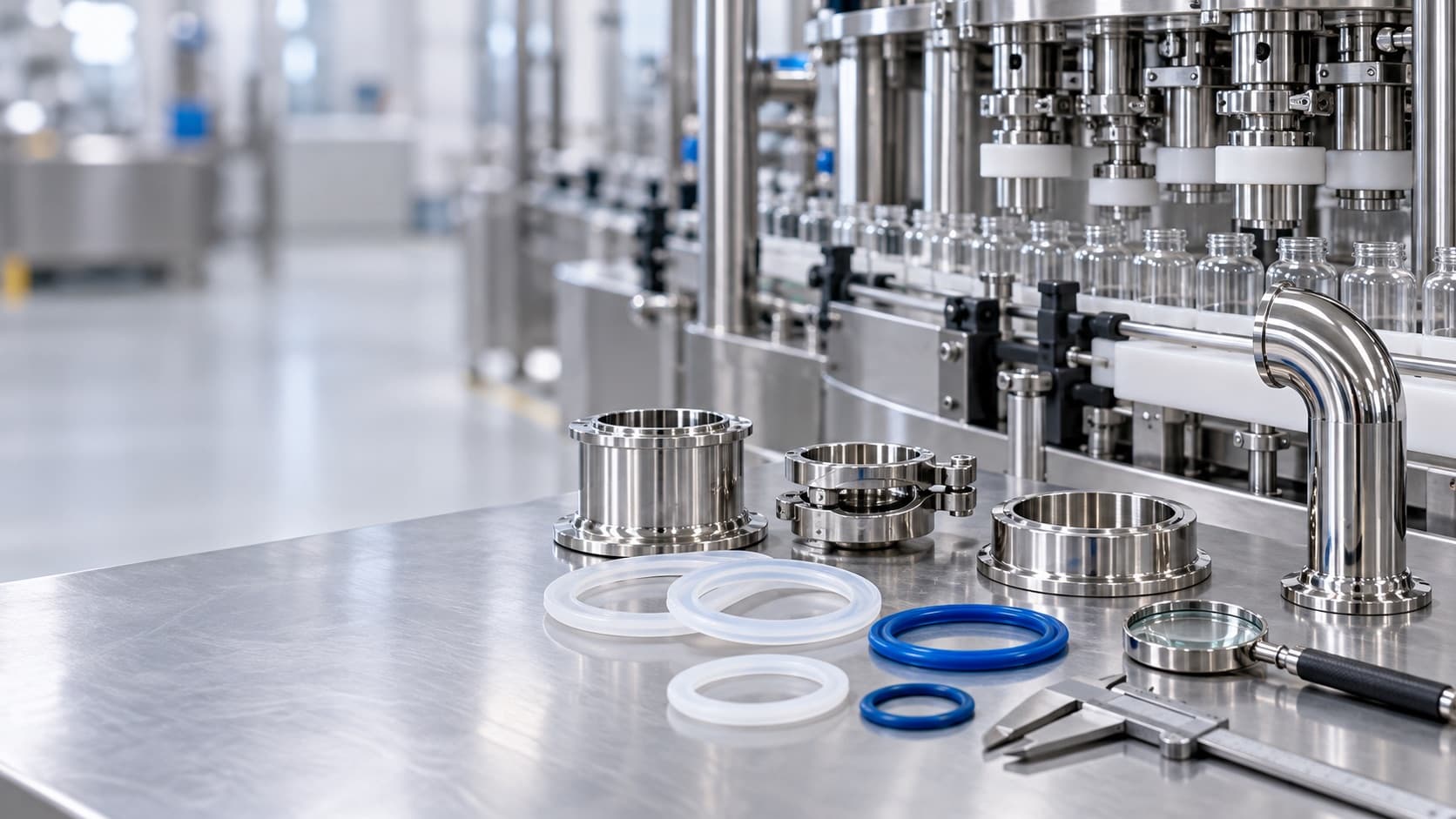
*Parts in contact and disassembled seals of a filling valve.*
Why compatibility is not a data ofcatalog
A gasket supplier indicates chemical resistance against product families, not against a specific formulation.The formulation includes excipients, preservatives, pH and temperature that can change the behavior.
In addition, the contact is not static: the product flows, is heated and cleaned with detergents.The combination of product and cleaning can attack a material that resists each separately.
That is why the selection is validated with the actual product and with the planned cleaning procedure.
Which parts are in contact
The product circuit includes hopper, ducts, valves, pump, nozzle and gaskets.It also includes measuring elements that touch the product, such as pressure or level sensors.
Each piece has a different material: stainless steel, PTFE, EPDM, silicone, FKM.The choice depends on the product and cleanliness.
Not all parts require the same degree of certification;It depends on the risk and the contact.
Questions about the product
The first question is the complete formulation: active ingredient, excipients, preservatives, pH and solids concentration.
The second is the process temperature and contact time.A product that stays hot for hours requires more resistance than one that stays hot in seconds.
The third is known compatibility: if the product is already packaged in other materials, that experience is a starting point, not a test.

*EPDM, PTFE and FKM gasketsfor different products.*
Questions about cleaning
The detergent, temperature and contact time define the aggressiveness of the cleaning.A hot alkaline detergent can attack joints that resist the product.
There is also rinsing and drying to consider.A detergent residue may react with the following product.
CIP cleaning, if applicable, adds pressure and flow that can affect the seals.
Compatibility table
| Material | Producttypical | Cleaning | Risk | Data to be confirmed |
|---|---|---|---|---|
| Stainless steel | Aqueous andgreasy | Broad | Chloride corrosion | Grade andfinish |
| PTFE | Wide | Wide | Compression set | Temperature and load |
| EPDM | Aqueous | Alkaline | Swelling with oils | Formulationcomplete |
| Silicone | Aqueous | Soft | Fat absorption | Product andtemperature |
| FKM | Fat and solvent | Broad | Amine attack | Formulation and pH |
How it is documentedthe decision
The decision must be recorded with the material, the supplier, the certificate and the justification.It should also include the conditions of use and limitations.
If the product changes, the decision is reviewed.A change of excipient may invalidate the selection.
Documentation allows you to respond to an audit and avoid informal changes.
How to select a material step by step
The starting point is the list of parts in contact, not the supplier's catalog.The product circuit is walked and, for each element, the function it performs, the material assembled, the associated joint and the type of contact are noted: permanent, intermittent or only during cleaning.This list is the index of the file and the basis of any subsequent review.
With the closed list, the service condition of each part is established: complete formulation, temperature, contact time and cleaning regime.The condition that governs is not the usual one, but rather the most demanding that the part will actually withstand, including stops, starts and remnants left in pipes and housings.
Then families of materials are preselected by known resistance and documented incompatibilities are discarded: solvents versus elastomers, chlorides versus stainless steel, amines versus FKM.The preselection is a working hypothesis, not a conclusion: the specific formulation may behave differently from the chemical family it represents.
The selection is closed with the test on the real product and with the review of the gasket supplier.The result is recorded piece by piece, with justification, limitations and date, and undergoes quality approval before assembly.A material approved without this sequence remains an informal decision, even if the material is correct.
Compatibility tests and their duration
The compatibility test is not limited to checking whether the material dissolves.Changes in mass, volume, hardness, color and dimensions are observed, as well as the appearance of cracks, blisters or adhesions.A small dimensional change can be enough to lose tightness in a joint that at first glance appears intact.
The duration is defined by the worst case of expected contact and not by the usual duration of the batch.The process time, the remainder left in the circuit and the stop time with product inside are added, and a margin is added.If the facility can be left with product during a long shutdown, the test should cover that scenario and not just the production shift.
The complete cleaning sequence is also tested: product, rinse, detergent, rinse and dry, repeated in several cycles.Many failures appear in alternation rather than continuous immersion, because the material swells with one fluid and contracts with the next.
The result is compared to an unexposed reference piece and recorded with measurements and photographs.If testing is performed by an outside laboratory, the report must identify the product lot and gasket lot;Without this identification the test is neither repeatable nor defensible.
Effect of detergent and cleaning temperature
Cleaning is usually more aggressive than the product.A hot alkaline detergent attacks elastomers that resist the formulation at room temperature, and the effect accumulates cycle by cycle until the gasket loses elasticity or cracks.
The temperature acts in two directions: it accelerates the chemical reaction and softens the material.The same detergent may be harmless at moderate temperature and cause swelling or hardening at high temperature.That is why the compatibility sheet must indicate the temperature of use and not only the chemical family of the detergent.
Contact time and concentration also count.A more concentrated and shorter cleaning is not equivalent to a more diluted and longer one, and the effect on the joint is not interchangeable.It is advisable to define the actual cleaning window, with its tolerances, and not the gentler version of the procedure.
The final rinse deserves the same attention.A detergent residue on the joint can react with the following product or promote the crystallization of salts, and incomplete drying leaves water in areas where the product does not circulate.Cleaning is validated as a complete sequence, not as an isolated stage.
Material certificates and traceability
The material certificate certifies the composition and the batch, not the compatibility with the formulation.It is an entry requirement and a necessary condition, but it does not replace the test or the technical justification of the choice.
Traceability requires being able to relate each assembled joint with its batch and with its certificate.Without this relationship, an incident in production cannot be defined: it is not known which batches of product passed through the affected part or which other machines assemble the same joint.The revision then becomes a complete replacement as a precaution.
It is advisable to archive the batch certificate, the manufacturer's technical sheet, the applicable declaration of conformity and the record of the compatibility test.Also the cross reference between drawing, part and supplier, because internal codes change with revisions and the same component can appear with two names.
When the supplier delivers a generic certificate without lot identification, traceability is broken.In that case, specific identification can be requested or the risk can be accepted in writing, with quality justification and the scope of acceptance.
Change control of the gasket supplier
The same material can change its formulation without changing its commercial name.The supplier can substitute an additive, vulcanizer or curing process, and the gasket still has the same name and color.The old technical sheet no longer describes the part that is received.
That is why change control must cover the supplier and not only the product itself.It is advisable to agree in writing on prior notification of changes in formulation, manufacturing plant and sub-supplier, with a deadline that allows the impact to be evaluated before the first new batch arrives.
Each notified change is evaluated with the matrix: which parts it affects, what service condition is modified and whether the test needs to be repeated.A plant change without a change in formula can alter tolerances, hardness and surface finish, and these parameters also govern the tightness.
If the supplier does not notify, the detection comes through the batch certificate or a production failure, and at that time the margin for reaction is minimal.Supplier auditing and periodic certificate verification reduce that risk, but do not eliminate it.
What to do if a joint fails in production
The first thing is to contain.The affected filling is stopped, the batches produced since the last verification are identified and the product is separated.The decision on these batches corresponds to quality, not production, and should not be made with the machine running.
The failed joint is then kept as it was disassembled, without cleaning it, and the time, part, joint batch and process conditions are recorded.A washed gasket loses most of the information: the residue, the deformation and the breaking point are the evidence.
The evaluation distinguishes the failure of the gasket from the failure of the assembly: assembly, tightening torque, damaged housing, overpressure or cleaning outside the setpoint.Changing the gasket without checking the housing repeats the failure with the next part and consumes the equipment's margin of confidence.
Closure requires documented corrective action, verification of the new gasket and review of the matrix when the cause is compatibility.If the failure compromised the tightness of the product, the fate of the batch is evaluated in accordance with the current quality procedure.
Periodic review of the materials matrix
The matrix expires even if nothing changes visibly.Suppliers adjust formulations, cleaning procedures are reviewed, and product formulations are updated for commercial or regulatory reasons.A matrix approved years ago can describe a reality that no longer exists.
The review compares the matrix with reality: current product, current detergent, assembled parts and archived certificates.It is not a reading of the document, but a check against the manufacturing file and recent work orders.
It is advisable to include in the review the parts that have never failed.A gasket with years of service can be out of specification without showing symptoms, and the failure appears with the first change of product or cleaning, when there is no longer room to test calmly.
When the matrix is maintained by the filler manufacturer, King Pack can review it together with the client and propose the corresponding changes;Final approval remains at the customer's discretion.The result is recorded with date, person responsible and conclusion: without changes, with update or with pending test.
How to document before an audit
The audit does not ask for an oral explanation: it asks for the file.For each piece in contact there must be a file with material, supplier, certificate, service conditions, justification and date of approval, in addition to the reference to the test that supports it.
The file is organized by piece and by change, so that it can be reconstructed which material was assembled on a specific date and with what product.This reconstruction is what allows us to respond for a given batch and not just describe the current practice, and it must be able to be read by someone who did not participate in the decision.
The tests must appear with their scope and limits: what was tested, for how long, with which batch and with what result.A report that only concludes that the material is compatible, without conditions or measurements, does not stand up to a technical question.
Finally, the documentation must include the accepted deviations and their justification.A documented and approved deviation is defensible;An undocumented one becomes a finding, even if the criteria applied were reasonable at the time.
Frequent errors
- Choose from the catalog. The specific formulation may behave differently.
- Ignore cleaning. The detergent attacks what the product does not attack.
- Do not consider temperature. Contact time changes resistance.
- Change supplier without review. The same material may have a different formulation.
- Do not document the decision. The selection remains in memory.
- Do not review after a product change. Compatibilityexpires.
How King Pack supports
King Pack can review the list of parts in contact and propose materials and gaskets compatible with the customer's product and cleanliness.The scope includes documentation of materials and training of personnel.Capacities and limits are confirmed in writing for each formulation.
Frequently asked questions
Which gasket is compatible with a greasy ointment? It depends on the formulation.Grease resistant materials are usually FKM or PTFE, but this must be confirmed with the actual product.
Can the same gasket be used for multiple products? Only if compatibility is verified for all.A new product requires review.
Does CIP cleaning require different materials? It may require them, due to the temperature and detergents.It is advisable to review it.
Are the material certificates sufficient? They certify the composition, not the compatibility with the formulation.They are necessary, not sufficient.
How often is compatibility checked? With each change of product, supplier or cleaning procedure.
What happens if a joint swells? It can lose tightness and contaminate.The material is replaced and reviewed.
Does compatibility affect validation? Yes, it is part of the material qualification and change control.
Is the supplier's technical sheet sufficient to approve a gasket? No. The sheet describes chemical families and is used to preselect or discard;approval requires testing with the actual product and cleaning.
What is done with already assembled gaskets after a change of supplier? They are identified by batch, compared with the matrix and it is decided if the test should be repeated before continuing to consume that batch.
Related technical resources
To expand thespecification, review the prefilled syringe filling and capping series and the guide for choosing a veterinary syringe filling machine.These resources help specify samples, scope and acceptance criteria before requesting a proposal.

*Immersion test of a gasket in the formulated product.*
Conclusion
Compatibilityof parts and joints is decided with the formulation, temperature and cleaning, not with a catalog.Documenting the selection and reviewing it at each change avoids leaks and contamination.
CTA
If you need to check the contact materials of your filler, send the formulation and cleaning procedure.The King Pack team can propose materials and document the decision.Request a technical review.