
Introduction
The feeding of bodies, plungers and caps is the stage where all the variability of the packaging supplier enters the line.If the feeder does not separate, orient and deliver the parts at a stable cadence, the following stations cannot compensate: jams, poorly positioned parts and rejections appear that are attributed to the machine when the origin is in the incoming packaging.
This article explains how orientation, nesting, statics and the type of packaging influence the feeding of an intramammary line, and what can be checked before purchasing.It is aimed at production and purchasing managers who need to distinguish a component problem from a station design problem.

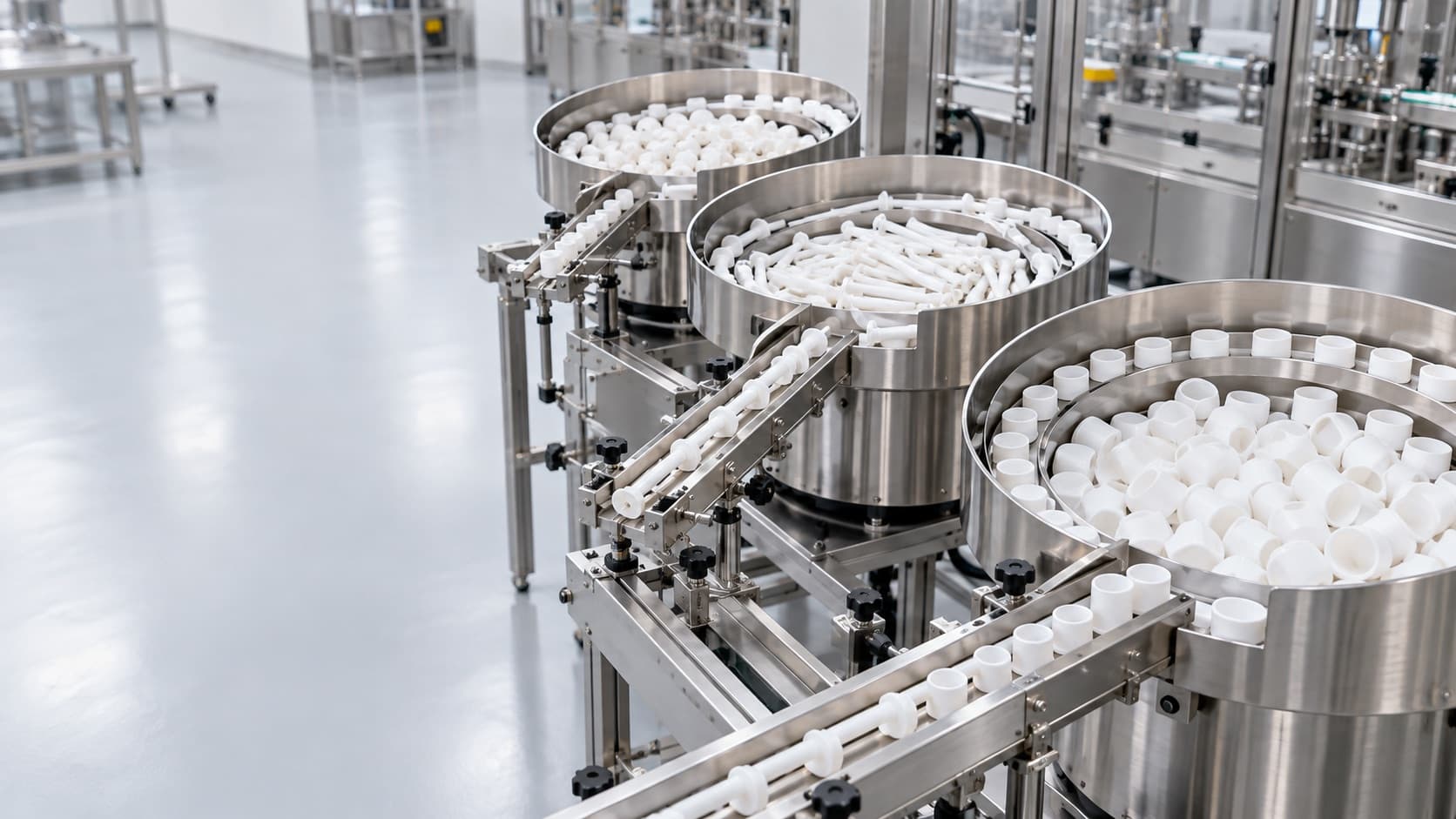
*Cap feeder orienting the pieces before capping.*
Why the feeding conditions the rest of theline
An intramammary line consumes three different component streams, each with its own physics.The body is a hollow and light piece that tends to roll;The plunger is a small piece that engages;The lid is a flat piece that stacks and orients itself poorly.The same feeding solution does not work for all three.
When feeding fails, the symptom usually appears far away: a stoppage in capping, a short dose because the body was not well established, or a rejection on inspection.That is why it is advisable to treat the feeding as a critical station and not as an accessory of the line.
Bodies: orientation and support
The body of the applicator must reach the conveyor with the cannula in a defined position and without supports that deform the wall.In thin-walled bodies, the support point matters as much as the orientation: if the nest presses on the shoulder, the part becomes oval and the insertion of the plunger fails.
The most frequent problems are double feeding - two pieces in the same nest -, inverted orientation and jamming at the feeder outlet.The first two are detected with sensors;the third usually requires mechanical adjustment and review of the batch.
Plungers: engagement and friction
The plunger is the part that engages the most in the feeders.Its geometry—stem, head, and seal—creates friction surfaces and points where static builds up.A poorly adjusted feeder delivers twisted plungers or two at a time.
Practical verification is counting and orienting: how many pieces per cycle, in what position and with what repeatability.If the feeder delivers well with one sample and fails with another, the problem is with the dimensional variability of the plunger, not the feeder.

*Comparison of bulk and tray packaging for the samecomponent.*
Lids: stacking and orientation
Lids stack and stick together, especially if the material is soft or if the packaging has been compressed.The feeder must separate them without damaging the sealing edge and orient them if the lid has a single position.
In lids with a tab, the orientation is critical: a lid rotated 180 degrees can enter the tooling and seat poorly.The usual solution is a mechanical positioner with a presence sensor and an orientation check before capping.
Nesting and input packaging
The input packaging determines the design of the feeder.A bulk bag requires separation and orientation;a tray with nests requires a removal mechanism;A box with stacked parts requires unstacking.Changing packaging without changing the feeder is a source of downtime.
Internal nesting also influences: pieces nested together arrive better positioned, but require more force to separate.The feeder must apply that force without marking the part.
Static and humidity
Plastic accumulates electrostatic charge, and the charge causes parts to adhere to guides, hoppers and sensors.In dry warehouses the problem worsens.Common solutions are ionization, conductive materials in the guides and humidity control;the choice depends on the material and the environment.
Static is not solved only with an ionizer.If the guide is insulating and the piece is charged by rubbing, the charge returns.It is advisable to measure before investing: a misdiagnosed static problem becomes a useless purchase.
How the exit lane is designed
The exit lane is the transition between the feeder and the conveyor.It is the area where the most jams occur, because the part must change regime: from vibrating freely to being precisely positioned.
A well-designed rail has three characteristics: controlled clearance, continuous lateral guidance and stepless exit.The clearance must admit the upper lot without blocking;the guide must accompany the piece to the nest;the step, if it exists, must be less than the radius of the edge of the part.
The draft angle also matters.A rail that is too inclined accelerates the piece and causes double feeding;one that is too flat slows it down and reduces the cadence.The adjustment is made with the real part and is verified with production.
The batch change in production
The batch change is the moment of greatest risk.A new batch may bring variations in color, finish or dimension that do not appear in the input inspection.Best practice is to test the first new batch with the line running and record the jam rate for the first hour.
If the new batch works, it is released;If not, it is compared with the previous batch to identify the difference.This record is the basis for addressing the problem with the component supplier instead of adjusting the machine blindly.
Indicators that should be measured
Feeding is managed with data, not with impressions.Three indicators are enough to start: jams per thousand cycles, double feeding per shift and time lost per intervention.With them, performance is compared between batches and between shifts.
The fourth, more qualitative indicator is the reason for the intervention: orientation, coupling, static or wear.Classifying jams makes it possible to attack the dominant cause instead of distributing adjustments.
What to ask from the component supplier
From the supplier of the applicator, plunger or cap, it is advisable to ask for three things: tolerance letter, burr control and stability of the process between batches.If there is no tolerance chart, measuring samples is the alternative.
It is also advisable to agree on an input acceptance criterion: what is considered a compliant part and what is rejected.This criterion prevents a defective batch from entering production and being attributed to the machine.
The hopper and the load level
In feeders with a hopper, the load level affects the pressure on the outlet.A full hopper exerts more weight and can speed up delivery;An almost empty hopper delivers less and favors gaps.The effect is small, but it is noticeable in the cadence.
The recommended practice is to keep the level within a band and refill in short intervals.If the operator fills only when the hopper is empty, the line works with two different regimes and the jam rate varies throughout the shift.
How to test the packaging change
If the customer is going to receive the same component in bags and on trays, the test must cover both formats.The same number of cycles is executed with each one and jams and double feeds are compared.
When a format does not work, there are two options: adapt the feeder with specific tooling or agree with the supplier on a single input format.The second is usually cheaper, but limits purchasing flexibility.
The cost of unstable power
A two-minute traffic jam every hour seems minor, but it adds up to more than an hour per shift.If it also generates rejections and forces an operator to intervene, the real cost includes lost production, dose variability and tool wear.
The useful comparison is not between feeders, but between scenarios: with the current jam rate and with the rate that is considered acceptable.This difference justifies or rules out an investment in tooling.
What data to include in the feeding RFQ
For the supplier to size the system, the RFQ must include the component with drawing and sample, the input packaging, the volume per shift, the expected rate and the jam acceptance criterion.It is also worth indicating whether several formats are planned.
Without the packaging and without the volume, the supplier can only offer a generic solution.With them, you can propose a system and test criteria.
How infeed is integrated with inlet inspection
Inlet inspection and infeed form a system.If the inspection rejects out-of-tolerance parts, the feeder works with a narrower range and the jam rate decreases.If inspection does not exist, the feeder absorbs all the variability and the problem is attributed to the machine.
That is why it is advisable to define an entry criterion: critical dimensions, burrs, deformations and packaging condition.The criterion does not have to be exhaustive;it is enough to cover the characteristics that affect feeding and filling.
Inspection can be by sampling or by online sensor, depending on the volume.In high productions, a presence sensor and a double feed control do not replace dimensional inspection, but they detect the most frequent failures.
When the input criterion is written, the conversation with the component supplier changes: it is no longer discussed whether the part is acceptable, it is compared with a specification.This change reduces resolution time and improves traceability.
Table: component, system and control point
| Component | Usual system | Critical variable | Symptomfault | Verification |
|---|---|---|---|---|
| Body | Vibratory or tray feeder | Orientation and double feeding | Jam or inverted piece | Presence and position sensor |
| Plunger | Centrifugal or ladder feeder | Hitch and orientation | Twisted or double plunger | Counting per cycle andvision |
| Lid | Lid feeder with positioner | Stacking and turning | Lid twisted or damaged | Lid sensororientation |
| Guidelines | Ducts and rails | Friction and wear | Recurrent jamming | Inspection andsetting |
| Environment | Ionization and humidity | Electrostatic charge | Attached parts | Charge measurement |
How totest the feed
The test must be carried out with at least two batches of each component and under the real conditions of the warehouse: temperature, humidity and cycle speed.It is advisable to start empty, measure the jam rate per hundred cycles and repeat with the line at production speed.
You must also test the packaging change.If the customer is receiving bags in one lot and trays in another, the feeder must operate with both or the limitation must be declared.
Frequent errors
- Design the feeder with a single sample. Lot-to-lot variability is the most common cause of jams.
- Ignore incoming packaging.The feeder is sized for a particular bag or tray format.
- Attribute a part problem to the machine. A burr or warped cap is not corrected by adjustments.
- Resolve static with an unmeasured ionizer. The cause may be the guide or humidity.
- Do not testbatch change. The first batch works and the second blocks the line.
- Forget counting. A feeder that delivers two pieces per cycle goes unnoticed until inspection.
How King Pack supports
King Pack reviews samples and incoming packaging before defining the feeding system, anddocuments design assumptions.The scope may include feeder selection, orientation fixtures, FAT verification, and training of personnel for batch changeover.Capacities are confirmed in writing for each component.
Frequently asked questions
Can the same feeder be used for bodies and plungers? This is not usual.Each component has different geometry and behavior, and requires a specific system or interchangeable tooling.
Which inbound packaging is best? Depends on volume and supplier.The tray simplifies orientation;The bag makes packaging cheaper but requires more separation.The important thing is that the feeder is designed for the actual packaging.
How is a double feed detected? With a presence sensor and, if necessary, with a counting control per cycle.Detection should be integrated into the line logic, not left to the operator.
Can static be completely eliminated? Not always, but it can be controlled with ionization, conductive guides, and humidity.Efficiency depends on the material and the environment.
What happens if I change lid suppliers? The feeder must be checked and the new batch tested.A change of supplier is a change in tolerances and surface finish.
How is the jam rate measured? With a record per shift and per component.The useful figure is the number of jams per thousand cycles, not the operator's impression.
Can a lid be fed without a positioner? Only if the lid is symmetrical and the capping does not require orientation.If it has a tab, the positioner is necessary.
What to do if the supplier changes the packaging without warning? Treat it as a scope change.The feeder may stop working and the line stops for no apparent reason.
Related technical resources
For further specification, please review intramammary syringe filling line and specification of a lineprefilled syringes.These resources help specify the samples, scope and acceptance criteria before requesting a proposal.

*Orientation guide and presence sensor at the feeder outlet.*
Conclusion
The feeding ofbodies, plungers and caps determines the stability of the entire intramammary line.Orientation, nesting, statics, and input packaging are design variables, not tuning details.Testing them with several batches before purchasing prevents jams from becoming routine in production.
CTA
If you are defining the feeding of an intramammary line, send samples of each component and the incoming packaging.The King Pack team can evaluate the appropriate system and document testing criteria.Request a technical review.